Unspeakeable Acts of Pruning

Facebook

(Hey, I think it’s Tree Week on the GP!)

Our land has a nice buffer of big, old oaks, hickories, and maples between us and the two-lane highway.  Power and phone lines thread through the middle of them. Thus, I have nightmares about orange Asplundh trucks.

So with much concern, I noted that utility crews and
subcontractors have been out in full force in our rural area,
inexplicably leaving one tree and then “pruning” another.

OMG that's awful

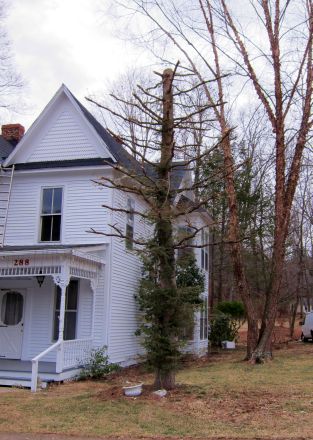
I pulled over and snapped this latest atrocity last night. The power lines are to the right (not in photo). As this is only a mere mile or two from our property, I may sit at home on the porch next week with the shotgun in my lap.

Facebook

Tree teaser untwisted

Facebook

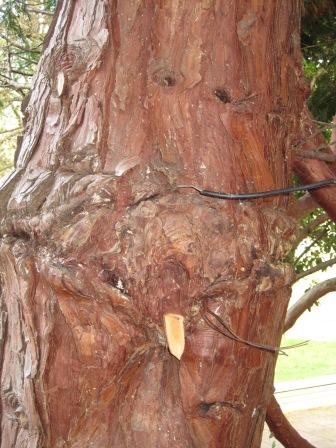
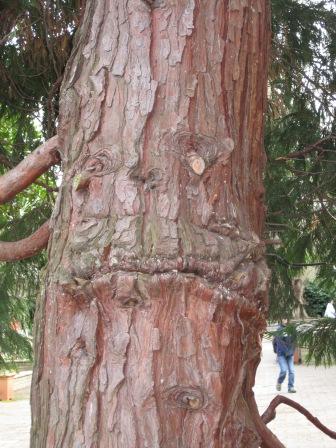
Once again you had some great diagnoses!  The popular view was neglected staking material, and you were right:

Peter’s answer was my favorite (I love puns – the worse the better!).  Tom, I hestitate to ask about your previous experience here….

As usual, thanks to all of you for playing our quiz.  I’ll try to be better about doing this every Friday.  Our survey results indicated you like this feature a lot.

Facebook

Trees can be good plumbers

Facebook

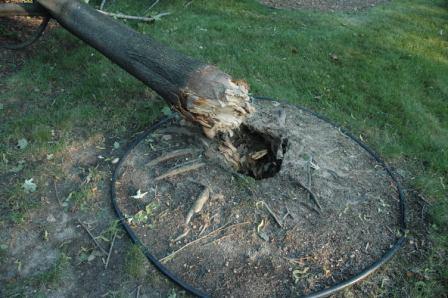
A short follow up to last weeks post on girdling roots.  Just to reiterate, the point of the post was that we need to be careful not to jump to conclusions when assessing tree problems.  It’s important to look beyond the first defect we see and consider additional causes.  And to also reiterate, girdling roots can be a serious problem and can lead to tree failures.  The photo below shows an example of tree that was both planted too deep and had stem girdling roots.  The result was a weakened area in the trunk, which was subject to breakage during a windstorm.

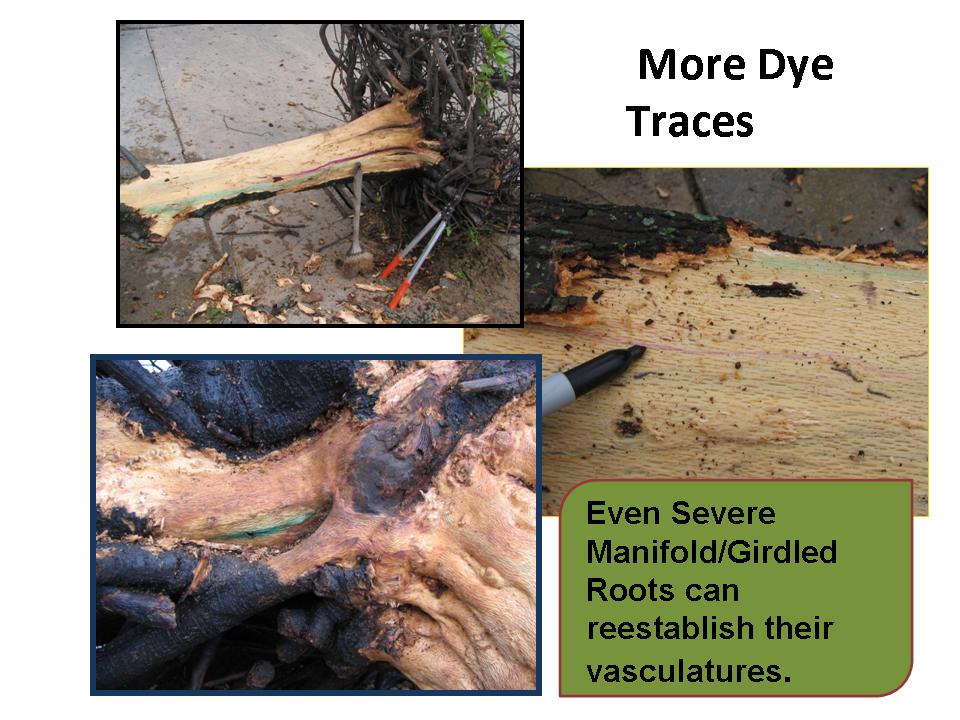
Many people also assume that girdling roots restrict flow of water and nutrients in the xylem.  They can, but trees also have the ability graft roots and re-establish connections between roots.  In the study I mentioned last week, Phillip Kurzeja and his co-workers  traced water flow in ’manifold roots’ (a series of interconnected, girdled roots) by injecting dye.  The trees were subsequently felled and de-barked, allowing the researchers to determine whether the roots were still functional.  As shown below the girdled roots were able to re-establish their vasculature and continue to translocate water up the stem. So trees can be efficient at fixing their own pipes!

Image: Phillip Kurzeja

It is important to note that this phenomenon occurs between roots but not between roots and the main trunk – hence the concern for impact of stem-girdling roots, especially for trees planted too deep.

Facebook

Guano

Facebook

One of the best organic fertilizers out there – at least in terms of how plants respond to it —  is bat guano.  As most of you probably already know, bat guano is made of bat droppings.  What you probably don’t realize is that bat droppings need to be aged for a while in an arid environment before they become guano.  Caves provide the perfect environment for this to occur, and so that is where most bat guano comes from.

Because guano needs to be aged in special surroundings before it is used it is not a rapidly renewable resource.  Instead it’s kind of like peat in that it takes anywhere between decades and thousands of years for the raw material from which it is made to develop into the stuff that we use.  Furthermore, by harvesting bat guano we can actually damage the ecosystems present in the caves from which the bat guano is harvested.  Think about it – bats generally feed outside the cave, so when they defecate inside the cave they are actually bringing new nutrients into the cave – nutrients that other creatures can use.  Whole ecosystems are based on this poo!  So when we harvest bat guano from a cave what we are doing is disturbing a specialized ecosystem – a very unique system.

So am I encouraging you away from bat guano?  No more than I would encourage you to consider reducing your usage of peat – or of oil — or any other non-renewable resource.  I can’t deny that it’s a great fertilizer, but if you want to use an organic fertilizer why not at least consider one that is renewable instead of one that is from a limited resource and which may cause harm to a unique ecological system?

Facebook

Blog Survey Results, Part 1

Facebook

I was gently reminded last week that I never published the results of our survey, asking our readers for feedback on the first full year of posting on The Garden Professors. All four of us are extremely grateful to those of you that participated, as we could use this information in our annual reporting and reviews.  Thank you all for taking the time.

To keep this from being too long for our blog, I’m going to just cover the first two questions today.  I’ll continue with this next week, where we’ll consider possible improvements to content and structure.

On the date we ran our analysis, 119 people had responded (the final number was 140).

Reason for reading

Science based information: 107 (90.0%)
Interesting and relevant topics: 101 (84.9%)
Ability to engage bloggers in Q&A: 39 (32.8%)
Usefulness as a CE resource: 75 (63.0%)
Entertaining approach: 78 (65.5%)

Some of the other reasons (you sent us lots!) included:

  • Friday quiz/mystery photos
  • Trusted source of information
  • Balanced and intelligent content
  • Diverse subjects
  • Ability to get feedback
  • Smart, funny, well-written, and challenging
  • Fun science fix

Behavior changes attributed to information on blog

Reduce use of chemicals, including fertilizers and pesticides: 52 (43.7%)
Reduced use of potentially invasive species: 40 (33.6%)
Improved ability to protect soil, including reducing erosion: 47 (39.5%)

Some of the other reasons included:

  • Stopped promulgating horticulture myths
  • Reduced use of peat moss
  • Improved ability to plant trees and shrubs
  • Improved ability to educate others
  • Improved ability to diagnose plant problems
  • More informed decision making about plant selection, gardening methods
  • Less work using better practices

[Sadly for some of you, I did not include the snide personal comments (about me) from trolls, irrationalists and/or the disgruntled. And to be honest, there were only 1 or 2 of these. But if you’re one of this little group, feel free to send your thoughts on to my supervisors! You’ll need to include your actual name and contact information, however, if you want your comments to be taken seriously.]

Facebook

The Hottest Thing in…Veg!

Facebook

Vegetable transplants and herbs were a bright spot last year (and the one previous) for most retail growers and independent garden centers.  Seed and transplant companies have taken note – saw lots of veg and herbs at the normally-ornamental trade shows.  As always, some good ideas, some a bit far-fetched…

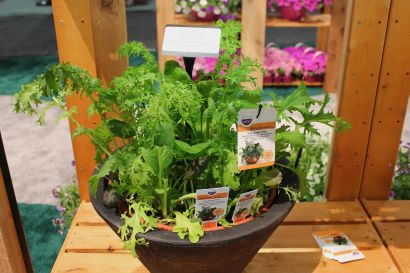
Pelleted lettuce seed (much easier to handle) mixes for the grower to create patio-size planters. Not bad! Snipping a few leaves will be fine, but if you eat salad more than once a month, you’re gonna need a bigger pot.

Basil and Swiss Chard plugs (seedlings), grown by Rakers Acres in Michigan, and shipped to greenhouse growers for “bumping up” to bigger pots to sell.

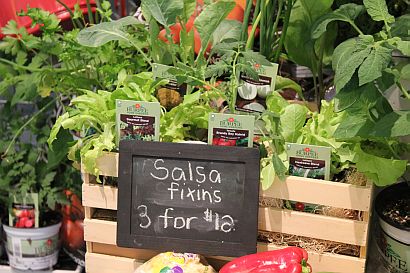
Saw lots of garden center marketing ideas such as this one from Burpee. Unfortunately, I have a very strong aversion to the word “fixins.”

Oh just stop it. An onion, in a pot. What the heck are you supposed to do with that?!

Facebook

Girdling roots: The source of all evil in the world?

Facebook

One of the most widely discussed topics in arboriculture and tree care these days is the problem of girdling roots.  Virtually every conference or workshop on tree care has a speaker or speakers on how poor planting technique or poor nursery practices lead to girdling roots and their subsequent correlation with poor tree performance, tree failures, global warming, the soaring Federal budget deficit, and the batting average of the Seattle Mariners.  Before we go any further let me state categorically that I do not think girdling roots are a good thing; nor do I think any of the consequences mentioned are a laughing matter – especially the Mariners’ batting average.  I do think, however, that we often see a rush to judgment as soon as girdling roots are found on trees that are declining or have died.  I attribute at least part of this to the increased availability of air spades for excavating tree roots.  I have nothing against air spades; they are useful tools and a great way to non-destructively examine and treat roots and even move trees.  The problem is that often when people see a tree in decline they examine the roots, see a girdling root, conclude that was the problem and blame the person that planted the tree (unless they were the person that planted the tree, then they blame the nursery).


Example of oak tree with leaf scorch (Photo Phillip Kurzeja)

A recent study here at Michigan State presented by Phillip Kurzeja at the recent Arboriculture Society of Michigan ArborCon, points out the importance of looking beyond girdling roots in assessing tree problems.

The problem:  Oak trees at several locations on the MSU campus have been suffering severe leaf scorch.  In some cases virtually 100% of the leaves on the trees are affected and growth has been severely affected.  Examination of the trees by a pathologist ruled out bacterial leaf scorch, suggesting that the problem may be abiotic.  The researchers looked at a battery of variables including degree of leaf scorch, number of girdling roots, planting depth, soil compaction, foliar nutrition, leaf water potential, and leaf photosynthetic function.  Most importantly, they looked at these traits on trees without scorch as well as trees with scorch.

Evaluating girdling roots (Photo Phillip Kurzeja)

The results:  Trees with mild or severe scorch leaf scorch had girdling roots.  At this point one might have leapt to the conclusion that the girdling roots were responsible for the leaf scorch.  But girdling roots were also found in trees that did not have any leaf scorch.  In fact, in some cases the healthy trees had more severe girdling roots than trees with the worst leaf scorch.  So, what factors differed between trees with scorched and un-scorched leaves?  The researchers are still working on the analyses but the most obvious differences were that trees with leaf scorch were consistently planted deeper and had lower levels of foliar manganese than healthy trees.


The presentation I saw did not include data on soil pH or soil nutrient levels, so it’s impossible at this point to establish causal relationships among planting depth, foliar manganese, and leaf scorch.  But, for those who have to answer the ‘what’s wrong my tree?’questions, this study does point out the importance of keeping an open mind and looking at a variety of factors and not leaping on the first defect to appear.

Facebook

Sudden Death Syndrome in Soy — Biggest Threat to the Entire Food Chain?

Facebook

This past week we received an interesting e-mail about something called “sudden death syndrome” which we were asked to blog about.  Here’s the article we were sent.  We don’t always take requests, but we thought that this was an interesting one, so we decided to write a little post about it.  Sudden death syndrome is basically a fungal disease which affects the roots of soybeans.  Recently there has been some press out there about how Round-up ready soybeans are particularly susceptible to this disease and that the spraying of roundup itself can lead to favorable environments for it.

This is a particularly attractive disease for a number of groups because it  provides fuel to their fire.  The anti-biotech group likes it because it makes Round-up ready crops look bad, the anti-pesticide group likes it because it makes pesticides look bad, the anti-Big Ag group likes it because it makes Monsanto look even more evil than usual.  So, in short, lots of happily indignant people.

So is it true?  Is using Round-up and Round-up Ready Soybeans a sure way to condemn ourselves to a soyless future?  On a side note this is something I really care about – I am a chronic soy sauce user.  If something is good without soy sauce it then it is going to be even better with it.  Well, I spend most of Monday and Tuesday looking through scientific articles and here, in a nutshell, is what I came up with:

Sudden death Syndrome is certainly real, and it can devastate a field.  It was around before Round-up and it will be here after Round-up is gone.  The biggest factor in whether it will be a bad year for SDS is the weather.  So what about the Round-up connection?  This is something that has been looked at by researchers, and here’s what they find.  In terms of the fungus responding well to Round-up –  some studies show that it does – most that it doesn’t.  Round-up Ready varieties of soybean may be resistant or non-resistant to SDS and, of course, the non-resistant varieties won’t fare as well as the resistant varieties if SDS is present (it seems possible that this is where the whole hullabaloo started — a field full of Round-up Ready soy but which wasn’t resistant to SDS contracted the disease while nearby non-Round-up Ready soy which did happen to be resistant to SDS did fine.)

Now there are some studies, mostly in test-tubes and greenhouses, which show that Round-up could make SDS worse, but in the field, where it actually matters, there just aren’t that many studies which show a correlation between using Round-up Ready soybeans and SDS — and more studies that show that there isn’t a correlation.  What it all comes down to is that there is a possible relationship between Roundup and SDS, but, despite a lot of research (both government and industry dollars flow easily to agronomic crops), this link isn’t crystal clear and may not exist at all.

Facebook

Should we use biochars in our gardens?

Facebook

In the last few years, I’ve had a number of people ask me about biochar:  what  is it and what does it do?  Should they add it to their garden?  Should they make their own biochar?  So while the subject deserves a longer review, I thought it would be useful to discuss it briefly on the blog.

In the strictest sense, “biochar” refers to charcoal that’s made as a byproduct of biofuel production.  Various crop residues, livestock manures, and just about any other organic material you can imagine has been studied for this purpose.  Biofuel production not only helps diversify our energy resources, but the biochar itself also boasts several benefits, not the least of which is that it serves as a long-term, stable repository of carbon.  Since the carbon in biochar decomposes so much slower than the parent organic material, it is often considered to be a “carbon negative” material.
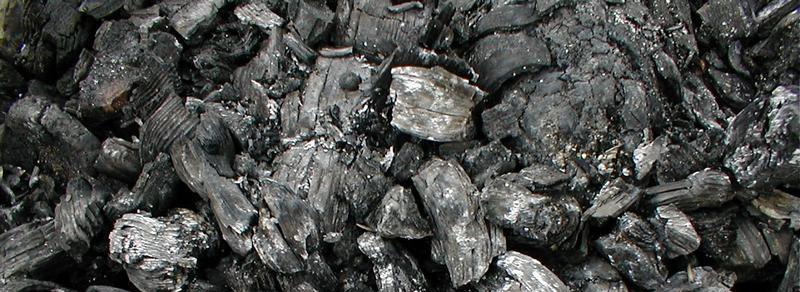
Even more exciting is that biochar offers some distinct, tested benefits to agriculture.  It is a porous, charged material that has been used to remediate soils by binding contaminants such as pesticides and heavy metals.  It offers a physical environment to mycorrhizae, which often benefit from biochar amendment.  It binds nutrients such as nitrogen, preventing runoff or leaching, and releases these nutrients to crops, most of which are shown to benefit from biochar additions.  The scientific literature is robust in examples, worldwide, of how various biochars benefit agricultural soils and crops.

But before you rush away to buy (or make) your own biochar, there are some significant caveats.  First, there is a sophisticated process used to make biochars, whose characteristics will vary tremendously depending on how they are produced.  Differences in temperature, for instance, will produce very different biochars from the same parent material.  (And you would be hard pressed to do this at home:  temperatures can range from 100-700C.)

Second, there is little, if any, research on the use of biochars in nonagricultural situations other than soil remediation.  This means no information on how it affects trees, shrubs, home gardens and landscapes, and other urban greenspaces.  As readers of this blog should know by now, there are many agricultural production practices that do not translate well to the home garden or landscape.

Third, biochars are generally very alkaline, often with a pH close to that of lime.  While this might be fine for some soils and plants, naturally acidic soils and their respective acid-loving plants are not going to react kindly to a more alkaline soil environment.

Finally, I hate to see people (and they are out there) who are now taking their pruning debris, arborist wood chips, and other organic material, burning it, and burying it.  Ideally, both bio-oils and biochar are made from excess crop residues and other debris generated in agriculture.  Arborist wood chips and other plant debris generated in a home landscape need to go right back onto the soil as part of a compost/mulch layer.  To burn this valuable resource strikes me as the classic “penny wise, pound foolish” mentality.
Facebook