Cornmeal myth busted

As my colleague Fred Hoffman says, the horticultural silly season is upon us. This week I heard from one of our European readers, questioning the use of cornmeal as a fungicide. He referenced an online article entitled “Cornmeal has powerful fungicidal properties in the garden.” He hadn’t been able to find any reliable information and thought it might make a good topic for our blog. So Johannes, this rant’s for you!

If you’ve followed the link to column in question, you’ll see that the original “research” is attributed to one of Texas A&M’s research stations in Stephenville, TX.… Continue reading this article “Cornmeal myth busted”
The Other Lamb’s Ears

I’m assuming even you tree people (aka other
Garden Professors) are familiar with the soft, silvery leaves of Stachys
byzantina
or Lamb’s Ear (variously Lamb Ears and Lamb’s Ears).  Not to
disparage S. byzantina, but in our part of the world it looks like a
pile of wet dryer lint in the winter; and can become similarly
disfigured during a hot, wet summer.  Spring brings bright,
pet-able new ears, followed by woolly flower spikes that could serve as
Q-tips for Shrek.… Continue reading this article “The Other Lamb’s Ears”

Garden seminar coming to a place near you?

I just got back from British Columbia where I spoke to 2 garden club/Master Gardener groups.  It’s always easy for me to do seminars in BC or along the west coast, but I rarely get a chance to go elsewhere.  Many times it’s the expense that keeps groups, especially garden clubs and nonprofits, from bringing in speakers.

So here’s my idea:  I keep a gift account budget here at WSU with the donations people make towards my educational program. … Continue reading this article “Garden seminar coming to a place near you?”

Mystery berry revealed

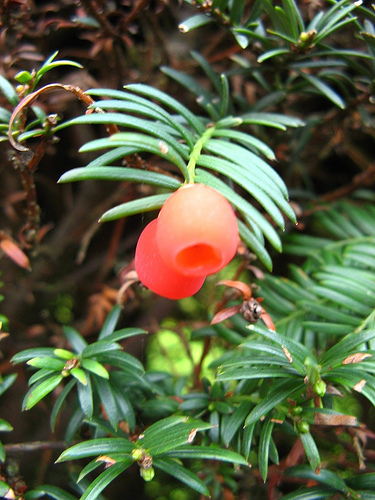
You guys are just too smart – I was hoping to trap someone into guessing a Vaccinium species. But no, you all knew this was a Taxus spp. (yew):

Because Taxus is a gymnosperm, this reproductive structure is actually a cone.  It’s botanically incorrect to call it a fruit of any sort, as the term "fruit" refers specifically to angiosperms. Taxus cones are modified for seed dispersal to include an edible, fleshy aril (very good, @GardenHoe!),… Continue reading this article “Mystery berry revealed”

What’s old is new again

While the Emerald Ash Borer (EAB) continues to expand in the upper Midwest (see http://www.emeraldashborer.info/files/MultiState_EABpos.pdf  for a current infestation map), EAB is old news here in Michigan, especially in the southeastern part of the state.  Efforts to restore urban and community forest canopy lost to EAB will continue, however, for the foreseeable future. In 2003 we established an Ash Alternative Arboretum MSU Tollgate Education Center in Novi, MI – which is near ‘Ground Zero’ for the EAB infestation in North America.… Continue reading this article “What’s old is new again”

Friday mystery

I just got back from Nanaimo BC, where I had gooseberries with my afternoon tea.  Below is another "berry" found on a commonly used ornamental.  (I use the term berry loosely – as you may know, the botanical definintion for berry excludes fruits like strawberry and raspberry, which are aggregate fruits.)

I’ve photoshopped this so that only the two "berries" are visible. On Monday I’ll post the entire photo, along with some botanical fun facts! See if you can guess what this is before then.

Shear lunacy

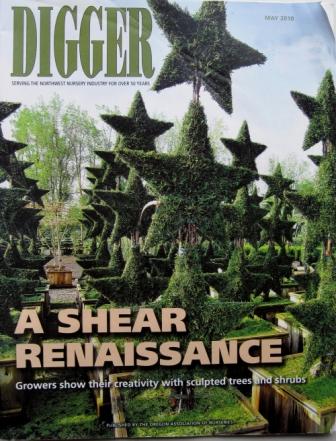
I subscribe to Digger magazine, the industry publication from Oregon Association of Nurserymen.  I am always curious about trends in the nursery industry and this magazine is a good way to find out what home gardeners are buying.

The cover feature of the May 2010 issue is on topiary. While I can appreciate topiaries in formal gardens – with dozens of gardeners to keep them shaped up – I think they are poor choices for most home landscapes. … Continue reading this article “Shear lunacy”

Visiting Virginia

The first thing that I did, gardening wise, when I moved to Minnesota from Georgia was to try all of the plants that I had grown to love in the South in the North — hoping beyond hope that perhaps someone had made a mistake when listing the hardiness zones of these plants.  The result was a mess of dead lacebark elms, Japanese maples, and butterfly bushes.  One plant that I did find could live, albeit just barely, was the beautyberry — a purple fruiting shrub that would survive as a perennial in Minnesota, just barely getting up to my knee — just enough to tease me.… Continue reading this article “Visiting Virginia”

Creative Uses For Old Water Breakers

Why, oh why, can’t someone engineer a sturdy, long-lasting, horticulturally-correct water breaker.

We have, at last count, six hoses in use at our very spread-out garden & farm.  I go through a lot of breakers, and am down to two, which I rotate around.  In dire need of some new ones (as well as a huge bale of TP), I perused the garden aisle at our local big box (rhymes with “Target”).  Pistol grip schnozzles abound – these things that propel the water
like a 95 mph fastball. … Continue reading this article “Creative Uses For Old Water Breakers”

Mystery photo uncurled!

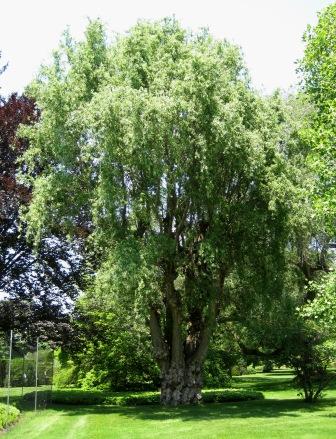
There were a few brave souls who ventured to ID the mystery plant – a trunk shot is not particularly helpful, I know.  But I was hoping that its contorted nature might help a little.  (It wouldn’t have helped me at all, but you all know by now that I am NOT a taxonomist.)

So our mystery tree is a curly willow (Salix matsudana):

…which may or may not be synonymous with Salix babylonica.… Continue reading this article “Mystery photo uncurled!”