Before I get into the meat of this issue I wanted to mention that, a couple of weeks ago, Purdue came out with a statement which basically supported a post that I had previously written – one where I stated that there’s not a lot of good evidence that using Roundup leads to sudden death syndrome in soybeans. Yeah me! Well, not really – that’s not the way science works. While it is nice that other scientists agree with my conclusion, that doesn’t mean that Round-up isn’t affecting soybeans – it just means that there’s no evidence of it right now.… Continue reading this article “Building a House of Straw — With Brix!”
Parking tickets, compost tea, and pseudoscience in the Ivory Tower
Back in November 2009, Jeff posted an educational and amusing commentary about Harvard’s use of compost tea. Much vigorous discussion followed, and we’ll return to that topic in a moment. But first, I’d like to tell you about my morning yesterday.
In September of 2010, I received a ticket for parking longer than 2 hours in a restricted zone. Now, there was no way I committed this infraction; I had hard core proof that could not be rationally challenged.… Continue reading this article “Parking tickets, compost tea, and pseudoscience in the Ivory Tower”
Lasso those grasses!
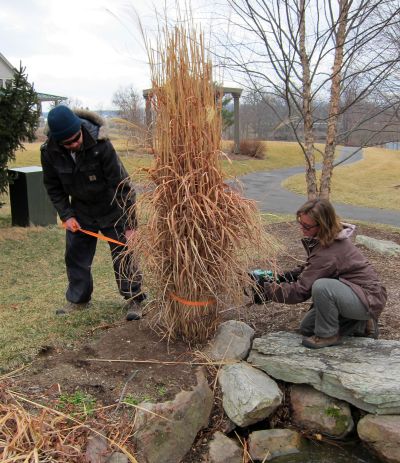
While Jeff and Bert were swilling beers and eating burgers last weekend (dang, wish I was there to commiserate!) I was whacking back the last of the perennials and grasses in our home garden. Tarp after tarp were filled with winter’s debris for compost pile as we fought 25 mph gusts the entire time. Not ideal conditions. However, a neat trick I learned years ago came in handy with the grasses. I’m assuming many of you utilize this technique also – so forgive me if this is a “nothing new” post Here’s Paul and Dabney, our Hahn Horticulture Garden horticulturists, demonstrating said technique:

Just cut below the web strap or rope with your favorite implement of destruction, and toss the whole bundle on the tarp to get it to the pile.… Continue reading this article “Lasso those grasses!”
Keep Calm and Carry On…
This past weekend GP Jeff Gillman and I were in Midland, Michigan for two different conferences and had a chance to catch up over dinner (Boulevard burgers – best in Midland) and a couple of cold Bell’s stout ales. It was nice to visit with Jeff since we have so much in common but rarely get to see each other. As you might suspect, our conversation centered on negotiating the perils of the tenure and promotion process at research intensive universities, dealing with bumbling administrators, and, of course, our fellow Garden Professors. … Continue reading this article “Keep Calm and Carry On…”
The roots of the rhody problem
There were several good shots at analyzing Friday’s unhappy rhododendron. Mature leaf size can be determined by light levels, as both Lisa B and Tom & Paul suggested. Moving a plant from a low to high light environment could cause this change in leaf size. This rhododendron hasn’t been recently transplanted, however, so we can eliminate light levels as a cause. (And there was no other impediment to light, such as the presence of shading plants.)… Continue reading this article “The roots of the rhody problem”
Friday puzzle: unhappy rhododendron
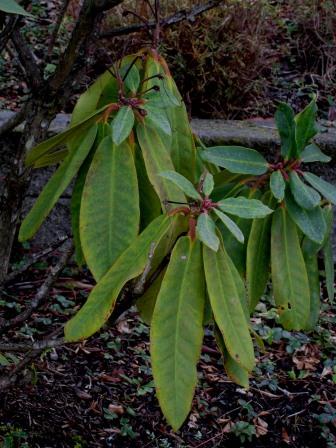
Today we have a diagnosis question. Consider this unhappy rhododendron:

While there is more than one problem with this poor thing, the one I’d like you to think about is why the newer leaves are smaller than the old leaves. (They are fully mature.) There are two parts to this question:
1) What is the physiological reason that the leaves are smaller? (In other words, what is directly causing this difference?)
2) Knowing this, what does this tell you about the underlying problem?… Continue reading this article “Friday puzzle: unhappy rhododendron”
Random thoughts from the NW Flower and Garden Show
Last week was Seattle’s NW Flower and Garden Show. This multi-day extravaganza features display gardens, educational seminars, and many opportunities to spend $$$. I had a little free time one day and shot some pictures, which I present here along with my commentary:
The Good
The “perfect” lawn is no longer just a monoculture of grass. At least two of the display gardens had flowers scattered for a designer version of ecoturf:


And a very cool repurposing of old heating vent covers as part of a patchwork of groundcovers:

The Questionable
A gorgeous Japanese maple (Acer palmatum), “born” in 1893:

I’m sorry.… Continue reading this article “Random thoughts from the NW Flower and Garden Show”
Off-label Use of a Chicken*
[Extremely] Preliminary research results from the University of Maryland indicate
chickens may be of interest in the fight against Halyomorpha halys, the brown
marmorated stink bug.
There are good stink bugs and bad stink bugs. The brown marmorated stink bug is a bad one. A relatively new introduced pest, it is piercing, sucking, and generally ruining vegetable and fruit crops (as well as some ornamentals) across a good part of the U.S. There are apparently few natural predators for this imported species and they reproduce like mad, thus the potential for this to become a very serious economic issue.… Continue reading this article “Off-label Use of a Chicken*”
When trees attack!
We typically think of trees as the ‘good guys’; they shade our homes and yards, they take up carbon dioxide and pollutants from the air, they give us oxygen. What’s not to like? Well, like a lot of good guys, trees can also have a dark side. One of the more sinister habits some trees have is getting into sewer lines. Some studies estimate that trees are responsible for up to half of sewer line repair costs. … Continue reading this article “When trees attack!”
Mystery teeth revealed
Friday’s puzzle was tough! Several of you were on the right track – this is a carnivorous plant. Right away Deb suggested a pitcher plant (then got sidetracked with chestnuts), but Derek was spot on with his guess of the “spiky bits” on a Nepenthes pitcher:

What the function of these spiky wings are is not clear to me; I did a little checking in the literature but failed to find anything convincing. It does seem to suggest a close relationship with fly traps. … Continue reading this article “Mystery teeth revealed”