I spent yesterday at the Washington APLD meeting in Seattle (that’s the Association of Professional Landscape Designers) – a new venue for me. In my relatively short time frame I focused on one example of an unsustainable practice (overamendment of soils with organic matter) and an unsubstantiated product (compost tea), both of which I knew were of interest to this group. I came away with a lot of new colleagues and a shared sense of excitement that landscape designers, like other horticulture professionals, also want the best science on which to base their recommendations.… Continue reading this article “Compost tea – now part of landscape design?”
Month: February 2012
Moving from tree planting to tree performance
I ‘like’ American Forests page on Facebook so I receive their periodic updates. One item that caught my eye recently was a profile article on Dr. Greg McPherson, who is an urban forestry researcher with the USDA Forest Service in Davis, CA. Even if you don’t recognize the name, if you have even seen any statistics on the economic and environmental benefits of trees in cities (energy conservation, carbon sequestration, etc), they probably cited information for McPhereon’s studies, either directly on indirectly,
http://www.americanforests.org/magazine/article/forest-frontiers-greg-mcpherson/… Continue reading this article “Moving from tree planting to tree performance”
Going Overboard with Paul Tukey
According to a post by Paul Tukey on safelawns.blog, a recent French study which was published in the Journal of Applied Toxicology shows that corn which has been genetically modified to produce the caterpillar toxin Bt is poisonous to humans. Furthermore, so is roundup.
Ladies and Gentlemen, we’re screwed.
The rapture is coming. The true believers who shun conventionally produced food and eat only organic, non-GMO will be saved. Those who don’t, well, they’re all as good as dead so don’t even bother worrying about ‘em.… Continue reading this article “Going Overboard with Paul Tukey”
Tom Fischer for the WIN!
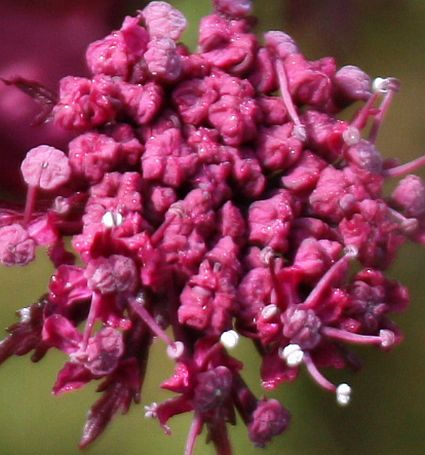
The answer to last Friday’s plant i.d. quiz is Angelia gigas. Tom guessed it; confirmed (seconded?) by Johannes.
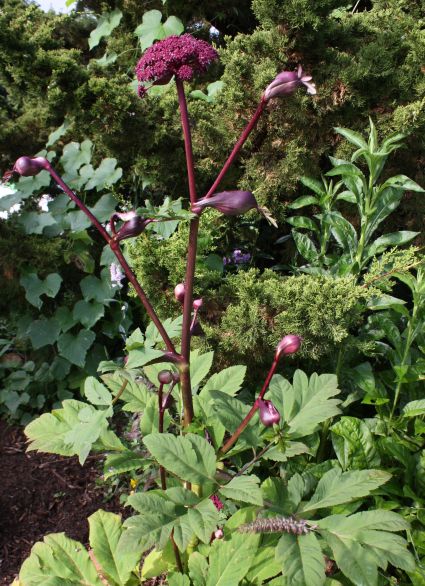
Fairly easy biennial from seed. Bees and butterflies love it. This one’s a bit spindly due to too much shade (it had reseeded from another spot). And that most certainly is not a dandelion in the background.
I love the buds – before opening, the flower is encased in bract with and disguised (?) with a wee leaf-like structure at the end.… Continue reading this article “Tom Fischer for the WIN!”
An uphill battle for evidence-based products
I was idly scrolling through Facebook, thinking about my topic for today, when I saw a link for “federal guidelines for sustainable landscaping.” Perfect! I skimmed through the document – some quibbles here and there, but nothing gasket-blowing on my first read – and then checked out the BioPreferred Catalog page. I looked under “Landscaping and Agriculture” and clicked on “Fertilizers.”
There are 182 listings. The very first one is “1-2-3 Instant Compost Tea.” … Continue reading this article “An uphill battle for evidence-based products”
Friday quiz – please try again!
If you tried to post a comment/guess on the Friday quiz, you couldn’t…I gave the post the same name as a previous post, which somehow negates Sharepoint’s ability to accept comments. Linda kindly renamed the post – so give it another try!
(And Deb – no! Bwahahaha!)
Another lesson from my (eastcoast) garden
When we lived in Buffalo, we became warriors in the gypsy moth battle. One of the things we quickly learned was to check tree trunks for larvae, especially those trees with thick, rough bark where caterpillars could hide. It went without saying that burlap used to insulate tender plants came off as soon as possible in the spring, because that burlap was a great place for larvae to live as well.
Back in Washington state, we don’t have a gypsy moth infestation (yet), but the lesson was retained: we don’t leave materials wrapped around the trunks or branches of trees.… Continue reading this article “Another lesson from my (eastcoast) garden”
Friday Quiz from Holly!
All right people…what is it?
*evil hand wringing and maniacal laughter*
[albeit quiet maniacal laughter, as not to disturb office mates]
Milky Spore
There are a lot of great products out there for controlling insect pests without using pesticides. Some of the best include insect diseases or predators which will attack the pest and not beneficial. For example, there are wasps that kill mealybugs and nematodes that attack grubs. Both of these products are pretty effective. That said there are also some products that just don’t work that well. One of them is known as milky spore disease.… Continue reading this article “Milky Spore”
Plants aren’t so cooperative after all
One of the underlying tenets of ecology is the principle of competitive exclusion. This principle states that when two species compete for the same vital resource, the better adapted species will ultimately displace its competitor. Simply put, it’s survival of the fittest.
More recently, some ecologists have suggested that nature’s not quite so brutal – that the species composition in an ecosystem is determined more by random fluctuations in population numbers than by direct competition.
But last month, this "neutral theory" was directly challenged by evidence on three continents which compared the abundance of particular tree species, both in the fossil record and in existing forest ecosystems.… Continue reading this article “Plants aren’t so cooperative after all”