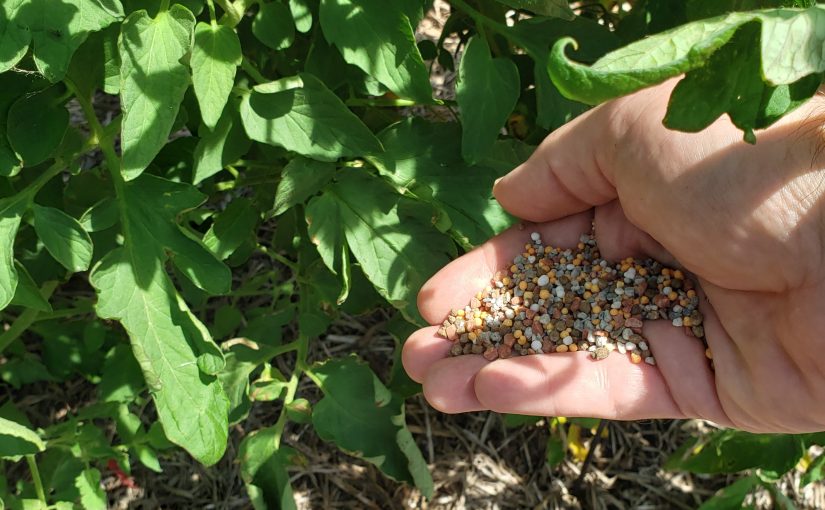
You see a bright shiny package at the garden center saying that it can help you have the most bountiful garden ever, the greenest lawn in the neighborhood, your plants will have miraculous growth, or it will supply every element on earth to make sure that your plants are living their best life. It’s got what plants crave….It’s got electrolytes! You reach out to grab that package and ……. Woah! Pump the brakes! Do you know if your plants even need to be fertilized? … Continue reading this article “To Fertilize, or Not to Fertilize, that is the question”
Tag: fertilizer
NON-GMO FERTILIZER?
I was asked by Dr. Linda Chalker-Scott to look up some information in order to answer a recent comment and question on a previous post.
Paraphrased, the question is, “… are there any verifiable “organic” fertilizers that can be guaranteed to be made from 100 percent non-GMO sources.”
First off, let me state up front that the whole “Non-GMO” labeling effort is pure marketing. There is no evidence to suggest products that come from genetically engineered crops are any different than crops made from other plant breeding methods.… Continue reading this article “NON-GMO FERTILIZER?”
Out of the bottle and into the bag
Last week I was having lunch with my mom at our favorite nearby nursery/café. After failing to resist the grilled cheese sandwich (3 cheeses! And buttery panini bread!), we walked off lunch in the garden supply part of the nursery. Normally I’m on my best behavior when I’m shopping with my mom (i.e. I don’t take photos of things I’m going to take to task on the blog). But like the 3-cheese grilled sandwich I was unable to resist the bags of biodynamic compost.… Continue reading this article “Out of the bottle and into the bag”
What about fall fertilization?
Posted by Bert Cregg
We had a question on the Facebook site regarding fall fertilization of landscape plants. Fertilization in general, and fall fertilization in particular, is a complex topic and needs a little more room for explanation than the Facebook discussion allows.
As a general rule, most landscape trees and shrubs can maintain acceptable growth and appearance without fertilization. There are a couple of reasons for this. As Linda noted in the Facebook discussion, woody plants are fairly efficient at internal nutrient recycling.… Continue reading this article “What about fall fertilization?”
Phosphorus and Big Macs
Minnesota, and I were cruising through old pictures and files and getting all sentimental about the cool stuff we used to do. A lot of it was never published just because after we were done with one thing we were just too damn excited to move on to the next. Anyway, one of the neatest experiments that we never wrote up was a phosphorus experiment. Here’s what it looked like to the casual observer.
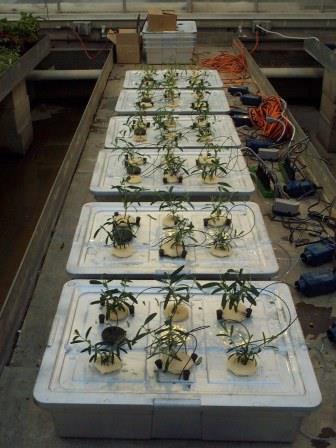
Now let me explain the neat part to you a little. … Continue reading this article “Phosphorus and Big Macs”
Good Stuff
Boy oh boy, what a fun day! People yelling at me from the left and from the right. But hey, I didn’t start doing what I do to make everyone happy. With that said….Nah, I don’t feel like attacking anyone today. Instead, let’s look at a good renewable fertilizer: Cotton seed meal. It’s got a reasonably good ratio of nitrogen to phosphorus and potassium — slow release of course. Basically a waste product given a meaningful purpose. … Continue reading this article “Good Stuff”
Does fertilization increase insect herbivores?
Always fun when you find a research paper that confirms what you’ve suspected all along. I ran across a paper last week in the Annals of Applied Biology entitled ‘Fertilisers and insect herbivores: a meta-analysis’ (Butler et al. 2012. Ann Appl Biol 161: 223–233). I’m interested in the topic because in recent years a dogma has emerged that if you fertilize a landscape tree it will be immediately devoured by insects. In this study the authors conducted a meta-analysis (basically a compilation of studies on a given topic and then combining and analyzing the aggregated results) and looked at dozens of studies of the response of insect herbivores to fertilization to answer the question, does fertilization increase insect damage? … Continue reading this article “Does fertilization increase insect herbivores?”
A Challenge
As I was looking over the label on a bag of fertilizer this morning I was reminded of the time, a few years ago, when a friend of mine and I went to a local K-mart and decided to see what the people in the gardening section knew. We started small—we went over to a bag of fertilizer and my friend asked what the three numbers on the bag meant. Now, as most gardeners know, those numbers indicate the amount of nitrogen, phosphorus and potassium in the fertilizer. … Continue reading this article “A Challenge”
Pop quiz time!
It’s the start of new semester. Best way to get student’s attention is with a pop quiz right off the bat! So in that vein, we’ll cross things up and give a quiz on Monday instead Friday. Relax; to make things a little easier we’ll make this one a matching exercise.
Here goes. At our recent Christmas tree conference in Austria, a colleague of mine at Oregon State University, Chal Landgren, presented the results of a study to look at the effectiveness of foliar fertilization on Nordmann fir. … Continue reading this article “Pop quiz time!”
Our visiting GP takes on fertilizers
Like many readers of this blog, I’m like a kid in a candy store where plants are sold. I try to justify the extra cost of a large annual pot instead of a scrawny 4-pack, or I imagine I’ll find room for that lime green Heuchera and my wife will learn to love it. But unless I keep my blinders on and stick to the shopping list, I’ll probably leave with a fertilizer. This year, I’ve purchased 12-0-0, 5-6-6, sulfur, and some 5-1-1 liquid. … Continue reading this article “Our visiting GP takes on fertilizers”