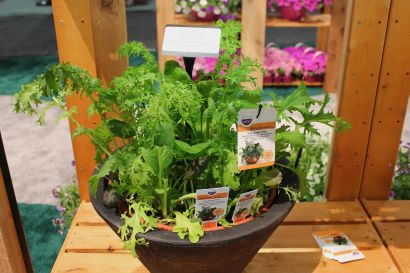
The Hottest Thing in…Veg!

Vegetable transplants and herbs were a bright spot last year (and the one previous) for most retail growers and independent garden centers.  Seed and transplant companies have taken note – saw lots of veg and herbs at the normally-ornamental trade shows.  As always, some good ideas, some a bit far-fetched…

Pelleted lettuce seed (much easier to handle) mixes for the grower to create patio-size planters. Not bad! Snipping a few leaves will be fine, but if you eat salad more than once a month, you’re gonna need a bigger pot.… Continue reading this article “The Hottest Thing in…Veg!”

Girdling roots: The source of all evil in the world?

One of the most widely discussed topics in arboriculture and tree care these days is the problem of girdling roots.  Virtually every conference or workshop on tree care has a speaker or speakers on how poor planting technique or poor nursery practices lead to girdling roots and their subsequent correlation with poor tree performance, tree failures, global warming, the soaring Federal budget deficit, and the batting average of the Seattle Mariners.  Before we go any further let me state categorically that I do not think girdling roots are a good thing; nor do I think any of the consequences mentioned are a laughing matter – especially the Mariners’ batting average. … Continue reading this article “Girdling roots: The source of all evil in the world?”

Sudden Death Syndrome in Soy — Biggest Threat to the Entire Food Chain?

This past week we received an interesting e-mail about something called “sudden death syndrome” which we were asked to blog about.  Here’s the article we were sent.  We don’t always take requests, but we thought that this was an interesting one, so we decided to write a little post about it.  Sudden death syndrome is basically a fungal disease which affects the roots of soybeans.  Recently there has been some press out there about how Round-up ready soybeans are particularly susceptible to this disease and that the spraying of roundup itself can lead to favorable environments for it.… Continue reading this article “Sudden Death Syndrome in Soy — Biggest Threat to the Entire Food Chain?”

Should we use biochars in our gardens?

In the last few years, I’ve had a number of people ask me about biochar:  what  is it and what does it do?  Should they add it to their garden?  Should they make their own biochar?  So while the subject deserves a longer review, I thought it would be useful to discuss it briefly on the blog.

In the strictest sense, “biochar” refers to charcoal that’s made as a byproduct of biofuel production.  Various crop residues, livestock manures, and just about any other organic material you can imagine has been studied for this purpose. … Continue reading this article “Should we use biochars in our gardens?”

Valentine’s Day, yet again…

We make fun and call it “National Forced Affection Day” (NFAD) around
our house. But it’s big business.

The National Retail Federation did a survey of 8900+ consumers in their 2011 Valentine’s Day Consumer Intentions and Actions Survey They found that the
average person will shell out $116.21 on traditional Valentine’s Day merchandise this year, up 11 percent over last year’s $103.00. Men spend twice
as much as women. Total holiday spending is expected to reach $15.7 billion.… Continue reading this article “Valentine’s Day, yet again…”

Is local always better?

As those that have followed the blog for awhile are aware, among my pet peeves are some of the naïve statements that are repeated ad nauseam by proponents of native plants for landscaping. You know the usual litany: natives don’t need water, don’t need fertilizer, resistant to insects, resistant to diseases, yada, yada… According to the dogma, native plants possess these traits because they’ve evolved here and they belong here. I hasten to point out; I have nothing against natives and think we ought to plant more of them whenever they are an appropriate choice.  … Continue reading this article “Is local always better?”

Friendly firs follow-up

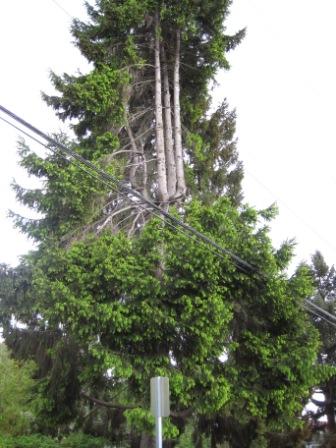
Looks like I was too easy on you Friday!  Most of the you correctly noted that this “devil’s fork” is most likely the result of topping by a human or nature:

Devil's fork

Given that there are powerlines nearby, and more importantly a view to the water downhill, it’s likely that someone deliberately headed this Douglas fir (Pseudotsuga menziesii) back.  On the other hand, this species will commonly lose branches, and often their leaders, in a windstorm.… Continue reading this article “Friendly firs follow-up”

Friday quiz – too close for comfort

Since Valentine’s Day is coming, today’s quiz features a situation that’s a little too close for comfort:

This is not the result of three trees being planted too closely together, either by a person or by nature.  What is it the result of?

Answer and another picture on Monday!

Cold enough for ya?

Like many people we spent the past couple days digging out from the massive snowstorm that swept across a large swath of the country.  This was definitely a made-for-TV-weather event as national and local TV weatherfolks took up their positions and gave us breathless live-remotes of the “Blizzard of 2011”.

40 mph wind + 1 little crack = a barn full of snow.

Almost as predictable as video footage of snow-ploughs on the streets and locals snow-blowing sidewalks; climate change skeptics are using the recent round of winter weather as proof that global warming is a hoax and that there’s really nothing to worry about except the economics of ‘cap and trade’.  … Continue reading this article “Cold enough for ya?”

Planting trouble: multiple trees in one hole

[I enjoyed Jeff’s Valentine story so much that I thought I’d stick to the theme of togetherness…for better or worse.]

A week or so ago a reader asked about the practice of planting three or four fruit trees in the same hole.  Having not heard of this before, I checked on the web and found many “how to” pages geared to home gardeners who either want a longer harvest of a particular fruit (early to late) or a mixture of different species. … Continue reading this article “Planting trouble: multiple trees in one hole”