Fall for Ornamental Grasses


I’ve written about ornamental grasses previously – they really are one of the toughest, most useful yet under-appreciated groups of garden plants.  Most provide at least three seasons of interest, but fall is when they really shake their pom-poms.

On a recent conference trip to western Michigan with pal and plantsman Paul Westervelt, we stopped by the trials at Walter’s Gardens of Zeeland – one of the largest perennial propagators (wholesale) in the country.

It was a beautiful, breezy day in their extensive gardens, and the grasses were positively alive with light and motion (and kittens – seven or eight, I think).Continue reading this article “Fall for Ornamental Grasses”
Point of view: tree fouls out

A few weeks ago the Seattle Times ran a story about a tree whose existence is straining a long-term neighborly relationship. The feud’s between former Mariners first baseman John Olerud and his neighbor Bruce Baker, both of whom live in the Clyde Hill area (a bit north of Bill Gates’ place in Medina). Baker owns a Chinese pine (red or white, I’m not sure, but I’m guessing red based on the photos) which interferes with Olerud’s view of Lake Washington and the Seattle skyline.… Continue reading this article “Point of view: tree fouls out”

The wackiness continues

It seems like every year we end up talking about ‘weird’ weather; either it’s extreme heat, extreme cold, too much rain, not enough rain, and on and on.  Here in the upper Midwest and other parts of the central US, however, 2012 is clearly a year to remember.  Our winter was fairly unremarkable until we hit 8 days over 75 deg. in mid-March.  This pushed our growing degree days up at least 3 weeks and set the stage for widespread late-freeze damage in April, wiping out the state’s cherry, peach, and plum crops. … Continue reading this article “The wackiness continues”

Clever Things I Saw This Summer, Part 1

I’ve been wanting to share a few silly things with you from my travels and travails this summer. But I’ve been a bit hesitant, due to the gravity of recent posts, comments, and related hoo-ha (I was completely unaware there was a cornmeal controversy).

I sure appreciate and admire the guts and grace with which my GP colleagues present their cases and engage our readers.  Important topics, all.

Which makes this segue even more awkward…Look! A jellyfish made from succulents!!!… Continue reading this article “Clever Things I Saw This Summer, Part 1”

Why I Don’t Worry Too Much About Organic Fruits and Veggies

Let me tell you something you already know.  If you grow something in your own garden you’ll know exactly what poisons were or weren’t put on it, how much fertilizer was used, and furthermore it will taste better.

If you buy your apples from the guy down the street who you’ve known for 20 years you’ll be able to ask him what he used to grow the crop, why he used it, and you’ll have the satisfaction of supporting a local industry. … Continue reading this article “Why I Don’t Worry Too Much About Organic Fruits and Veggies”

Deconstructing the cornmeal myth

Back in June of 2010, I wrote about an online column that recommended applying cornmeal as an antifungal soil amendment. (Important note: we are not talking about corn gluten meal. Just cornmeal.) The upshot of the post was while some gardening personalities extol the use of cornmeal to kill soil pathogens like Rhizoctonia and Sclerotinia, no published science supports the practice.  The post was effective in encouraging the author of the referenced online column to update her information, but the controversy didn’t die.… Continue reading this article “Deconstructing the cornmeal myth”

The new hardiness map’s obsolete! The new hardiness map’s obsolete!

I posted back in January about my excitement about the update of the USDA Hardiness zone map.   While I acknowledged some of the shortcomings of the new map, I was excited because it was a big improvement over the old map, both in terms of content (more recent temperature data included) and presentation (interactive search features, better graphics).


Dr. Nir Krakauer, assistant professor of civil engineering in The City College of New York’s Grove School of Engineering, was less impressed, however, and has essentially declared the new hardiness map dead on arrival.  … Continue reading this article “The new hardiness map’s obsolete! The new hardiness map’s obsolete!”

The good, the bad, and the ugly. A reply.

Ginny Stibolt of the Florida Native Plant Society recently posted Native Plant Issues: The good, the bad and the ugly, featuring me as the ugly.  I posted a reply on her post, which I include here.  To keep things in context, I encourage you to read her post first.

Enjoy your weekend!

Hi Ginny:

Some comments and a few points of clarification.

On the first item, as a Federal agency the USDA is bound by the Executive Order on Invasive Species which defines natives as species that occur in an ecosystem “other than as a result of an introduction”. … Continue reading this article “The good, the bad, and the ugly. A reply.”

Poisoned bird seed and trust

Over the years I’ve said some nice things about Scotts Miracle-gro products, such as one of their potting soils, and some not so nice things, such as with their Round-up resistant Kentucky bluegrass. I’ve never thought of them as a particularly good or particularly bad company, just a company trying to do the best it could while being reasonably honest about what it was doing (You could argue that they tried to pull something fancy with the Round-up resistant Kentucky bluegrass, but I’m going to give them the benefit of the doubt and say they were just exploiting an obvious governments loophole – not exactly good, but hey, it’s a dog eat dog world out there).… Continue reading this article “Poisoned bird seed and trust”

A plant riddle for you

This week Jeff, Bert and I are brainstorming new and exciting ways that The Garden Professors can invade…I mean integrate into…the gardening world. (We’re channeling Holly, who had a conflict with another even this week.)  We’ll leave discussion of the particulars for another day.  But that’s my segue into my text-short but picture-perfect invasive plant story.

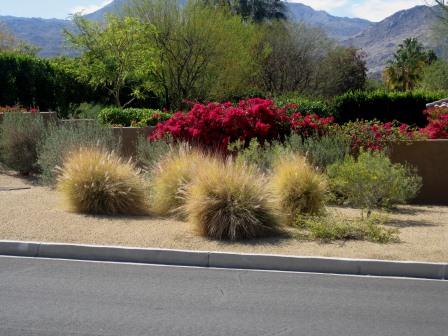
Earlier this spring I was in Palm Desert and spotted a large clumb of purple fountain grass (Pennisetum setaceum) in a landscape:

So here is the riddle: Why did the fountain grass cross the road?… Continue reading this article “A plant riddle for you”