Building Healthy Soils in Vegetable Gardens: Cover Crops Have Got It Covered Part II: Types of Cover Crops – Non-legumes, Legumes, and Mixtures

Megan M. Gregory, Blog Contributor, Cover Crop Nerd, and Graduate Research Assistant, Cornell University
Email: meganmgregory1@gmail.com
Website: http://blogs.cornell.edu/gep/

This article is part of a four-part series about cover cropping in vegetable gardens.  Stay tuned for Part III next week. 

Vegetable gardeners are turning to cover crops to improve soil quality, add nitrogen (N) to the soil through legume N fixation, suppress weeds, and attract beneficial insects in their gardens. … Continue reading this article “Building Healthy Soils in Vegetable Gardens: Cover Crops Have Got It Covered Part II: Types of Cover Crops – Non-legumes, Legumes, and Mixtures”
Garden Site Selection

Shawn Banks: Extension Blog Contributor
Johnston County Extension Agent/Educator
North Carolina State University
shawn_banks@ncsu.edu

As an extension agent one question I often get asked by new gardeners is, “Where do I put a vegetable garden in my yard?” That leads to a lot more questions, but let’s answer the where question first. There are four basic considerations when selecting a garden site.

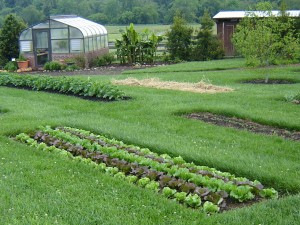
narrow strip of garden vegetables in a backyard area

The first thing to consider is the need for direct or full sunlight. Most vegetables need a minimum of six to eight hours in order to produce a crop.… Continue reading this article “Garden Site Selection”

Building Healthy Soils in Vegetable Gardens: Cover Crops Have Got It Covered Part I: Introduction to Cover Cropping

Megan M. Gregory, Blog Contributor, Cover Crop Nerd, and Graduate Research Assistant, Cornell University
Email: meganmgregory1@gmail.com
Website: http://blogs.cornell.edu/gep/

This article is part of a four-part series about cover cropping in vegetable gardens. Stay tuned next week for Part II

What are cover crops, anyway?

Cover crops are close-growing plants sown in rotation with food crops, or inter-seeded between food crops to cover bare ground. … Continue reading this article “Building Healthy Soils in Vegetable Gardens: Cover Crops Have Got It Covered Part I: Introduction to Cover Cropping”

Pruning Overgrown Apple Trees

Ward Upham: Extension Blog Contributor
Extension Associate – Home Horticulture Rapid Response Coordinator
& Extension Master Gardener Coordinator
Kansas State University Extension
wupham@ksu.edu

pic

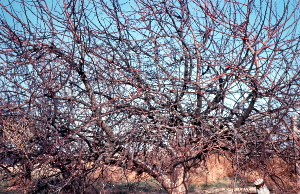
Apple trees that are not pruned for several years will often produce so many branches that very little energy is left for fruit production. Overgrown apple trees are also difficult to harvest and spray. Gardeners who have such a tree are often at a loss as to how to get it back in shape.… Continue reading this article “Pruning Overgrown Apple Trees”

A 19th Century Garden Hero: Hero or villain today?

John Porter: Extension Blog Contributer
Extension Agent, Ag and Natural Resources
West Virginia University
John.porter@mail.wvu.edu

There’s been much ado in the press and on social media about the use of Genetically Modified Organisms (GMOs) in the food system.  While there is a scientific consensus on their safety, many still reject their use. While the controversy rages on, an innocent bystander has taken fire, mainly from the spread of misinformation on social media.  It seems that simple hybrids, produced through a selective, yet natural, breeding process have been mislabeled as genetically modified. … Continue reading this article “A 19th Century Garden Hero: Hero or villain today?”

Managing Diseases without Fungicides: A Focus on Sanitation (A Visiting Professor feature)

Submitted by:
Nicole Ward Gauthier,
University of Kentucky Extension Plant Pathologist
PEOPLE: University of Kentucky Department of Plant Pathology Website
Kentucky Diseases of Fruit Crops, Ornamentals, & Forest Trees on Facebook
Amanda Sears, Kentucky Extension Horticulture Agent
Madison County Cooperative Extension Website

Alternatives to Fungicides

When diseases occur in urban landscapes, it is often presumed that fungicides are the most important and effective disease management tools available. However, a good sanitation program can help reduce the need for chemical controls and can improve the effectiveness of other practices for managing disease.… Continue reading this article “Managing Diseases without Fungicides: A Focus on Sanitation (A Visiting Professor feature)”

A tale of two winters

I’m not sure we’ve ever been quite so ready for the calendar to turn to March. That’s assuming, of course, you live somewhere east of the Rockies. For people on the west coast, the sentiment is probably, “When are those people back East ever going to quit b-tching about their weather…” While I was dealing with 10” of snow and 25 mph winds whipping up 3’ deep drifts on Super Bowl Sunday, my friends back home in Washington state were mowing their grass.… Continue reading this article “A tale of two winters”