I just returned from another great “Addicted Confer Syndrome” conference. In reality, ACS stands for the American Conifer Society. The meeting I attended was the Central Region chapter of the ACS held in Green Bay, Wisconsin. You might be thinking that only white spruce and tamarack are the only conifers that can be grown this far north, but you would be wrong. There are many outstanding conifers that can grow up here and throughout the U.S.… Continue reading this article “When Size Does Matter: Dwarf Conifers for the Home Landscape”
Tag: conifers
The Walking Dead: Christmas tree edition
Zombies are big deal these days. Seems like you can hardly turn on the TV these days without seeing someone (or someTHING) coming back from the dead. Turns out Christmas trees are no exception. Every so often during the Holidays I will get a call or an e-mail that starts off, “My Christmas tree is starting to GROW!” And indeed they are. Under certain circumstances, conifers that are cut and brought indoors can break bud and begin to grow; sometimes putting on considerable new growth.… Continue reading this article “The Walking Dead: Christmas tree edition”
Feel the burn…
One of the most obvious impacts of this winter’s winter is rapidly becoming apparent in Michigan and other parts of the Midwest: winter burn on conifers. The primary symptom of winter burn is needle browning, especially on evergreen conifers in exposed locations. Needles may be damaged by extreme cold or the browning may be associated with winter desiccation as needles lose moisture during brief warm-ups. Winter burn is one of those situations that draws a lot of attention because it can look devastating; yet it often has relatively little long-term impact on plants.… Continue reading this article “Feel the burn…”
My favorite on-line conifer resources
Posted by Bert Cregg
I just wrapped up putting together a species profile on grand fir (Abies grandis) for Great Lakes Christmas Tree Journal, which is the professional trade publication of the Michigan Christmas Tree Association. I do a lot of articles and presentations on conifers and while I draw on my personal experience and background as much as possible, invariably I’ll need to consult some references. Here are some resources that may come in handy if you need to develop a presentation or article or just want to know more about conifers.… Continue reading this article “My favorite on-line conifer resources”
R U nuts?
One of the things that comes along with having an extension appointment at a major university is I get lots of calls and e-mails from homeowners on a never-ending list of sometimes bizarre tree topics. Technically, my extension responsibilities are related dealing with professionals; such as arborists and nursery and Christmas tree growers, but the ‘consumer horticulture’ calls still find me. Last week I received a voice-mail message from an excited gentleman speaking at a decibel level somewhere between rock concert and jet plane take-off. … Continue reading this article “R U nuts?”
Brace yourself
The photo below (graciously sent to me by former MSU Extension Educator Jennie Stanger) graphically illustrates the importance of removing ALL staking and supporting materials from trees once they are established.
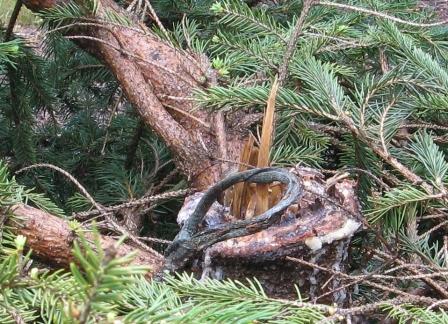
Just a matter of time (Photo: Jennie Stanger)
In this case the stakes were removed but the strapping material was left around the tree. Since this is a spruce, Jennie supposes no one wanted the prickly job of wading into the center of the tree to take off the strap. … Continue reading this article “Brace yourself”
The heartbreak of ‘Carrot-top’ syndrome
The perk of participating in a blog is you get a platform to vent on your pet peeves. Recently I’ve seen several classic examples of ‘Carrot-top’ syndrome. No, I’m not talking about the red-headed comic; though he tends to annoy me too.

Annoying Carrot-top #1.
The ‘Carrot-top’ I’m referring to occurs when white pine trees are sheared as Christmas trees but then planted as landscape trees. The typical result is that the side and lower branches remain suppressed while the terminals go crazy. … Continue reading this article “The heartbreak of ‘Carrot-top’ syndrome”
Spring fever: Conifer style
We finally got a reprieve from our wet, cold weather. Just in time for the annual inspection of the conifer troops at the Harper Collection of Dwarf and Unusual Conifers at MSU’s Hidden Lake Gardens. One of the interesting things about making repeated trips to a conifer collection like this is that different conifers stand out each time. Whether due to lighting, background foliage, your mood, whatever; it seems like there are different stars each time.… Continue reading this article “Spring fever: Conifer style”
Finding agreeable things not sought for
As a graduate student at the University of Georgia many years ago I took a course in research methods. One of the discussions that stuck in my mind all these years centered on the word ‘Serendipity’. The classic definition of the word is “the faculty or phenomenon of finding valuable or agreeable things not sought for.” As scientists we rely heavily on the scientific method as a systematic method of inquiry to make new discoveries. But we also need to need to keep our eyes and minds open to serendipitous discoveries along the way as well. … Continue reading this article “Finding agreeable things not sought for”
Spin Cycle
The issue of potential damage to conifers by the turf herbicide Imprelis continues to get a lot of air play in this neck of the woods. One of the interesting things about watching an emerging story such as this is watching some of the sideshows that go on around it and how people spin the issue to match their needs and agenda.
Example 1:
Heritage Lawn Care Company put out flyers in neighborhoods in southeast Michigan with affected trees to promote their service. … Continue reading this article “Spin Cycle”