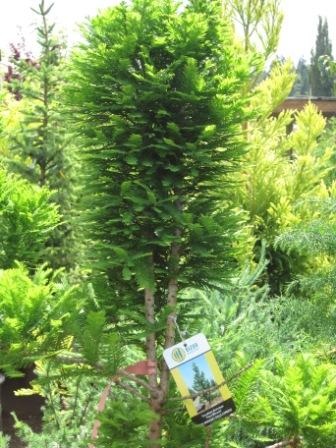
Go sport fishing at your local nursery

Regular fishing, for actual fish, is quite possibly the second most boring think ever invented (First place, of course, goes without question to baseball) but sport fishing! Now THAT is something I can get behind.

By sport fishing I mean, of course, looking for sports – chance mutations – in plants. Sometimes a flower color changes, or sometimes a leaf becomes variegated, like on this lilac branch I found at a friend’s nursery a couple years ago

variegatedsyringa

Nurseries are great places to go “fishing” for these sports, simply by walking down the rows of plants looking for anything odd or out of place.… Continue reading this article “Go sport fishing at your local nursery”
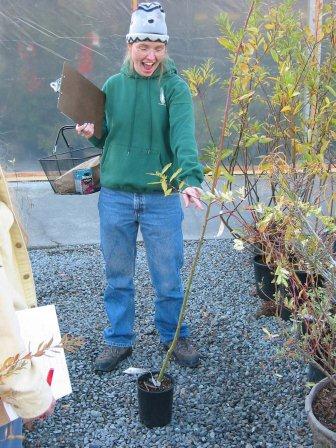
Buying locally-grown plants

Of course we want to buy locally-grown plants! There are a gazillion sound reasons to do so.  In a paper that may be from near here, or not, I perused the gardening column over Sunday coffee, written by (a human) (name withheld to protect the very, very nice and usually accurate author). But in this particular article, the writer ventured deep into huh? territory.

And that territory is my area of expertise: nursery and greenhouse production and marketing.… Continue reading this article “Buying locally-grown plants”

A Real, Live, Learning Experience

What a crazy spring! But it finally, finally came here to the Blue Ridge Mountains (Linda Chalker-Scott refers to them “speed bumps”).

My Ornamental Plants Production & Marketing class has been at work since early February, growing plants and marketing them at the Hort Club Plant Sale as part of their lab experience.  Of course, they are completely at my mercy as to what they get to grow (bwuhh ha ha *evil hand wringing*). … Continue reading this article “A Real, Live, Learning Experience”

You don’t have to be crazy to work here, but it helps

Recently I spent a week in Oregon working on a Christmas tree genetics project along with my colleagues Chal Landgren( Oregon State University), Gary Chastagner ( Washington State University), and John Frampton (North Carolina State University).  The objective of the project is to identify superior seed sources of Turkish fir and Trojan fir for use as Christmas trees around the United States.   We refer to the project as the Cooperative Fir Genetic Evaluation or CoFirGE – remember, the most critical step in any experiment is coming up with a catchy acronym.    … Continue reading this article “You don’t have to be crazy to work here, but it helps”

When all else fails…

As someone who has had a foot in Horticulture and a foot in Forestry throughout most of my career, people often ask me to compare the two disciplines.  One of the truisms that applies in both cases is, “When all else fails, blame the nursery.”  I’ve seen this following seedling die-offs in industrial forest plantations and I’ve seen it many, many times after street tree or landscape planting failures.  In fact, if you believe some people, tree nurseries are responsible for every plague and pestilence to ever afflict mankind. … Continue reading this article “When all else fails…”

Plant containers – does size really matter?

A few days ago I got a question from Cynthia about “potting up.”  For those of you for whom this is an unknown phrase (and no, it’s not a euphemism for a certain herbal activity), it refers to the practice of moving plants into ever larger containers.  She was wondering if there was any “real science” behind the practice – in other words, why not just start out with a larger container?

Hah! I needed no further encouragement and spent several days collecting and reading decades’ worth of research.… Continue reading this article “Plant containers – does size really matter?”

Time for another WOW (Why oh why)!

During my nursery visits this summer I came across Taxodium distichum ‘Peve Minaret’, a dwarf cultivar of bald cypress.  I hate it:

Why? Because it’s a crummy specimen. If it’s not quite clear, here is a close up of the double leader:

I’ve ranted a couple of times about the production nursery practice of topping young trees to create fuller crowns (you can see those posts here and here). I’m constantly taken to task for this, with comments along these lines:

1) There’s nothing wrong with it.… Continue reading this article “Time for another WOW (Why oh why)!”

W.O.W. (aka Why oh why do nurseries sell this plant)?

Since we’re back on the alien train (spaceship?), I thought I’d bring up another of my least favorite shrubs – Scots broom – as our next installation of WOW (why oh why?).

Scots (or scotch) broom (Cytisus scoparius) is a much-reviled intruder in the western and eastern United States.  Originally introduced as a sturdy ornamental, this legume quickly invaded disturbed areas and is labeled as a noxious weed in several western states.  In Washington, it’s quarantined. … Continue reading this article “W.O.W. (aka Why oh why do nurseries sell this plant)?”

Where to draw the line on a vine

Last week’s column on “why do nurseries sell this plant?” struck a chord with many readers as well as with Holly!  So here is this week’s submission:  that ubiquitous vine, English ivy.

First of all, we’ll stipulate than many ivies are sold as English ivy (Hedera helix) but may be entirely different species.  Genetic research on invasive ivy populations in the Pacific Northwest identify most as H. hibernica (aka Atlantic ivy), with H. helix making up only 15% of the invading populations. … Continue reading this article “Where to draw the line on a vine”

Why do nurseries sell this plant?

I wish I were more like Holly…wandering around nurseries finding pretty and unusual annuals and perennials to get excited about.  Instead, I seem to gravitate to plants that annoy me.

Today while looking for some trellises (for those containerized Clematis vines that I’ve been torturing) I saw pots of the Equisetum hyemale (“a tall, evergreen, spreading, reed-like grass”) for sale:


As readers of this blog surely know, Equisetum spp. – or horsetails – are not grasses but primitive relatives of ferns. … Continue reading this article “Why do nurseries sell this plant?”