
Love notes of genetics and physiology for Valentine’s Day

Ahhh….’Tis the time of year when we celebrate romantic love in homage to a 3rd Century priest who came up a head short for performing unsanctioned Christian weddings.  (It is also of note that St. Valentine, or Valentinius as his friends called him, is the patron saint of bee keepers but, strangely, not of birds, flowers, or trees).

In celebration, many suitors, partners, spouses, fling-seekers, and woo-wishers will flock to florists, grocery floral counters, and even gas stations to purchase flowers, namely roses, that have likewise been beheaded.… Continue reading this article “Love notes of genetics and physiology for Valentine’s Day”

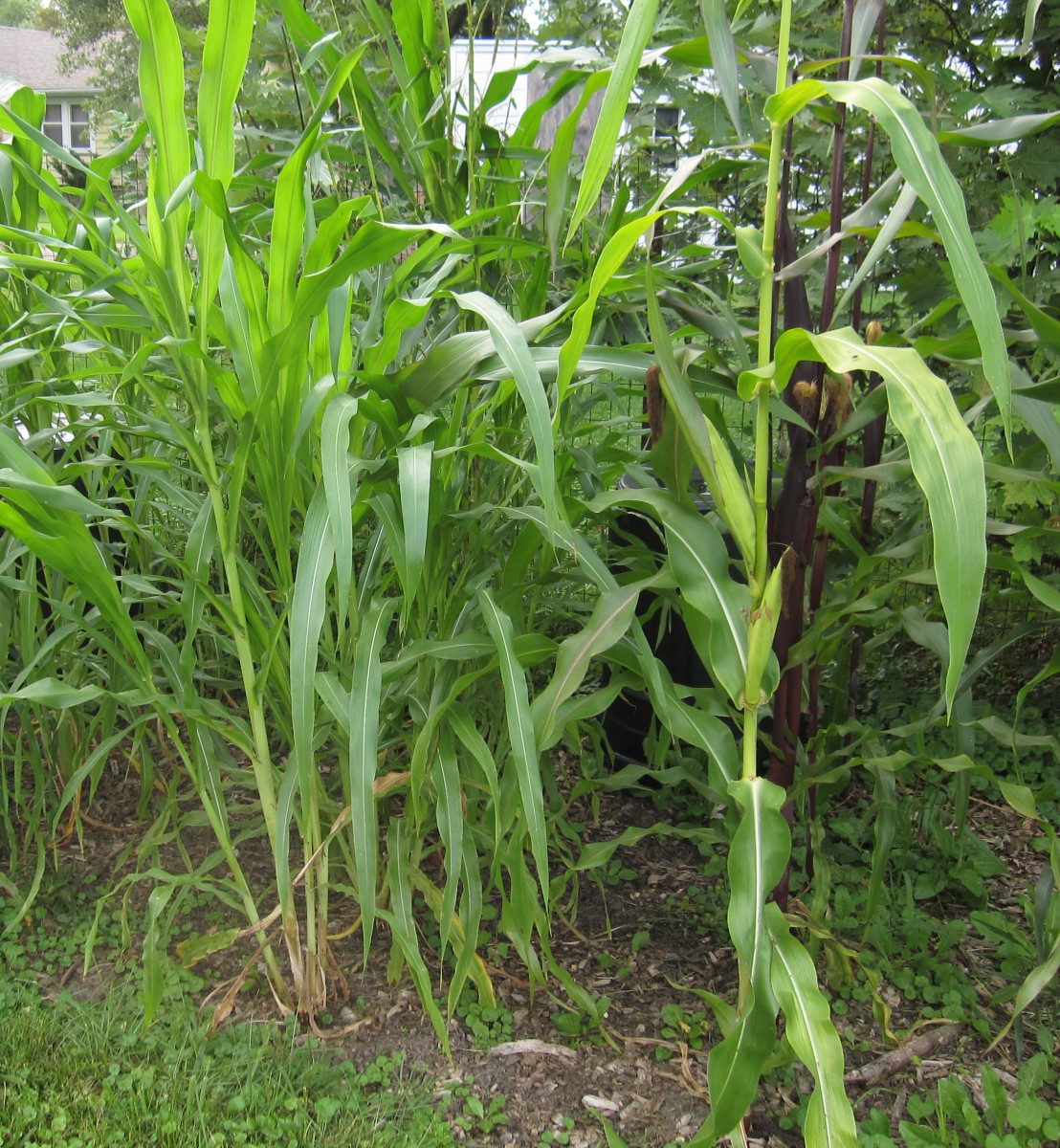
Corny Ancestry

I love growing weird plants, and I’m endlessly fascinated by plant breeding and the extreme transformations humans have made in our crop plants over the history of agriculture.

Which is why growing teosinte, the wild ancestor of corn, was a no brainer. Even before I planted it, comparing the seeds is fascinating. teocornseed

Once growing you can see the similarity. Teosinte is on the left in the picture below, corn on the right.

teocorn

The most dramatic difference between the two, I think, is the “ear” of teosinte, which is nothing more than a thin sprig of half-a-dozen seeds.… Continue reading this article “Corny Ancestry”

Jumping genes!

This spring, I noticed this striped flower in a stand of feral Hesperis matronis
hesperistransposonStripey flowers! And like almost all striped flower variants, almost certainly caused by transposons, aka jumping genes.

To understand transposons, you can think of genes as instructions. So when making a flower, a plant may be following a gene that says:

MAKE PURPLE PIGMENT

And so it does, and the flower is purple.

You can think of a transposon as a gene that says:

COPY ME!Continue reading this article “Jumping genes!”

Infographic with a BIG grain of salt

Infographics can be great: They’re bright colorful ways to make sometimes complex concepts visual and easy to understand. Sadly, “easy to understand” does not necessarily equal “accurate” and they can also be extremely misleading.

Take this beautifully made image from National Geographic. It is an older image — first posted back in 2011, but it makes the rounds on social media from time to time, and popped up in my facebook newsfeed a couple days ago.… Continue reading this article “Infographic with a BIG grain of salt”

Cross-pollination making you cross?

No, your cucumbers have not hybridized with your melons.

I’ve been fielding different versions of the same question a LOT lately.
Three different people have sent pictures of “cucumelons” telling me they planted cucumbers next to their melons, and now the cucumbers look strange, so they’re concerned that they have cross pollinated with the melons. One person planted what was supposed to be a red raspberry next to their yellow raspberry, but the new plant is producing yellow fruit, so they think that it must be cross pollinating with their yellow plant, causing the fruits to turn yellow.… Continue reading this article “Cross-pollination making you cross?”

You don’t have to be crazy to work here, but it helps

Recently I spent a week in Oregon working on a Christmas tree genetics project along with my colleagues Chal Landgren( Oregon State University), Gary Chastagner ( Washington State University), and John Frampton (North Carolina State University).  The objective of the project is to identify superior seed sources of Turkish fir and Trojan fir for use as Christmas trees around the United States.   We refer to the project as the Cooperative Fir Genetic Evaluation or CoFirGE – remember, the most critical step in any experiment is coming up with a catchy acronym.    … Continue reading this article “You don’t have to be crazy to work here, but it helps”

News flash – genes don’t explain everything!

Last week dedicated blog follower Ray E. sent me this link to a story in the Smithsonian magazine.  It’s a fascinating look at adaptive responses by frog eggs and apparently is causing quite a stir in the evolutionary biology community.  Phenotypic plasticity, which is the ability of an organism to modify its appearance or behavior based on environmental cues, is being hailed as a “revolutionary concept in biology.”

I don’t get it.

Anyone who’s studied plants for any length of time knows about this phenomenon. … Continue reading this article “News flash – genes don’t explain everything!”

Today in Cucurbit News…

Cucumbers are one of the most widely-grown vegetables in the world.  Baker Creek Heirloom Seeds (a great place to buy unusual and international veggie seeds) lists 51 varieties from North America, Southeast Asia, China, India, Mexico, and Europe.  Dark green ones seem to be in the minority – yellow, white, orange and red skins in shapes round to elongated dominate.

Cukes traditionally have a few nutrients including some Vitamin A from carotenoids and beta carotene, but have never had the reputation as nutritional power house.… Continue reading this article “Today in Cucurbit News…”

A word about GMOs from our visiting GP

I gave a talk to a group of gardeners last year about vegetable and community gardening.  There was a wide variety of gardening experience represented, but one statement from a seasoned gardener bothered me a bit.  And I think my response bothered him a bit too.  I haven’t thought much about it until recently, when a high school English teacher I know told me a student expressed similar ideas in her class.  The erroneous idea from my audience member was this: our tomatoes are being poisoned with ‘germetically modinified’…something something. … Continue reading this article “A word about GMOs from our visiting GP”

Is This Really a Good Idea?

Transgenic plants have been with us for well over a decade now.  I have had the opportunity to work with many of the tools used for this technology, though most of that is far behind me (over 15 years now since I “ran a gel”) — I’m much happier being outside or even in front of a computer writing than in a lab.  Fortunately I have a number of “lab rat” colleagues so I’m relatively up to date on what’s going on and what “gene-jumper” scientists can and can’t do.… Continue reading this article “Is This Really a Good Idea?”