Are Soaker Hoses Safe?

By Cynthia Lee Riskin

With drought predicted for the west, southwest, and south through June 2015 (National Weather Service March 2015), many conscientious vegetable gardeners will try to conserve water by using soaker-hoses, those bumpy black hoses that weep water onto the soil through tiny pores.

Brussel sprouts and red lettuce
Soaker hoses are made from fine-crumb rubber, usually recycled from vehicle tires. Research strongly establishes that tire particles leach heavy metals, carcinogens, and mutagenics, among other toxins. Yet soaker hoses have not been studied for potentially increasing the toxicity of edible plants.… Continue reading this article “Are Soaker Hoses Safe?”
Nature’s Poisons

It’s more than a little bit intimidating to be a part of the Garden Professors team, since I have no advanced degrees, and my undergraduate degree is in Mathematics, with no formal training in Botany, Horticulture or Plant Science at all.

I am, however, an avid and active hobby gardener; I read a lot; and I have a life-long love of learning and sharing what I’ve learned with others, which led to a nine-year stint as a county Extension Educator, implementing a county wide mosquito management program for West Nile, with additional responsibilities for pesticide education and consumer horticulture.… Continue reading this article “Nature’s Poisons”

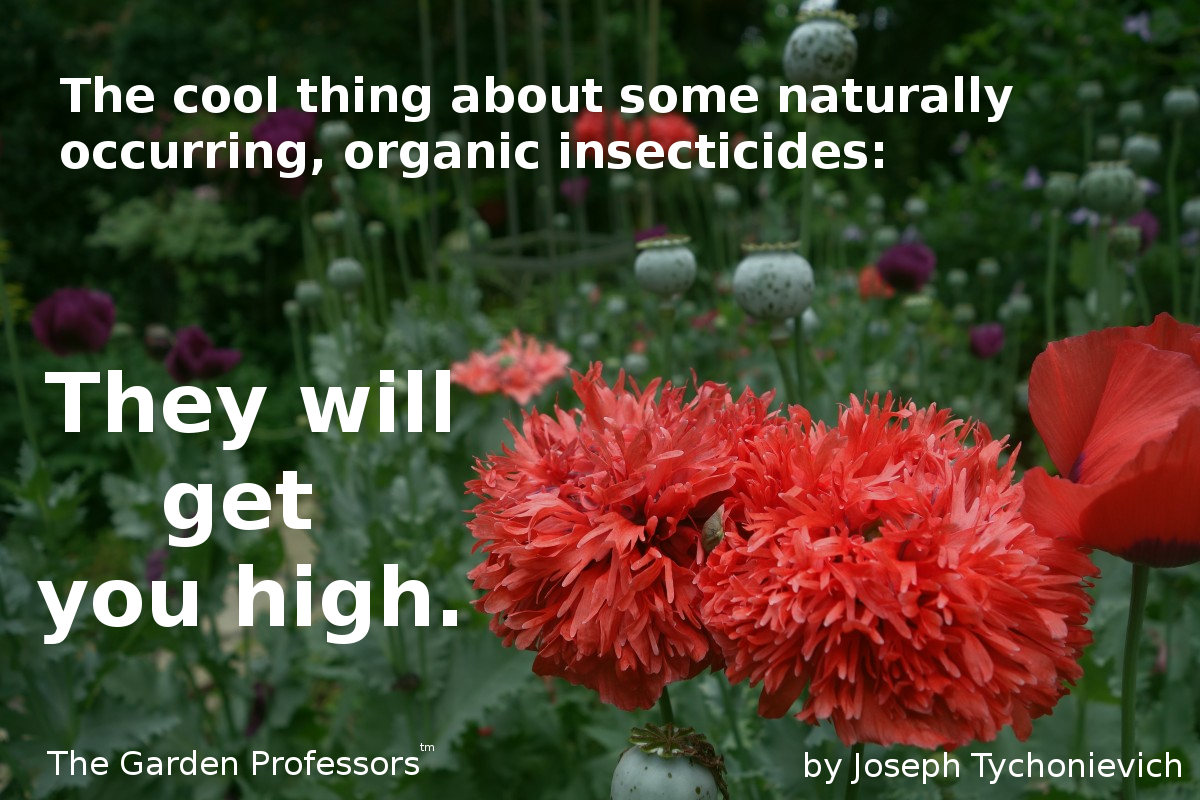
Organic insecticides that will get you high

papaversgetyouhigh

Plants are crazy chemical factories, synthesizing a whole host of compounds that we use for flavoring and dye and medicine and… getting high. And why are they making all these chemicals? They’re certainly aren’t doing it for our sake… no, quite often they’re trying to kill something – usually insects — and it just so happens that sometimes our brains and bodies react differently enough that instead of killing us, they make us high. Well, and sometimes they kill us too.… Continue reading this article “Organic insecticides that will get you high”

Rubbing salt into wounds

Last week I posted about some horticultural disasters I witnessed in the Czech Republic.  This week the chamber of horrors is little closer to home; virtually in my back yard to be specific.  Our property backs up to US 127, the main North-South through route in our area.  It’s a limited access highway with a posted speed of 70 mph, which means an average speed of 82.7 mph.  It also means the road is regularly salted whenever it snows during the winter.  … Continue reading this article “Rubbing salt into wounds”

The invisible, insidious presence of heavy metals

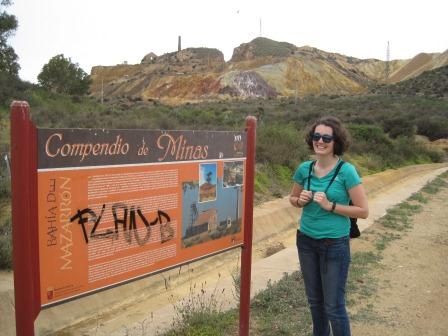
I spent the last two weeks in Spain, combining business with pleasure.  It’s interesting when something that starts out as part of the pleasure ends up being business instead.


Charlotte translated this sign for me – it’s historical information. Note the brightly colored mine tailings in the background.

My daughter is teaching English in Mazarrón, a small town in the province of Murcia. The climate there is very similar to southern California, though drier and not as warm: it’s pretty much a scrubland ecosystem.… Continue reading this article “The invisible, insidious presence of heavy metals”

A Note To Horse Owners

Every once in awhile I get to work with really, really cool people who do really, really cool work.  This is one of those times.  About a year ago I received a message from Dr. Stephanie Valberg, a Professor over at the University of Minnesota’s Equine Center.  It seems that she was interested in looking at a deadly disease called Seasonal Pasture Myopathy which she thought might have something to do with horses ingesting maple leaves. … Continue reading this article “A Note To Horse Owners”

Toxic mulch: When shredded bark goes bad

We typically think of mulching landscape beds as a good thing.  And it usually is; helping to conserve soil moisture, reducing soil temperatures and contributing to soil organic matter.  Recently, however, I received an e-mail from a local landscaper that reported severe damage to annuals and perennials in a landscape bed immediately after applying hardwood mulch.  The problem, sometimes referred to as ‘sour mulch’ or ‘toxic mulch’, occurs when mulch is left is large piles and undergoes anaerobic conditions. … Continue reading this article “Toxic mulch: When shredded bark goes bad”

Sunday Bloody Sunday

Is this title too extreme?  I’ll leave that up to you.

Most of you are aware of the frog controversy that surrounds Round-up.  A few years ago a professor from Pittsburgh showed that this chemical can kill aquatic creatures if it gets into a pond. Particularly tadpoles.  Not that Round-up is intended to be used around water, but still, it is a concern and I don’t want to minimize it.  Nor do I want people to forget that other supposedly safer products have their own set of dangers.… Continue reading this article “Sunday Bloody Sunday”

Out of the lead frying pan and into the phosphate fire

A recent NYT post reports that adding fish meal to lead-contaminated soils will cause the lead to bind to phosphate found in fish bones.  As the article explains, this chemical reaction results in the formation of pyromorphite, “a crystalline mineral that will not harm anyone even if consumed.”

Given my concerns about excessive phosphate loading in urban soils, I contacted Dr. Rich Koenig, an urban soil scientist and chair of WSU’s Crop and Soil Science department. … Continue reading this article “Out of the lead frying pan and into the phosphate fire”

Read and follow label directions…

Every extension specialist or educator that mentions any kind of pesticide in a talk or article always includes the disclaimer ‘Read and follow all label directions.” However that caveat ranks somewhere between “Your seat cushion may be used as a flotation device” and “Do not remove tag under penalty of law” as the most ignored phrase in the English language. While we can probably rationalize ignoring the last two (If a jetliner ditches in the middle of the Atlantic is a seat cushion really going to save you? … Continue reading this article “Read and follow label directions…”