Pigmented Mulch in Paradise

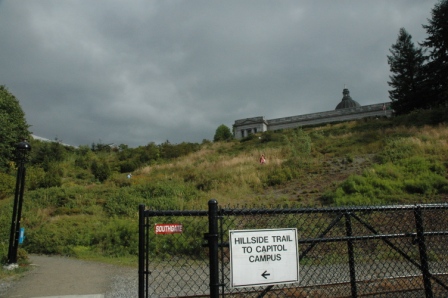
Just back from a quick vacation to Little Cayman island.  Truly a dot on the map – the whole island is about 7 miles long and a mile wide. Only 150 locals and a couple hundred tourists are on island at any one time.  It’s beyond laid back, with few attractions other than the resident iguanas and red-footed boobies (booby jokes abound).

Airport terminal/post office/fire station.

The big draw is diving – LC is the home to Bloody Bay Wall, one of the most famous dives in the Caribbean. … Continue reading this article “Pigmented Mulch in Paradise”
Need a lift?

One of the topic groupings for our posts is titled ‘Cool research’.  The subject of today’s post has actually been around for a few years but I still think it’s pretty cool.


When we think of interactions between plants we usual think of negative interactions such as competition for water and nutrients or maybe allelopathy.  But there are cases where plants can benefit each other.  One of these is a phenomenon known as hydraulic lift.   Continue reading this article “Need a lift?”

Crazy Tree Revealed

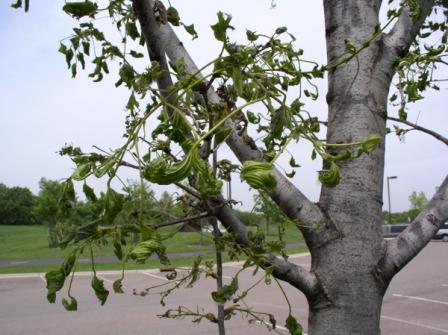
Matt had it right — the tree was indeed an ash — and did not die of its exposure to herbicides — but it did look pretty bad for a year!

Why bother having trees?

Sorry to be late with my post this week – I was away reviewing grant proposals.  It was interesting and useful work, but really drains your brain.  So with that being said, my post is long on pictures and short on words.

One of the things that bugs us GP types is poor plant placement.  Why bother planting a tree if you’re not going to allow it to grow naturally?  Here are some photos to mull over the weekend. … Continue reading this article “Why bother having trees?”

What the Heck Is This?

Thought I’d throw up a quiz today.  In the work that I do I frequently see trees and other plants damaged by herbicides.  The plant in the picture below was accidentally hit with an herbicide very similar to 2,4 D, but one that is not currently labeled for general landscape use (clopyralid). Can you guess what type of tree it is?

Balanced Fertilizer and Peak Phosphorus

When I first started reading extension recommendations for plants around 15 years ago now, I read a lot about “balanced fertilizers”.  Today I still see balanced fertilizers recommended, but not nearly as frequently, which is a good thing.

At this point you may be asking yourself “what is a balanced fertilizer?”  A balanced fertilizer is one that has three numbers on its label which are the same — such as a 10-10-10 or a 14-14-14 (Nitrogen, Phosphorus and Potassium are the three nutrients indicated by
these numbers). … Continue reading this article “Balanced Fertilizer and Peak Phosphorus”

Restoration ecologists – you need us! Part 2.

Last month Linda posted on the need for horticultural knowledge for those trying to restore native habitats or at least establish native plants. There seems to be a pervasive notion that if we plant natives all we have to do is stick them in the ground and walk away. They’re native, right?  Don’t need irrigation; don’t need fertilizer; all that good jazz.   Well, often there is lot more to it than that.


A case in point. … Continue reading this article “Restoration ecologists – you need us! Part 2.”

Icky Friday puzzle solved


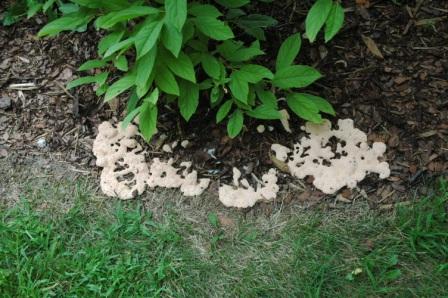
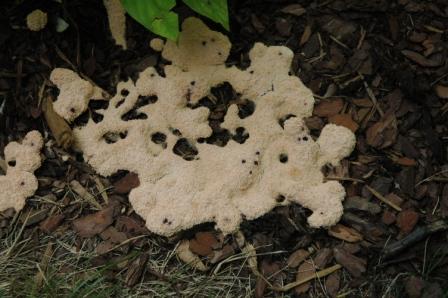
OK, now we know why we usually leave the puzzles to Linda: mine are too easy!  As several folks correctly noted the photo in my yard was an example of the "dog vomit fungus" or, more correctly "dog vomit slime mold" Fuligo septica.  Either way, it’s fairly disgusting and fairly common.  My expereince has been it that it often shows up shortly after I lay dowm some fresh mulch (ground pine bark in this case) and then we get rain and warm temps. … Continue reading this article “Icky Friday puzzle solved”

Friday puzzle time

Was on the road earlier this week and missed my regular post.  Thought I would slide in here with a Friday puzzler.  This one is from my very own yard last week.  Know what it is?

Almost But Not Quite

Today I was reading an interesting gardening website with a wide variety of advice, some good and some not so good.  As I analyzed the website in my mind to figure out why some stuff was good and some stuff was bad it occurred to me that the problem was that a lot of the stuff that the author was recommending was based on testimonials.  And then it occurred to me that many of you out there might not know what a testimonial is and why recommendations based on testimonials shouldn’t be recommended — and then viola!… Continue reading this article “Almost But Not Quite”