Stuck in the middle with you

Clowns to the left of me,

Jokers to the right, here I am,

Stuck in the middle with you


More than once in the past couple months I’ve come close to pulling the plug on FaceBook.  What started as a fun and easy way to keep up with family and friends back home and stalk old girlfriends has devolved into an infinite do-loop of whininess, acrimony and vitriol over GMO’s, organic food, vaccines, and President Obama. … Continue reading this article “Stuck in the middle with you”
Spec errors mount

For years I subscribed to Consumer Reports. I appreciated their objective approach to product testing and lack of advertising. In their own words, their policy is to “maintain our independence and impartiality… [so that] CU has no agenda other than the interests of consumers.” But recently they’ve veered off the science-based trail – at least the one running through our gardens. Their approach to plant and soil sciences is more pseudo than science. And last year, after 30+ years of loyal membership, I quit my subscription when Consumer Reports began partnering with Dr.… Continue reading this article “Spec errors mount”

Go ahead, weed, make my day…

Ridding an ecosystem of invasive plants is never easy. We can bring in goats to munch on offending plants or force armies of schoolchildren into slavery to pull them out; but, in all likelihood the sneaky little devils (the invasive plants, not the schoolkids) will be re-sprouting and back with a vengeance before we can turn around. For many invasive plant infestations the most practical long-term solution is chemical control – in other words, herbicides. Of course, herbicides have their issues such as drift and potential impacts on non-target plants.… Continue reading this article “Go ahead, weed, make my day…”

WARNING: This post contains graphic content

As many of you know, numerous homeowners and golf courses in the Midwest experienced substantial damage to trees, especially conifers as a result of application of Imprelis, a new turf herbicide that was released by DuPont in fall 2010.   If you do a google image search for ‘Imprelis’ you can see lots of photos of the typical damage we observed in summer 2011, when most Imprelis damage became apparent.  The usual symptom of Imprelis exposure were brown, twisted and stunted shoots or trees killed outright.… Continue reading this article “WARNING: This post contains graphic content”

New study on pesticide use and GMOs

Some environmental extremists discount agricultural research done by universities, because they receive funding from Big Ag and therefore their researchers can’t be trusted. So this news report of a recent study by one of my Washington State University colleagues is doubly important: it dispells this baseless assertion and it provides some significant – and troubling – information about pesticide use and GMO crops.

Briefly, the article links an increased use of herbicides as a result of increased use of GMOs such as Roundup-ready crops.… Continue reading this article “New study on pesticide use and GMOs”

My Thoughts on 2,4 D


My sister, who lives in the Pittsburgh area, just gave me a call.  She and her husband have two kids and a lawn and she wanted to know my feelings about using herbicides to keep the grass free of weeds.  When we were growing up our parents had a large lawn (and lots of fruit trees) and it took two of us two hours to mow the whole thing.  It kind of turned her off to grass. … Continue reading this article “My Thoughts on 2,4 D”

So…How Much Pesticide Is Actually In Our Fruits and Veggies?

We have discussed the dirty dozen here before – those foods which a group called The Environmental Working Group (wow—fancy name – everything they say must be true!) has established contain more residues of different pesticides than other foods.  I’ve already stated my concerns about selecting organic foods instead of conventionally grown ones because of a fear of pesticides so I won’t restate that here.  Instead what I want to call your attention to an article sent to me by our visiting professor, Charlie Rowher. … Continue reading this article “So…How Much Pesticide Is Actually In Our Fruits and Veggies?”

The New Evidence Against Glyphosate

This past week Susan over at Garden Rant asked me about a paper which she had recently read which “proved” that Round-up caused birth defects.  This study was interesting because it took embryos of chickens, exposed them to glyphosate (the active ingredient in Round-up) and then looked at the problems which the embryos had.  Indeed, there were problems at concentrations of glyphosate much lower than what you’d see in normal agricultural applications.  This is similar to other studies which “prove” how toxic glyphosate is which have been conducted over the years where various types of cells have been removed from human bodies, exposed to glyphosate, and then the resulting cellular damage has been taken as an indication that this herbicide is incredibly dangerous to us.… Continue reading this article “The New Evidence Against Glyphosate”

How to Kill Buckthorn

Last year we completed a small research study on how to kill buckthorn.  If you live in the upper Midwest then you’re familiar with this plant as a shrub which has escaped cultivation, been spread by birds, and generally made a nuisance of itself, particularly at the edges of forested land.

Buckthorn is notoriously difficult to kill after it gets more than about a foot high.  It laughs at single applications of roundup. If it’s pulled out of the ground any roots that don’t come with it have a good chance of sprouting shoots themselves, and it seems to enjoy being treated with organic herbicides like vinegar. … Continue reading this article “How to Kill Buckthorn”

What the Heck Is This?

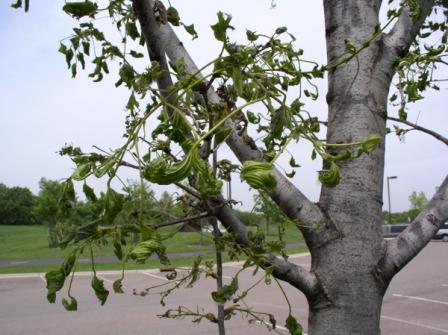
Thought I’d throw up a quiz today.  In the work that I do I frequently see trees and other plants damaged by herbicides.  The plant in the picture below was accidentally hit with an herbicide very similar to 2,4 D, but one that is not currently labeled for general landscape use (clopyralid). Can you guess what type of tree it is?