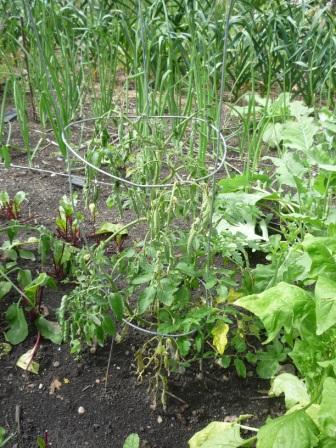
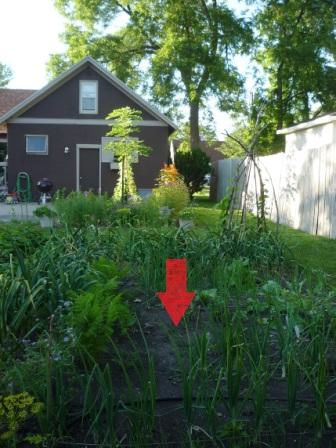
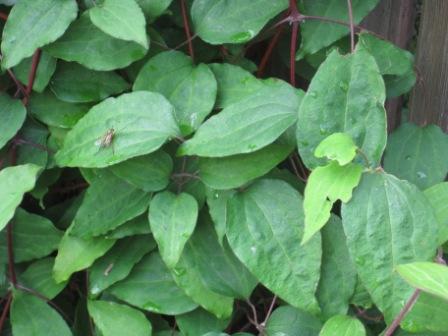
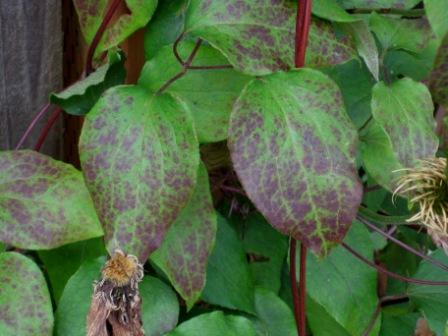
Well, Dr. Rohwer was right – he thought you’d get this more easily than I did! Ray and Jon were spot on – this is classic juglone toxicity from those walnut trees (Juglans spp.) you see in the background. Many of these leaves ended up on the roof, leaching into the rain barrels (good sleuthing Ray and KennyG!), the water in which was used in irrigating the vegetable garden. In fact, Dr. Rohwer divulged that the rain barrel water was quite brown from the walnut leaves. Thus, the tomatoes met an unhappy end, because tomatoes definitely do not love walnuts.
Juglone toxicity, an example of allelopathy, is an interesting phenomenon – it does not affect all plants equally. In fact, this clue was given in the puzzle, when Dr. Rohwer mentioned the "garlic and carrots, amongst young beets, onions, kohlrabi, and bolting radishes and spinach" also in the garden. Many of these vegetables are known to tolerate juglone, as are various landscape plants. (There is an excellent publication from Purdue on juglone toxicity with lists of tolerant and sensitive species.)
Juglone is most prevalent in the nuts, roots and leaves of walnut trees. This makes sense: germinating walnut seeds and expanding root systems are both able to kill their competitors, retaining more resources for themselves.
Juglone tends to be less of a problem for established trees and shrubs, as their root systems are more extensive; seedlings would be the most sensitive stage. And walnut wood used as part of a wood chip mulch has not, as far as I know, been shown to cause juglone toxicity in landscape plants.