David Hobson, a garden columnist, sent me this great photo of his petunia planted earlier this year. Take a look at the root growth (or lack thereof):

David Hobson, a garden columnist, sent me this great photo of his petunia planted earlier this year. Take a look at the root growth (or lack thereof):

As someone who has had a foot in Horticulture and a foot in Forestry throughout most of my career, people often ask me to compare the two disciplines. One of the truisms that applies in both cases is, “When all else fails, blame the nursery.” I’ve seen this following seedling die-offs in industrial forest plantations and I’ve seen it many, many times after street tree or landscape planting failures. In fact, if you believe some people, tree nurseries are responsible for every plague and pestilence to ever afflict mankind. … Continue reading this article “When all else fails…”
This week I discovered that one of our center’s landscape trees is ready to bite the dust. I was sad – but also happy. It’s a wonderful teaching moment and if the tree has to give up its life to save others, I guess that’s okay.
As the video will show you, this Japanese maple was planted some years ago with a root circling the trunk. As both the trunk and root have developed in girth, we’ve reached a point where the trunk is constricted and the weight of the tree is splitting this V-shaped specimen down the middle just like a turkey wishbone. … Continue reading this article “Why it’s important to prune tree roots before planting”
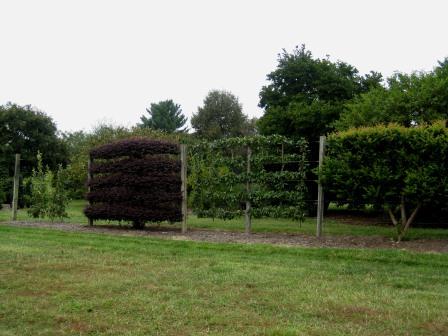
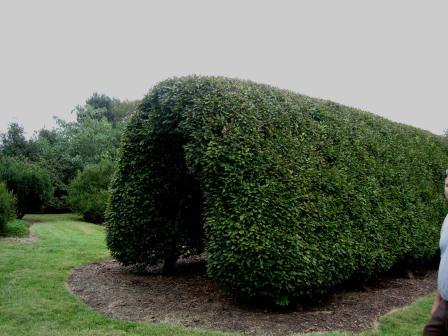
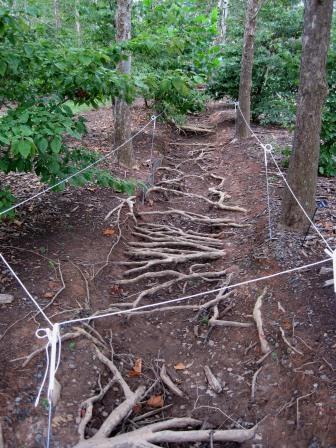
This week I’m in Charlotte, NC as a guest of Bartlett Tree Experts. In addition to providing tree services, this company also maintains the Bartlett Tree Research Laboratories and Arboretum. The latter includes over 300 acres of tree collections and ongoing research trials. Here’s a sampling of the tree research we had a chance to observe:

Demonstration espalier pruning…

…and pleaching

Comparison of root barrier materials. This area was covered with a sidewalk for a number of years and then exposed to observe tree rooting patterns. … Continue reading this article “An unusual company”
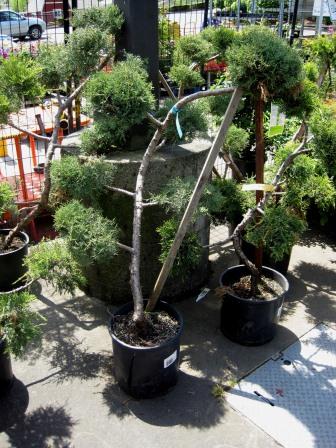
I’m going along with the “dead tree” theme of the week, but doing a little prognosticating at the same time. Bert and Holly showed you tree demise on site; I’m going to show you tree demise in the making. We can call this “dead plant walking.”
I’ve done a few WOW postings in the past, often with a focus at what you might find at a nursery or big box store. Here’s a recent find at an unnamed BBS, in the “topiary” section:

Unless you intend to have a giant stake as part of your topiary statement, this tree (actually a juniper) will morph into a prostrate form before your very eyes. … Continue reading this article “WOW again (Why oh Why?)”
I get a lot of questions about a lot of different products and practices. New topics send me to the scientific data bases and that’s where I went for today’s posting. One of my garden writing colleagues asked me about colored glass rooters – glass containers in different colors that can be filled with water and a plant cutting. The conventional internet wisdom, according to my colleague, is that green and blue glass rooters are the best.… Continue reading this article “Does colored glass help root cuttings?”
After getting off to a cool and soggy start, summer has come with a vengeance to Michigan, with heat indices expected to push 100 degrees by Wednesday. Along with warmer temperatures, summer also means our research season is getting into full swing as well. One of our biggest efforts these days involves our project to look at pre-plant storage and handling on shade tree liners.
As many GP blog readers are aware, emerald ash borer (EAB) has dominated the conversation regarding shade trees in the Midwest for the past 6-8 years. … Continue reading this article “Getting to the root of the problem”
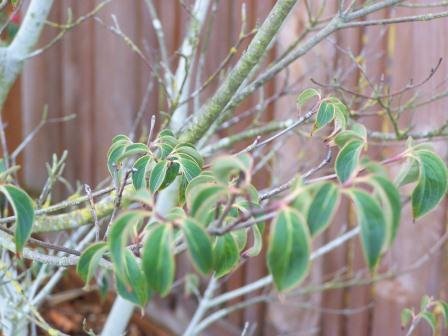
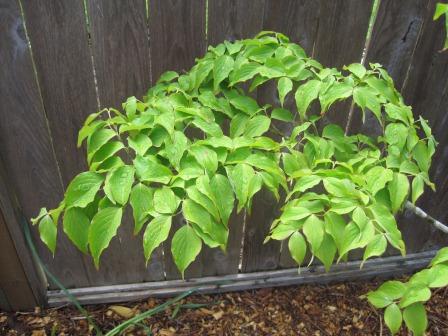
A little more than a year ago I posted a Friday quiz based on a failing Cornus kousa.The answer explained that our landscape has, in part, a perched water table that effectively rotted most of the roots of this poor tree over several years. Last spring we moved it to a different section of our landscape where we know the drainage is better, and I’ve been monitoring its recovery since that time.

Cornus kousa leaves in 2007

Cornus kousa leaves in 2011
We were gratified to see that the leaves this year are significantly larger than those of previous years. … Continue reading this article “Update on root-rotted Cornus kousa”
This has been an exciting week for me. On Monday we started cleaning off 72 rootballs of various tree species that had been planted 5 years ago for a study. These trees had been planted in containers and become potbound at the nursery from which we received them. We treated them in one of three ways. Either we did nothing (in other words we just dropped the pot bound tree in a hole), we used the standard methods that Universities recommend for slicing potbound roots (Four deep slits down the sides and a deeply cut X across the bottom), or we cut off all of the circling roots by cutting the pot bound root system into a box shape.… Continue reading this article “Harvesting an Experiment”
We typically think of trees as the ‘good guys’; they shade our homes and yards, they take up carbon dioxide and pollutants from the air, they give us oxygen. What’s not to like? Well, like a lot of good guys, trees can also have a dark side. One of the more sinister habits some trees have is getting into sewer lines. Some studies estimate that trees are responsible for up to half of sewer line repair costs. … Continue reading this article “When trees attack!”