Imprelis damage to landscape conifers

Herbicide issues seem to be dominating my life these days. Over the past several weeks reports have surfaced around the Midwest of landscape conifers – primarily spruces and pines – that have developed rapid and severe die-back. While there are a host of insect pests and pathogens that can cause die-back in conifers, the recent cases are noteworthy in the speed with which trees expressed symptoms.
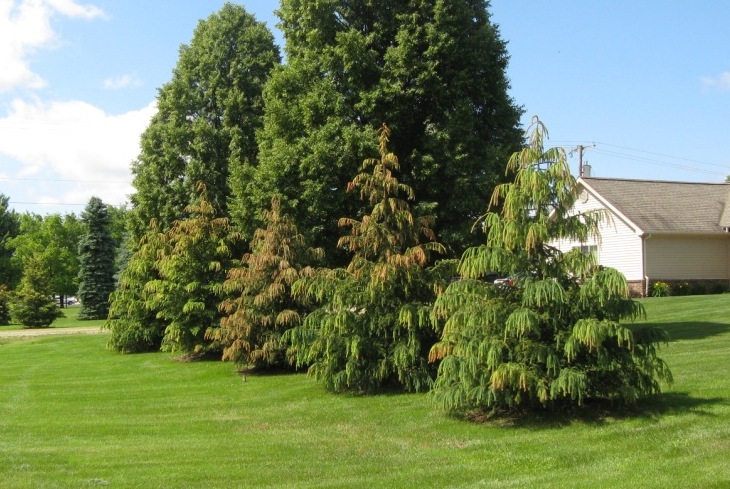
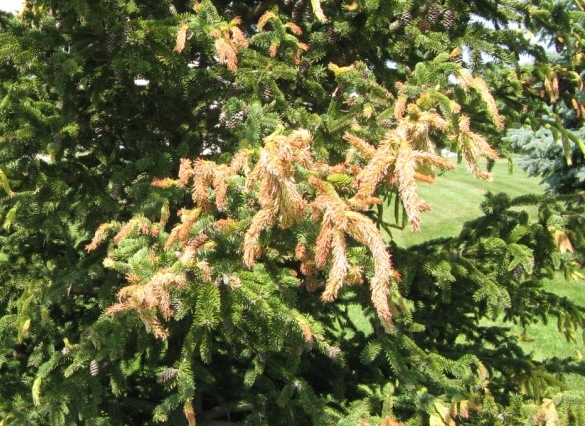


Photos: Andy and Carol Duvall

In many cases that have been reported the common thread appears to be the use of Imprelis, a turf herbicide developed and marketed by Dupont.  … Continue reading this article “Imprelis damage to landscape conifers”

Warning: This blog may be hazardous to your health

Following up on Jeff’s post last week regarding blue spruce.  Jeff noted, and several posters agreed, that even though blue spruce will eventually have a host of pest problems, for the first 10 years or so it’s a darn good looking landscape conifer.  Jeff went on to draw the analogy that choosing a blue spruce is like choosing sexy sports car or gas guzzler over a boring, high MPG sedan.  To a certain extent the libertarian in me agrees. … Continue reading this article “Warning: This blog may be hazardous to your health”

Porsche 911 or Toyota Camry

Earlier today I was in a meeting with some other professionals from across Minnesota (and a few from Wisconsin and other areas) to discuss the disease problems of conifers.  Our discussion quickly became focused on the use, and overuse, of Colorado blue spruce, a tree that just doesn’t do well in Minnesota — Or Michigan from what Bert has written!  Everyone in the meeting was yammering on about how we need to educate nurseries and consumers about how terrible the Colorado blue spruce is in our environment — you’re lucky if you can get 10-15 years out of the thing before it succumbs to one disease or another. … Continue reading this article “Porsche 911 or Toyota Camry”

Landscape conifers: The Good, the Bad, and the Underused

This week is our annual Great Lakes Trade Expo, the main trade show and education venue for Michigan nursery and landscape industry. One of my talks was for the Arboriculture track on landscapes conifers. The theme this year was “The Good, the Bad, and the Underused.” Hey, you try giving a dozen talks a year for 10 years and see if you can come up with an original title!


The selections were based the following, admittedly subjective, criteria.… Continue reading this article “Landscape conifers: The Good, the Bad, and the Underused”

What fir?

OK, it’s the middle of December so I get to indulge my passion for Christmas trees.  One of the most interesting projects I’ve gotten to work on during my time at Michigan State is a study to look at alternative species of firs (Abies spp) for Christmas trees and well as for landscape conifers.  Firs are fascinating trees that are distributed throughout temperate regions of the northern hemisphere.  There are about 50 species, many of which are important for timber, landscaping or Christmas trees.… Continue reading this article “What fir?”

A lawn alternative we can support: Conifers!

As many of the blog readers are aware, I do a lot of writing about conifers.  In the process I mingle with members of the American Conifer Society or ‘ACS’ for short -although some wag has suggested that ACS actually stands for Addicted Conifer Syndrome, such is the devotion of these enthusiasts for their beloved conifers.  A couple weekends ago I was privileged to attend the first ever ACS ‘Illinois Conifer Rendezvous’ hosted by Rich and Susan Eyre, owners of Foxwillow Pines nursery in Woodstock, IL. … Continue reading this article “A lawn alternative we can support: Conifers!”

Love in Broom

Recently, Rebecca Finneran, an MSU Extension Educator from the Grand Rapids area sent me a cool photo.  The tree is a large Norway spruce near the Kent country Extension office.


This is a great example of witch’s broom.  Witch’s brooms are growth anomalies that occur on various trees, most commonly conifers,   Brooms can be caused be a variety of factors including diseases, aphids, environmental stress and random mutations.  In some cases the growth defect is only present when the casual agent, say, a pathogen is present.  … Continue reading this article “Love in Broom”

A rose by any other name…

This past week I got to spend three days doing one of my favorite things; talking about conifers.  Wednesday I was a last-minute guest lecturer for a landscape design class and Thursday and Friday I did my ‘Conifers for Connoisseurs’ talk for our MSU Extension ‘Plants of Distinction’ program.  One of my favorite conifers and one I often recommend as a large specimen tree is Alaska yellow-cedar (the name I learned in Mr. Chance’s Botany class at Olympia High School) or Nootka false cypress (the usual common name for the tree in this part of the world). … Continue reading this article “A rose by any other name…”

And now for something completely different…

From this week’s e-mail file…

“Dear Dr. Cregg:

As I’ve done for many year, this year I harvested my “wild” Christmas  tree from the Huron-Manistee National Forest. I cut the tree at ground level. Soon after I brought it home, it started sprouting new light green clumps of needles at the tips of many branches. Is the tree actually growing? It doesn’t seem possible that it’s still alive, but it seems to be thriving and I hate to toss the tree to the curb if it’s fighting for life.

Continue reading this article “And now for something completely different…”

O Tannenbaum!

Twas the blog before Christmas…  My last chance to post about Christmas trees for another year.  I’m always surprised when I troll around the web or do interviews how many myths about Christmas trees still abound.  So in the spirit of the season, a little Christmas tree myth-busting.


“Good grief.  I’ve killed it.”

Using a real tree hurts the environment
Here’s a real post from the e-how.com website:

“Its so not fair to cut down all those baby trees, use them for a few weeks and then toss them by the curb for garbage removal.… Continue reading this article “O Tannenbaum!”