Valentine’s Day, yet again…

Facebook

We make fun and call it “National Forced Affection Day” (NFAD) around
our house. But it’s big business.

The National Retail Federation did a survey of 8900+ consumers in their 2011 Valentine’s Day Consumer Intentions and Actions Survey They found that the
average person will shell out $116.21 on traditional Valentine’s Day merchandise this year, up 11 percent over last year’s $103.00. Men spend twice
as much as women. Total holiday spending is expected to reach $15.7 billion. The main categories of consumer spending include $3.5 billion on jewelry, $1.6 billion on clothing (didn’t say what kind, heh!), $1.5 billion on candy and $1.1 billion on greeting cards. $3.4 billion will be spent on dining out. With $1.7 billion worth of  flowers sold, it is, by far, the most important (and stressful) holiday for the floral industry, including growers, wholesalers, and florists.

If you do choose to participate in NFAD,  please spend your dollars in the floriculture sector, but take a look at some of the alternatives to red roses.
Plant-based alternatives, that is. You can choose to follow the herd and cough up $39.95 for a dozen scentless, soon-to-be lifeless red roses. Nothing is more depressing than a vase full of roses with bent neck – that signature wilt that indicates water is not making it all the way to the flower – usually due to a bacterial clog in the pipes.

Alternative: for $19.95, thrill him/ her with a lovely Phalaenopsis (moth orchid) to grace a desk or windowsill. Now, I’ve killed my share of orchids, but this symbol of your affection will last a LOT longer than roses with just a bit of care (indirect light and do not overwater!).


from www.orchidweb.com

Or perhaps a florist Cyclamen – comes in all the requisite VD colors of pink, white, and red. Really tough little plants – if you forget to water them for several weeks, they’ll often just go dormant. Let them rest for a while longer, pull off the dead leaves, and commence reviving them with frequent waterings and a little bit of fertilizer – they will bloom again.

Just some suggestions for those so inclined.  Alas, I know what I’ll be getting…squat, with a big red bow.
Facebook

Is local always better?

Facebook

As those that have followed the blog for awhile are aware, among my pet peeves are some of the naïve statements that are repeated ad nauseam by proponents of native plants for landscaping. You know the usual litany: natives don’t need water, don’t need fertilizer, resistant to insects, resistant to diseases, yada, yada… According to the dogma, native plants possess these traits because they’ve evolved here and they belong here. I hasten to point out; I have nothing against natives and think we ought to plant more of them whenever they are an appropriate choice.  The problem, of course, with the typical native company line is that these statements are so obviously nonsensical they undermine the credibility of native plant advocates. Adaptations to resist environmental stress, for example, are a function natural selection and evolution. There are lots of droughty environments in the world; why should we assume that only local plants will be adapted to drought? Then there is the obvious problem of disturbed environments. Why should we assume that trees that have evolved in native woodlands will be good street trees?  In fact, often they’re not.


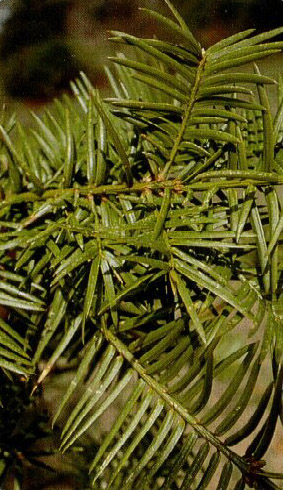
Torryea taxifolia

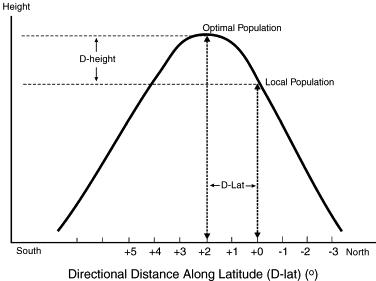
But a new and potentially contentious argument is emerging in the ‘Is native better?’ discussion:  Assisted migration.   The basic premise of assisted migration (also referred to as assisted colonization) is that climate is changing faster than many organisms, especially long-lived organisms like trees, can evolve.  Therefore to prevent species extinctions we should pro-actively move species (typically northward in the Northern hemisphere) so they will be in a better place as the world gets warmer.  Sound far-fetched?  Some of this is already occurring.  In Florida a group called the Torreya Guardians has already taken it upon themselves to establish populations of a threatened conifer, Torreya taxifolia, in the southern Appalachians, outside of its native range in the panhandle of Florida. http://www.torreyaguardians.org/  In British Columbia, the provincial forest service is beginning to incorporate climate change scenarios into its tree improvement and development plans; trying to identify seed sources and species adapted to climates predicted throughout the 21st century.http://www.msnbc.msn.com/id/32012170/ns/us_news-environment/


Is local better?  Foresters often see significant growth gains by moving seed sources northward.  Will climate change increase this effect?

Clearly assisted migration is a controversial topic fraught with all kinds of uncertainties.  Is climate really changing?  How fast will it change?  What about unintended consequences?  Could the assisted species out-compete a local species that would’ve been OK otherwise?  And then there are those who might wonder aloud about the hypocrisy of embracing species movements when they’re done by conservation biologists but not by horticulturists.

Facebook

Friendly firs follow-up

Facebook

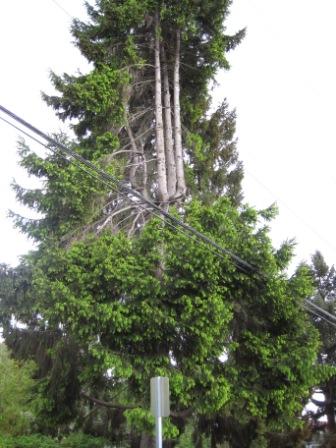
Looks like I was too easy on you Friday!  Most of the you correctly noted that this “devil’s fork” is most likely the result of topping by a human or nature:

Devil's fork

Given that there are powerlines nearby, and more importantly a view to the water downhill, it’s likely that someone deliberately headed this Douglas fir (Pseudotsuga menziesii) back.  On the other hand, this species will commonly lose branches, and often their leaders, in a windstorm.

In any case, a tree that’s been topped and not correctively maintained is an invitation to disaster, and indeed this tree has sent up numerous new leaders.  With the proximity of houses, roads, powerlines, etc., it’s a classic hazard tree.  It’s too late to train the tree to a single leader, and the best long-term strategy would be to remove it completely and replace it with a species more appropriate for tiny urban landscapes.

Facebook

Cold enough for ya?

Facebook

Like many people we spent the past couple days digging out from the massive snowstorm that swept across a large swath of the country.  This was definitely a made-for-TV-weather event as national and local TV weatherfolks took up their positions and gave us breathless live-remotes of the “Blizzard of 2011”.

40 mph wind + 1 little crack = a barn full of snow.

Almost as predictable as video footage of snow-ploughs on the streets and locals snow-blowing sidewalks; climate change skeptics are using the recent round of winter weather as proof that global warming is a hoax and that there’s really nothing to worry about except the economics of ‘cap and trade’.  Just google “climate change skeptics blizzard” and you’ll get the idea.

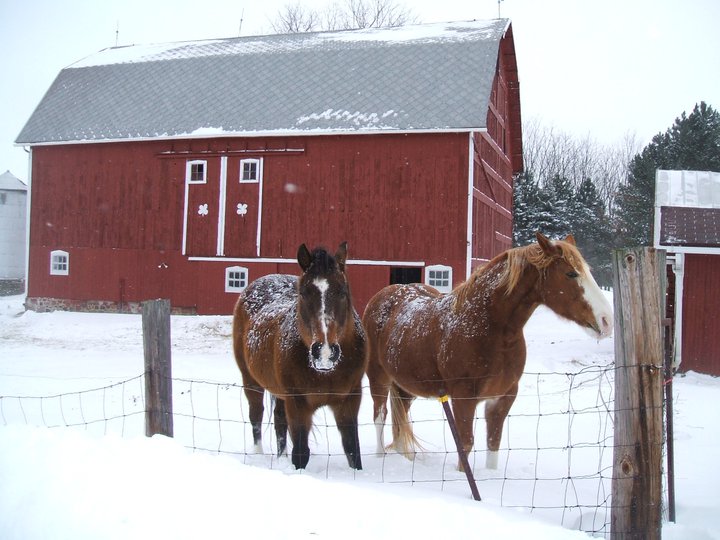
Bob and Quincy were unfazed by the sub-zero wind-chills.

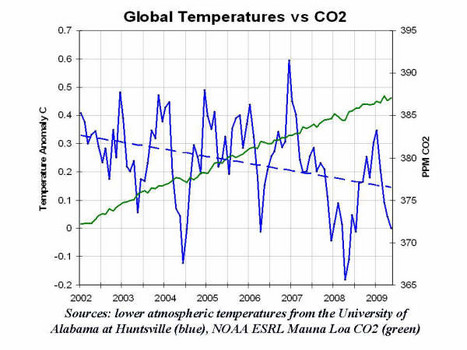
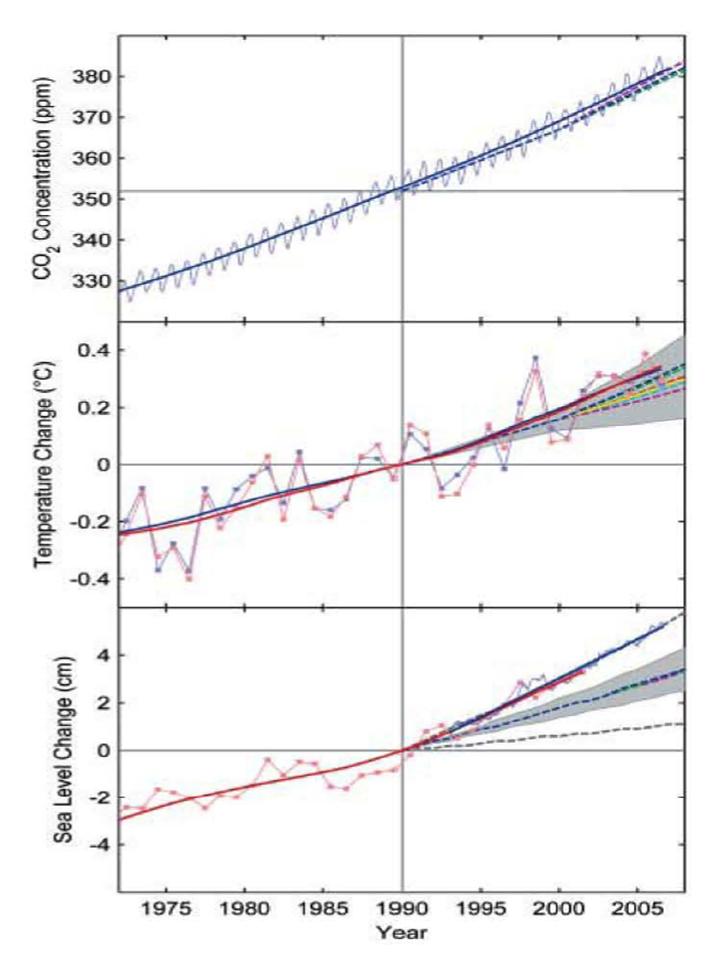
The problem, of course, is that climate patterns don’t move in a strictly linear trajectory and looking at one extreme event doesn’t prove anything one way or the other.  Even looking a few years time sequence may not present the full picture.  Deroy Murdock used the illustration below to argue in the National Review Online that there is no link between rising CO2 and increasing temperatures.


But looking at a broader timescale tells a different story.  While there are year to year fluctuations a clearer association between rising CO2 and global temperature begins to emerge.

The figure above was taken from an article by Stamhoff et al. 2007, “Recent Climate Observations Compared to Projections” (Science 316 (4): 709).  The dashed lines represent the ranges predicted by a major climate model starting in 1990 – the solid line represents what actually happened.  As shown in the figure, climate models have been fairly accurate overall and, if anything, have been conservative in predicting climate change; especially with regard to changes in sea level.


So where am I going with this? There are certainly enough climate change debate/Al Gore bashing blogs out there to go around and I don’t want to devolve entirely into that debate, but the simplistic ‘exception proves the rule’ mentality of the skeptics gets a little tiresome.  I remember hearing my first talk on global warming at a forest biology conference in the mid-1980’s.  The main point that stuck with me then was that increasing global CO2 would not necessarily result in warming every year but that we would see an increase in the frequency and severity of extreme climatic events; droughts, hurricanes, floods, and yes, even blizzards.  Even some of the earliest discussions on climate change in the early 1980’s (e.g., Manabe and Stoufer 1980) recognized complex feedbacks in the global climate system that would result in some regions getting wetter while others suffered drought.  So while the skeptics may use this weeks’ blizzard as evidence against climate change, increasing frequency of severe weather actually argues for it.

A few other climate facts to ponder:

-Global CO2 is increasing and continues to increase (see top panel in figure above).

– Globally, 12 of the 13 warmest years on record have occurred since 1995.

-Intensity of hurricanes and cyclones is increasing (Webster et al., 2005).  While Fox and Friends were happily using the Blizzard of 2011 to debunk climate change; did they notice the most powerful cyclone on record was slamming into Australia?

-Frequency and severity of droughts is increasing worldwide (Burke and Brown, 2006).

-Glaciers are disappearing.  If you want to go to Glacier National Park and actually see a glacier, you need to hurry.   In 1850 there were 150 glaciers in the park.  Today there are 25 and they will likely be gone in 10 years.


Facebook

Planting trouble: multiple trees in one hole

Facebook

[I enjoyed Jeff’s Valentine story so much that I thought I’d stick to the theme of togetherness…for better or worse.]

A week or so ago a reader asked about the practice of planting three or four fruit trees in the same hole.  Having not heard of this before, I checked on the web and found many “how to” pages geared to home gardeners who either want a longer harvest of a particular fruit (early to late) or a mixture of different species.  Doesn’t it sound just great, especially for smaller urban yards?

One of these sites has these written instructions: “Plant each grouping of 3 or 4 trees in one hole at least 12 to 15 inches apart.”

Now, I’m sorry, but this is just asking for trouble down the road.  Readers of this blog know that root systems extend far past the drip line, and that roots from different trees are going to compete with one another.  You’ll end up with three unhappy trees, all jostling for space and resources, just like kids in the back seat during those long car rides.

But wait! you might say.  There’s research on high density tree planting, and it’s been shown to increase fruit yield on a per acre basis!

Yes, in fact there is a lot of planting density research on many different species of fruit trees.  What’s considered by researchers to be “high density” varies, but it rarely exceeds 2698 trees/acre (6666/ha for our international readers).  Optimal and sustainable levels of high density planting are also variable, as they depend on not only species but rootstock and the crown architecture; 1214/acre (3000/ha) might be a mid-range number.  This can be converted to a per-tree requirement of 36 sq. ft. or a 6’x6’ planting area.

How does this compare to the 12-15” recommendation given earlier?  If we’re generous and use the 15” recommendation, this translates to 6.25 sq. ft. per tree or 6970 trees/acre.  The 12” recommendation would lead to a whopping equivalent of 10,890 trees/acre.  (And no, it doesn’t matter if you’re using dwarfing rootstock or not; most of the higher densities in the literature are for dwarfing rootstocks.)

You don’t have to be a math whiz to see that these densities are totally out of line with reality.  Sure, you can probably keep overcrowded trees alive with lots of water and fertilizer, but they’ll be under enough chronic stress so that pests and disease might take hold, and fruit production will likely be poor.  And it’s about as far from a sustainable practice as you can get.

Facebook

More Master Gardener Fun!

Facebook

Am just heading out the door for Fairfax, Virginia – part of the greater Northern Virginia metro area, with traffic that scares the pants off of us country mice. I’m doing the Master Gardener training for the Fairfax Master Gardener Association.  Their attendance is so huge, they have to split into a morning session (150 people) and an evening session (100+). Two and a half hours of training on “herbaceous plants” twice in one day – that’s a lot of yakking even for yours truly.   But what a terrific group. I led the herbaceous sessions in 2007 and was impressed at the diversity of age, ethnicity, levels of knowledge, you name it. A complete cross-section of the area, all with the common desire to learn. Merrifield Garden Center generously (and brilliantly) hosts the training in their large meeting room. Alas, after we all get worked up over the fab perennials, annuals, and tropicals, there’s not much to buy this time of year.
I’ve written about the tremendous contribution of volunteer hours that Master Gardeners make to our state.  As the budget axe drops hither and thither, Extension programs always seem to be at risk. All of the Garden Professors have noted their own state’s struggles with such. Here’s the (slightly) brighter side, though – the Fairfax Master Gardener Association receives no funding from federal, state, or local government. Just some training materials from Extension Same with most of the other associations across the state. Not much to cut, really. In turn, it was calculated that MG volunteers across the state reported 334,000 hours of service for 2009. That’s a pretty good return on very little investment from the state.  Heck, I don’t even have an Extension appointment. But I’m a believer in the MG system, and want to help in whatever way I can, even if it means leaving the peaceful mountains and driving to Northern Virginia. A bit of a bonus is there’s really good shopping up there. Heh.

Facebook

An Early Valentine’s Story

Facebook

In honor of Valentine’s day I have a story about love and betrayal to share….OK, maybe not….perhaps something more along the lines of branches and ants.  Same difference right?

There was once a tree that was much loved.  It was planted in a cute little corner of a street next to a historic building and was well cared for by its owners. Its many limbs rose to the sky in a seething mass which made the tree look vigorous and robust…and those who planted the tree were very happy.

Over time, however, the people who planted the tree neglected it.  The street where it was originally planted changed from a bustling center for traffic to a lonely, out-of-the-way road.  As it was ignored its branches grew together and made a mess — and nobody noticed this mess — except for a little horticulturist who had to walk by the tree every day on his way into work.

The little horticulturist was fascinated by the tree.  Not because the tree was a particularly fine specimen, no, that wasn’t it at all.  Instead the little horticulturist was fascinated by the tree because its limbs grew together so closely that they actually appeared to be grafting with one another, something that the little horticulturist would often spend hours contemplating (what can the little horticulturist say — sometimes he liked to avoid real work).


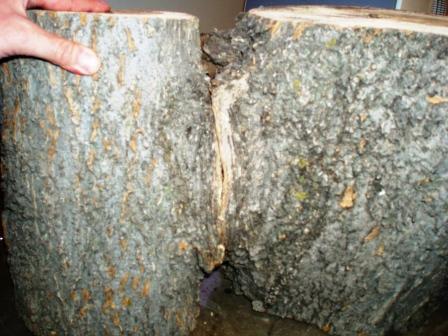
Two limbs apparently grafted together!

Then one day something terrible happened.  An evil green insect invaded the street where the tree lived, and all of the ash trees on that street had to be cut down.  Even though the tree couldn’t be infested by the insect (it was a hackberry), it was still on the list.  The little horticulturist pleaded with the groundskeepers to keep the tree, but orders were orders and the tree had to go.

But unbeknownst to the groundskeepers the little horticulturist knew one of the people cutting down the tree and asked the tree cutter to save him some of the trees limbs where they appeared to be grafted together.  And the tree cutter did, and delivered them to the little horticulturist.

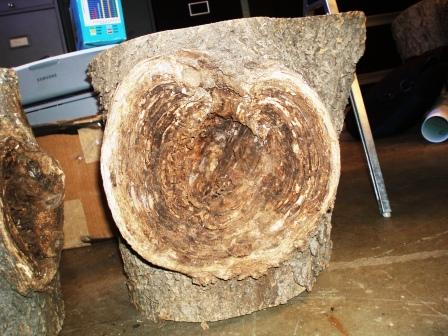
But alas!  The grafts that the little horticulturist had seen were not truly grafts at all!  They were rotted out sections of trunk which had grown around each other!  The little horticulturist was crestfallen!  How could this be?  He left the decaying limbs in his office as he considered what to do next.


Hmmm…There’s no graft after all –what a mess!

Days stretched into weeks and the limbs continued to sit in the little horticulturists office.  And then, one day, from the depths of the limbs sprouted new life!  Winged carpenter ants flew around the room and into neighboring rooms!  Colleagues shouted curses and obscenities!  Graduate students were afraid to use the drinking fountain because of the masses of ants which alighted there!  The custodians took to wearing dust masks!  And, despite incessant pleading by almost everyone, the little horticulturist would not part with the limbs because he wanted to have props whenever he told the story of the day the ants took over the 4th floor.

The moral of this story is that you shouldn’t hold onto things once you figure out that they’re worthless.

Facebook

Landscape design – fatal flaw

Facebook

So many great answers…so many problems with this landscape!  Everyone who made a comment was spot on in their reasoning.  And each of these flaws was completely preventable with good design.  But I’m not sure I would have been able to predict the problem that I now see every week at this location:

his area is the only access point for service vehicles of any persuasion. And sometimes they DO park on top of the planting strip.  Fred’s designation of these ground covers as “Stompus flatii” was perfect!

Lesson to be learned:  sometimes it’s best NOT to have planting strips if they clash with the realities of site use.

Facebook

Friday quiz – landscape design

Facebook

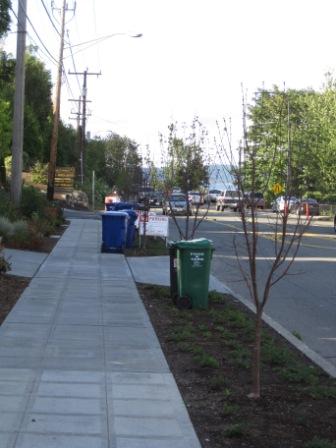
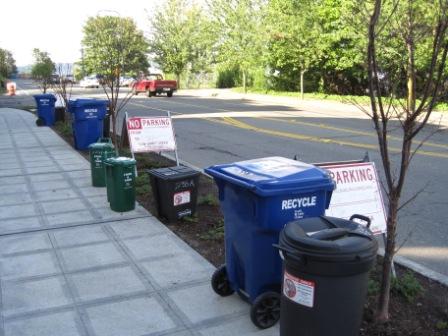
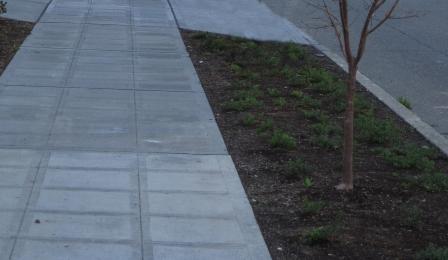
Down the street a ways from where we live is a relatively new condo complex wedged between a hill and the street.  A narrow planting strip separates the sidewalk from the street, as shown below:

The driveway at the top of the photo bisects the planting strip and dead ends in the parking area for the condos.  I have photoshopped this a bit, for reasons you’ll see on Monday.  But this is a true representation of the landscape.

I’d originally taken photos of this area for my ongoing “why trees die” collection (since all but one died within 2 years), but there’s something else wrong in this landscape related specifically to the design.  Can you figure out what it is?

Answers and more photos Monday!

Facebook