As an Extension Specialist working with nursery and landscape issues, I’m frequently called upon to troubleshoot problems with trees and shrubs in various settings. Sometimes it’s residential or commercial landscapes, sometimes nurseries, sometimes Christmas trees. So naturally I was intrigued when the most recent issue of American Nurseryman featured a cover story on diagnosing nutrient deficiencies in plants. The article was written by Dr. Gary Gao, Extension specialist with Ohio State University. The article http://www.amerinursery.com/article-7428.aspx is good and does a good job on covering the basics. … Continue reading this article “Diagnosing plant problems”
Month: October 2011
Green candles identified
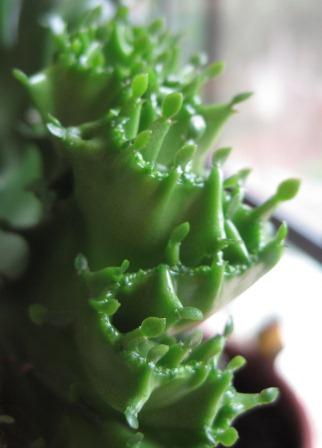
Not many guesses this week – too many Halloween parties? In any case, Hap was correct – this is a closeup of the growing edge of Euphorbia lactea ‘Cristata.’ The "candles" on the edge are tiny leaves that appear whenever water is abundant but shed quickly during dry periods:
Thanks for playing, and Happy Halloween!
Friday quiz returns!
I’ve been remiss in getting quizzes posted – partially a time issue, but mostly a lack of interesting photos. But I’ve got one today:
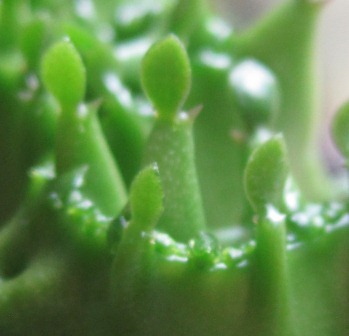
Can you identify what this plant is, and specifically what the little green candles are?
Answers on Monday!
The Wrong Message
Every once in awhile I’ll see a new garden product that really speaks to me. Something that promises spectacular results on some garden problem that I’ve had to deal with before and attacks it in a novel way. Then I’ll read the advertising materials for the product and be let down before even trying it. Such is the case for a new product called Liquid Ladybug (which, by the way, is one of the niftiest product names that I’ve ever seen — so there’s a win for the company!).… Continue reading this article “The Wrong Message”
Today in Cucurbit News…
Cucumbers are one of the most widely-grown vegetables in the world. Baker Creek Heirloom Seeds (a great place to buy unusual and international veggie seeds) lists 51 varieties from North America, Southeast Asia, China, India, Mexico, and Europe. Dark green ones seem to be in the minority – yellow, white, orange and red skins in shapes round to elongated dominate.
Cukes traditionally have a few nutrients including some Vitamin A from carotenoids and beta carotene, but have never had the reputation as nutritional power house.… Continue reading this article “Today in Cucurbit News…”
A little about bugs
I’m not much of an entomologist. (Okay, I’ve never had a single bug-related class.) But I do appreciate insects in all of their bewildering shapes and behaviors. And after this weekend I’ve become a little more entomologically educated.
I spent the weekend in Prescott, Arizona at the annual MG conference. Besides meeting lots of great Master Gardeners (and Extension educators) in that state, I also met Dr. Whitney Cranshaw from Colorado State University. He gave a keynote talk called “Gardening for Insects – or not!” … Continue reading this article “A little about bugs”
The people have spoken…
OK, the results are in for our reader poll to design a landscape tree transplant study here at MSU next spring. And the winner is…er, I mean, winners are: Root ball manipulation and Fertilization at the time of planting. Root ball manipulation drew 74.3% of the responses, Fertilization was chosen by 63% (voters could chose more than one favorite topic). All other proposed topics were under 40% (Mycorrhizae – 37%, Crown reduction- 31%, Cambistat – 11.4%, Bioplex – 11.4%).… Continue reading this article “The people have spoken…”
Any PR is good PR…I think…
Virginia Tech (my institution of employment) does a good job of bringing newsworthy research and outreach stories to the university’s home page. With a huge college of engineering, robotics seems to be the dominant theme (no matter how lame the robot is) closely followed by solar-powered cars etc. So it’s a rare and thrilling event when a news items with a horticultural topic is featured on the VT web site!
As I read it yesterday, my heart sank a bit.… Continue reading this article “Any PR is good PR…I think…”
The Genetically Modified Kentucky Bluegrass Problem (The Anger As Promised)
One of the nice things about my job is that I get to work with a lot of other researchers who work in a lot of different areas. One of these areas is molecular biology and I certainly know people who have genetically engineered plants to do one thing or another. Maybe it’s because I know so many people who work with them, but I’m not fundamentally opposed to genetically engineered crops. Which isn’t to say I’m not concerned about certain genetically modified crops, but in general I think that the systems we have in place to review them have done a decent job of making sure that nothing too terrible is released.… Continue reading this article “The Genetically Modified Kentucky Bluegrass Problem (The Anger As Promised)”
Reader input wanted for new book
(Note: I’ll be doing another blog posting later today. Just want to be sure I get this out.)
I’m writing a new book on plant physiology for gardeners – a book that explains how plants work and why they sometimes do weird and unexpected things. I’d like to hear what kind of “how” or “why” questions you’d like to see answered in this type of book. Please add your comments to this post, or send them to me directly.… Continue reading this article “Reader input wanted for new book”