I just got back from Nanaimo BC, where I had gooseberries with my afternoon tea. Below is another "berry" found on a commonly used ornamental. (I use the term berry loosely – as you may know, the botanical definintion for berry excludes fruits like strawberry and raspberry, which are aggregate fruits.)
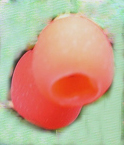
I’ve photoshopped this so that only the two "berries" are visible. On Monday I’ll post the entire photo, along with some botanical fun facts! See if you can guess what this is before then.
Published by

Linda Chalker-Scott
Dr. Linda Chalker-Scott has a Ph.D. in Horticulture from Oregon State University and is an ISA certified arborist and an ASCA consulting arborist. She is WSU’s Extension Urban Horticulturist and an Emerita Professor in the Department of Horticulture. She conducts research in applied plant and soil sciences, publishing the results in scientific articles and university Extension fact sheets.
Linda also is the award-winning author of five books: the horticultural myth-busting The Informed Gardener (2008) and The Informed Gardener Blooms Again (2010) from the University of Washington Press and Sustainable Landscapes and Gardens: Good Science – Practical Application (2009) from GFG Publishing, Inc., and How Plants Work: The Science Behind the Amazing Things Plants Do from Timber Press (2015). Her latest effort is an update of Art Kruckeberg’s Gardening with Native Plants of the Pacific Northwest from UW Press (2019).
In 2018 Linda was featured in a video series – The Science of Gardening – produced by The Great Courses. She also is one of the Garden Professors – a group of academic colleagues who educate and entertain through their blog and Facebook pages. Linda’s contribution to gardeners was recognized in 2017 by the Association for Garden Communicators as the first recipient of their Cynthia Westcott Scientific Writing Award.
"The Garden Professors" Facebook group - www.facebook.com/groups/GardenProfessors
Books: http://www.sustainablelandscapesandgardens.com
View all posts by Linda Chalker-Scott
Taxus?
Looks like yew to me too.
Taxus is my vote.
Yep, it definitely looks like a Taxus spp. aril to me too. It’s the only non-toxic part of Taxus, isn’t it, and only when ripe?
Yep, looks like a yew. I thought that the berries were toxic too .
I agree that it’s Taxus. Isn’t the ‘fruit’ of Taxus called an aril? I once called poison control because my son was eating these and they said not to worry unless he had crushed the seed inside (in which case he would get sick in an hour or so). I figured if poison control wasn’t worried, I wouldn’t either. He’s still alive, so I guess they were right.