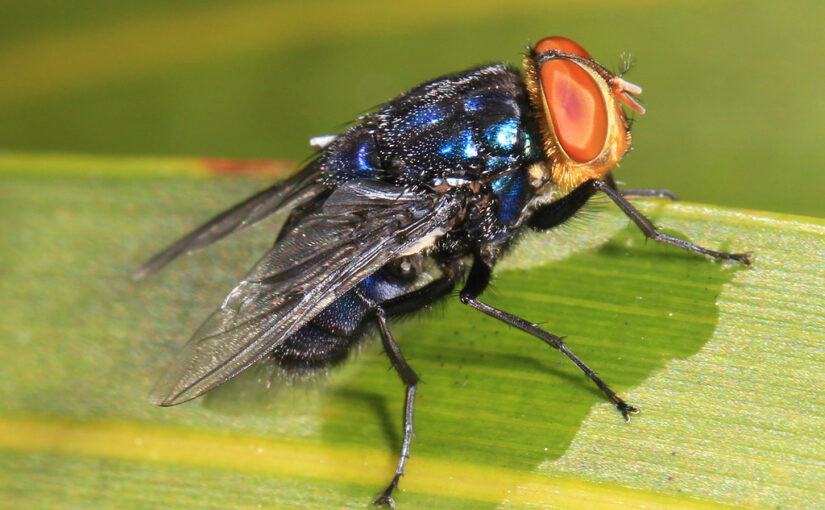

The New World screwworm is an insect that feeds on living flesh and it is making headlines this year as federal agencies race to battle it.
What exactly is a screwworm (Cochliomyia hominivorax)? Despite the name, screwworm is not a worm at all. This insect is a blue-green blow fly native to the Americas. Adult flies themselves are not the problem. The danger begins when females lay eggs in open wounds, cuts, or even mucous membranes of warm-blooded animals.
When the eggs hatch, the larvae burrow into living tissue, “screwing” into it. Their primary target is livestock (but the screwworm can make a home in humans, pets, and wildlife). For newborn calves, infection generally occurs at the site of the umbilical cord and is usually lethal. What makes this fly unique is that it targets healthy flesh – most other carnivorous fly larvae are attracted to dead or decaying flesh and actually play a critical role in recycling nutrients.
The screwworm was eradicated from the U.S. decades ago, but recent outbreaks in Central America have reignited concern among livestock producers, veterinarians, and scientists. The main tool that USDA and APHIS have against this pest is something called sterile insect technique.
Sterile insect technique (SIT) involves mass-rearing male flies, sterilizing them with radiation, then releasing them into the environment. When sterile males and females mate, the resulting egg is not viable. Over time, repeated releases of sterile males collapse the population. This technique has significant advantages over insecticides, which are difficult to deliver in a targeted manner to the flies.
In the last couple of years the USDA has spent over $270 million to increase sterile insect production in Panama (where there is a rearing facility) to 100 million sterile flies a week. This year, they announced they are reopening a production facility in southern Mexico and a dispersal facility in Texas, which should generate another 100 million sterile flies a week.
There is another variation of SIT that involves gene editing which scientists are also exploring for the screwworm. Rather than irradiating the insects, researchers edit insect DNA to cause male sterility. Generally researchers use CRISPER-Cas9, a sort of molecular “scissor” to modify or cut specific genes associated with fertility. As a safeguard, the genetic modifications are designed to be self-limiting, meaning that the trait will not persist over many generations. One of the advantages of gene-editing over traditional SIT is that it allows for the release of eggs, not just adults, which can be less costly. It also has a higher sterilization efficacy than traditional SIT methods.
What do you think about releasing gene-edited organisms into the environment? This technology is coming onto the market for several insect pests and can be controversial due to ethical concerns about the morality of altering species, or concerns with unintended impacts. But it can also have incredible benefits for controlling pests that are devastating to crops, livestock, or people.