Building a Better Container, Part Deux: The Ellepot

I enjoyed Jeff’s post on the RootTrapper and thought I’d share another interesting and [relatively] new development in the world of greenhouse growing containers.

Take a tube full of growing media, wrap a paper sleeve around it, and voila – the Ellepot!
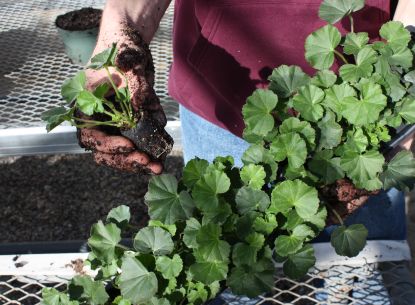

It’s bottomless, root permeable, and degradable. Each Ellepot sits in its own cell in a re-usable tray.  The great aeration and drainage makes for a happy, healthy root system.  Another plus is that after transplanting, there are no pots or packs to throw away

I’d say the bulk of Elle Pots are utilized at the propagation end of things – starting seeds and rooting vegetative cuttings – either for greenhouses  to “grow on” themselves or as plug/liner products sold to finishing growers (see student Paul Hutcheson holding a geranium liner above).Continue reading this article “Building a Better Container, Part Deux: The Ellepot”
Visiting Professor guest post: Organic foods

There are lots of reasons consumers give for buying organic foods, but a few reasons are very common.  Among them is the notion that organic foods are better for you.  Really?  Are organic fruits and veggies better for you?  Depends on what you mean by ‘better for you’.  But as far as we know, the answer is probably ‘no’, especially if you’re buying organic fruits and veggies (F&V) at the store.  It might seem crazy, but there’s no good evidence to support the notion that you will be more healthy by shopping for organic F&V. … Continue reading this article “Visiting Professor guest post: Organic foods”

Short tree syndrome solved!

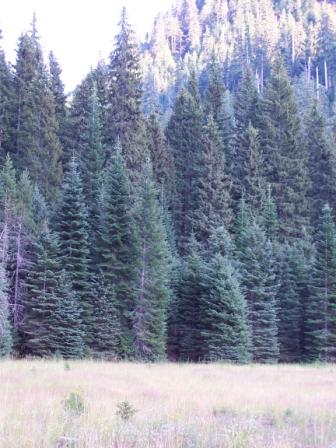
Good answers from Kenny S., Jimbo, Joe Schalk and Diana!  You were all skirting about the phenomenon of thigmomorphogenesis – or touch-induced change (also discussed in Jeff’s post of January 7.  The tests in the GP’s class are cumulative!).  In this case, the touch is wind.  Edge trees (or corn stalks) are more exposed and receive more wind, resulting in stunted heights and increased trunk diameter (you can’t see this last characteristic in the Friday photo). … Continue reading this article “Short tree syndrome solved!”

Friday quiz time

Here’s an interesting phenomenon you can see in any group of plants – it’s what we call the edge effect:

Today’s question:  why are the trees in the foreground so much shorter than those just a few feet farther from the edge?  Answer on Monday!

Building a Better Container

As most of you know, roots circling around a container isn’t considered a good thing.  And so people try various things to control circling roots.  One of the more creative horticultural minds out there, Carl Whitcomb, a guy why basically got sick of academia and went into private industry (and, as far as I can tell, loathes peer review and the whole process of publication), decided to see what he could do about making containers that don’t encourage circling roots. … Continue reading this article “Building a Better Container”

Permaculture – more concerns

One of the gardening topics I’ve researched extensively is the use of landscape mulches.  (You can read a literature review I did a few years ago here.)  So I was more than a little frustrated to see one of the worst mulching techniques – sheet mulching – extolled in the book Gaia’s Garden (pp. 85-90).

Sheet mulches, like newspaper and cardboard, can be used successfully as a temporary weed control measure (i.e. a few weeks before planting a vegetable garden).  … Continue reading this article “Permaculture – more concerns”

Last-Frost-Date Roulette

We all play the game – at least the more impetuous among us do. You sneak a few tender things out into the garden, or on to the patio.  When the temperature drops and there’s a frost warning, no problem…just cover them up or bring them in.

Unless you forget.

oh, the humanity...
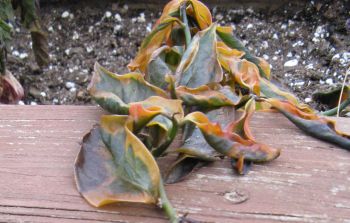
This WAS a rare and neato Pereskia aculeata ‘Variegata’. Paul W., please send me another…

Before dawn on Monday morning, (May 9) the temperature on our little mountainside dropped below freezing for four hours, going as low as 29.5 F according to our weather station. … Continue reading this article “Last-Frost-Date Roulette”

Green mystery disk identified!

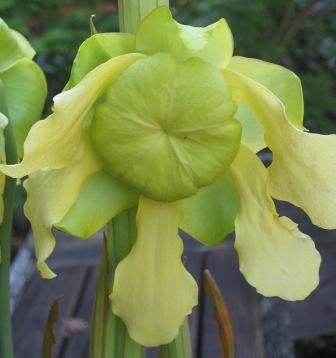
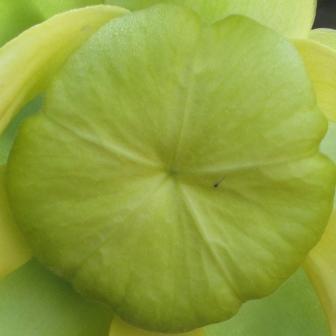
Initially I was disappointed that no one answered the question…then Paul W. emailed to say that the post wasn’t accepting comments.  We’re not sure why that happened, but Paul and perhaps many of you knew this was part of the flower of Sarracenia flava – the yellow pitcher plant:

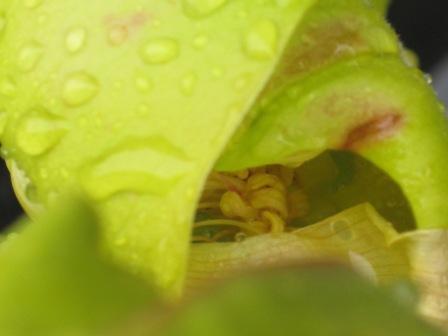
I think this is a stunning flower whose floral structure promotes cross-pollination.  Insects crawl in between the long yellow petals and the green "umbrella" to enter the flower and reach the pollen:

Before they reach the anthers, however, their backs rub up against the stigma, which are five tiny points at the "spokes" of the umbrella. … Continue reading this article “Green mystery disk identified!”

Every survivor has a story

It’s been suggested, not unfairly, that the Garden Professors are sometimes a little ‘Tree-Centric’.  As a forester and tree physiologist by training, I’m probably the guiltiest among my co-conspirators on that count.  But occasionally I do notice things less than 10’ tall and lacking a single, woody trunk.


When weather permits I like to take my lunch down to the MSU annual trial gardens behind my office here at the Plant and Soil Science Building.  Every summer the annual gardens are awash with the color of impatiens, geraniums, petunias, and other annuals. … Continue reading this article “Every survivor has a story”

Friday’s “disk of mystery”

What is this "green disk of mystery?"  It’s about 2" in diameter:

Answer on Monday – have a great weekend!