Corny Ancestry

I love growing weird plants, and I’m endlessly fascinated by plant breeding and the extreme transformations humans have made in our crop plants over the history of agriculture.

Which is why growing teosinte, the wild ancestor of corn, was a no brainer. Even before I planted it, comparing the seeds is fascinating. teocornseed

Once growing you can see the similarity. Teosinte is on the left in the picture below, corn on the right.
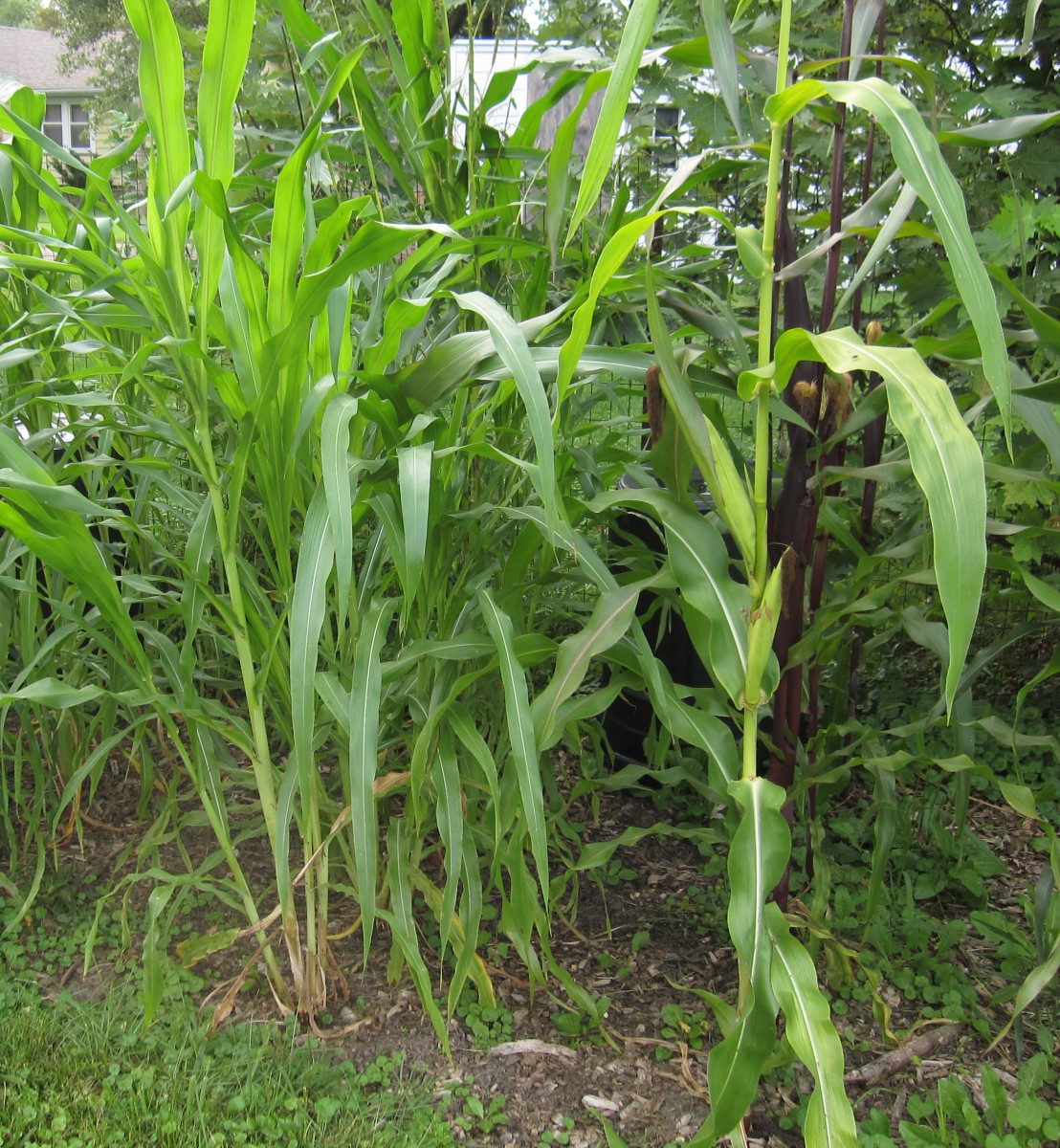
teocorn

The most dramatic difference between the two, I think, is the “ear” of teosinte, which is nothing more than a thin sprig of half-a-dozen seeds.… Continue reading this article “Corny Ancestry”

Eggplants getting their buzz on

eggplantflower

I was checking my eggplants today, and watching the bumble bees getting busy with the large purple flowers. As they flew in, buzzing away, they landed on the flower and kept buzzing — but the note changed, dropping in pitch. The bumble bee hummed away for a while, then flew off to the next flower.

I was watching buzz pollination at work. Egg plants, and a lot of other flowers, don’t leave their pollen hanging out in the open where any ant or fly that happens by could eat it.… Continue reading this article “Eggplants getting their buzz on”

Observations regarding you-pick blueberries…

We just finished up with our 8th season of welcoming you-pickers to our back yard, which happens to include three acres of northern highbush blueberries. This has been an interesting venture – helps pay for our farm, obviously, but also presents an opportunity to connect with the “general public” outside of academia [that probably wouldn’t happen otherwise, considering we are both introverts]. Ninety-nine-point-nine percent of the folks that take the trouble to come to a you-pick are fabulous, functional human beings.… Continue reading this article “Observations regarding you-pick blueberries…”

Jumping genes!

This spring, I noticed this striped flower in a stand of feral Hesperis matronis
hesperistransposonStripey flowers! And like almost all striped flower variants, almost certainly caused by transposons, aka jumping genes.

To understand transposons, you can think of genes as instructions. So when making a flower, a plant may be following a gene that says:

MAKE PURPLE PIGMENT

And so it does, and the flower is purple.

You can think of a transposon as a gene that says:

COPY ME!Continue reading this article “Jumping genes!”

Are Soaker Hoses Safe?

By Cynthia Lee Riskin

With drought predicted for the west, southwest, and south through June 2015 (National Weather Service March 2015), many conscientious vegetable gardeners will try to conserve water by using soaker-hoses, those bumpy black hoses that weep water onto the soil through tiny pores.

Brussel sprouts and red lettuce
Soaker hoses are made from fine-crumb rubber, usually recycled from vehicle tires. Research strongly establishes that tire particles leach heavy metals, carcinogens, and mutagenics, among other toxins. Yet soaker hoses have not been studied for potentially increasing the toxicity of edible plants.… Continue reading this article “Are Soaker Hoses Safe?”

Spec errors mount

For years I subscribed to Consumer Reports. I appreciated their objective approach to product testing and lack of advertising. In their own words, their policy is to “maintain our independence and impartiality… [so that] CU has no agenda other than the interests of consumers.” But recently they’ve veered off the science-based trail – at least the one running through our gardens. Their approach to plant and soil sciences is more pseudo than science. And last year, after 30+ years of loyal membership, I quit my subscription when Consumer Reports began partnering with Dr.… Continue reading this article “Spec errors mount”

Walnut warfare

Recently, a question about using black walnut chips for mulch was posted on our Garden Professors Facebook group page. As gardeners know, black walnut has a reputation as a chemical warfare species that will kill anything growing underneath it – a phenomenon called allelopathy. So it’s logical to wonder about the lethality of walnut chip mulches.

To get a good feel for the science behind black walnut’s allelopathic abilities, I was fortunate to find a relatively recent review on the topic (Willis, R.J.… Continue reading this article “Walnut warfare”

Cross-pollination making you cross?

No, your cucumbers have not hybridized with your melons.

I’ve been fielding different versions of the same question a LOT lately.
Three different people have sent pictures of “cucumelons” telling me they planted cucumbers next to their melons, and now the cucumbers look strange, so they’re concerned that they have cross pollinated with the melons. One person planted what was supposed to be a red raspberry next to their yellow raspberry, but the new plant is producing yellow fruit, so they think that it must be cross pollinating with their yellow plant, causing the fruits to turn yellow.… Continue reading this article “Cross-pollination making you cross?”

Spring = really?

I’m sorry I’ve been so quiet, but I am not feeling SPRING. Here in the Blue Ridge of Virginia (Zone 6), March is averaging 10 F below average. Snow and ice is piled up on the north side of buildings. My Herbaceous Landscape Plants class is not impressed by the inch-tall Mertensia and the fact that the only thing we can call a cool-season annual (pansies/violas) is brown mush. All the delightful Zone 7 things I’ve been pushing on people for several years here – er, whoops.… Continue reading this article “Spring = really?”

Re-using containers? A cautionary tale.

I attempted to clean up our little home greenhouse over the holiday break. There’s no good place to recycle pots around here, and I hate throwing them away…so I suffer from container build-up. Figured I’d sort through the haphazard pile in the corner of the greenhouse, wash and re-stack the useable ones, and finally ditch the busted ones.

As I started separating the first stack, I noted a tiny flash of red. It is well-known and oft-reported among my gardening and grower buddies that the Southern Black Widow (Latrodectus mactans) really enjoys a nice stack of grubby pots.… Continue reading this article “Re-using containers? A cautionary tale.”