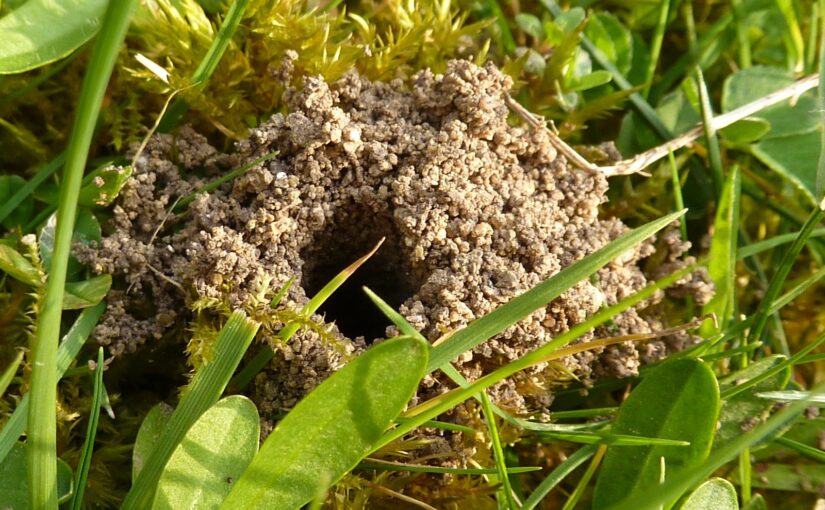
This week I read about a new bee-related discovery in the New York Times that surprised me: thousands of years ago, during the late Quartenary period, a group of bees made their nests inside of animal bones. For these bees, tiny cavities in bird and mammal skeletons provided protected spaces where they could raise their young. This story perfectly illustrates one of the defining characteristics of bees: they are extraordinarily resourceful!
When we think about bees, we usually think of European honey bees. But there are over 20,000 species of bees found globally, and few people realize how diverse they are in nesting habits and behaviors. Understanding where bees nest can change how we think about gardens, landscapes, and what “good habitat” really means.
Bees That Nest Underground
Many bees are ground nesters that dig their own tunnels. Mining bees, digger bees, and many sweat bees excavate narrow tunnels in the ground, often preferring sunny, well-drained areas with bare earth. Inside each nest, the female creates a series of chambers that receives a pollen/nectar ball along with an egg.
Many bees use spaces that already exist underground rather than excavating their own nests from scratch. They can utilize natural cracks in soil, abandoned burrows, gaps between roots, and old rodent tunnels.
Some small sweat bees and mining bees take advantage of these ready-made spaces, modifying and partitioning them into brood chambers for their offspring.
For a bee, a preexisting cavity offers several advantages. Excavating soil takes energy, and existing tunnels may already provide the right moisture, temperature, and protection from predators. In dry climates especially, underground nests can buffer bees from extreme heat.
These bees often line their brood cells with waterproof or antimicrobial materials, such as mud, plan resins, waxy coatings, or secretions they produce from specialized glands.
Bees That Nest Aboveground
Some bees move their nesting activities aboveground, either taking advantage of hollow spaces already present in nature or excavating their own. They may take residence in hollow plant stems, dry twigs, rocky cracks, and dead trees. Leafcutter bees are one of my favorite examples, they usually nest aboveground in cavities and they line their nests with leaves (you may notice perfectively circle cut-outs on your roses and other ornamentals, these are from leafcutter bees!)
Another above-ground nesting bee is the carpenter bee, which excavates tunnels into wood using strong, jaw-like mandibles. This can alarm homeowners because they may take residence in exposed lumber or fence posts – but these bees are harmless and won’t burrow deeply into homes or cause damage in the same way that termites do.
To promote aboveground nesting bees, practice messy gardening – leave dead stems, pithy plant material, and other debris in your garden (where it makes sense to do so) for bees.
Some Bees Use Extraordinary Nesting Sites
Perhaps the most bizzare example of nesting is Wallace’s giant bee, the world’s largest bee. This bee was thought to be extinct but rediscovered in 2019 during an bee expedition in Indonesia.
This enormous bee actually forms a nest inside active termite nests in trees. Females have huge mandibles which they. Use to gather sticky plant resin. The resin protects their nesting chambers within the termite colony.
Have you seen any unique bees nesting in your garden? Where do they live?
Currently have a nest in a pile of cat fur lodged in a compartment of a small table. They appear to be manipulating the fur into an attractive tunnelled home.
That’s so cool! I hadnt heard of that! Just make sure your cat isn’t treated with anti flea medicine before leaving the fur out? The active ingredient in those flea and tick medications sometimes includes imidacloprid (a neonic known to harm bees).