Over the last two weeks I’ve been dwelling on the information that people get about gardening from various sources. I’m not talking about really serious gardeners – I’m talking about the guy down the block who might grow six tomatoes, two cucumbers, and a head of lettuce. He’s got 6 trees on his property and he keeps his lawn nice, but not immaculate, by mowing weekly and fertilizing and applying herbicides once a year. Where is this guy getting his gardening information? … Continue reading this article “How to get the information out?”
Plant containers – does size really matter?
A few days ago I got a question from Cynthia about “potting up.” For those of you for whom this is an unknown phrase (and no, it’s not a euphemism for a certain herbal activity), it refers to the practice of moving plants into ever larger containers. She was wondering if there was any “real science” behind the practice – in other words, why not just start out with a larger container?
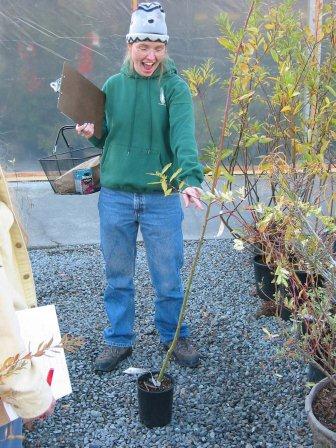
Hah! I needed no further encouragement and spent several days collecting and reading decades’ worth of research.… Continue reading this article “Plant containers – does size really matter?”
Mouse Tombstones
Doing this…
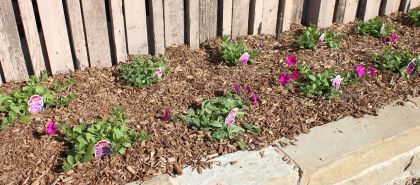
I must identify each and every Wave petunia!
leads to this…
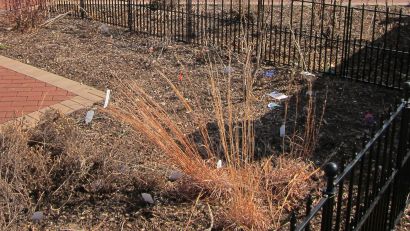
and this…
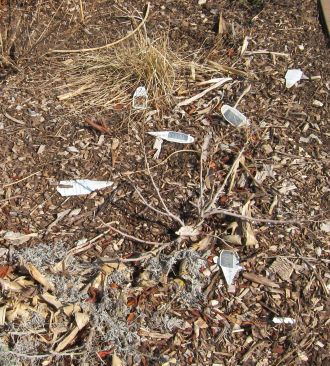
Unfortunately, the second and third photo are from a college teaching and display garden. There are a lot of inexpensive yet more attractive ways to relate plant identification to your visitors.
We all do this, of course, to some extent in our home gardens. Walk around with weird plant in hand, dig hole, stick it in, say to self "I’ll come back and get that label to add to my (pick one) Excel garden database/bag of random tags/photographic memory."… Continue reading this article “Mouse Tombstones”
Heck, it’s hellebore!
You were too smart for me this week. Though my husband was convinced that Friday’s photo was not enough to help identify the plant, JRR, Foy, and an unnamed commenter all recognized hellebore:
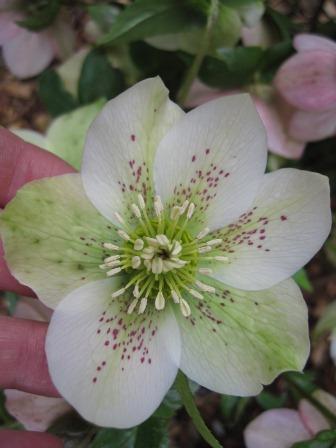
Always a welcome sight in the spring. And don’t be fooled by those old wives’ tales that hellebores don’t like wood chip mulches. These beauties have been in wood chip mulches all their lives, and not only do they do great, their seedlings do as well.
Friday quiz photo
I finally got a chance to get outside (translation: it stopped raining) and took this photo:
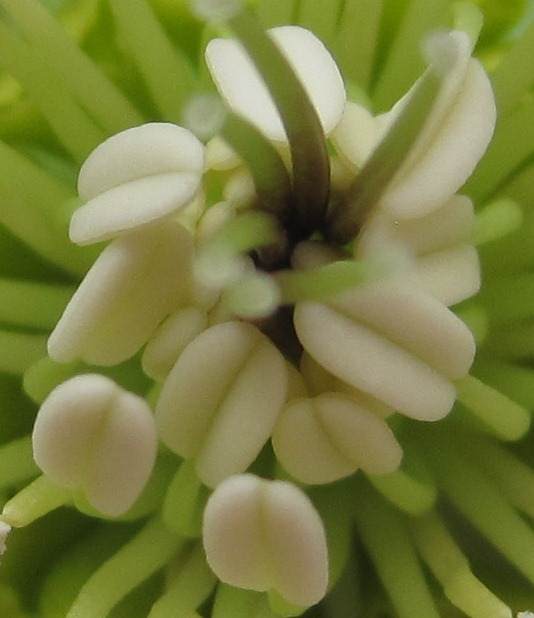
They kind of look like barley grains, but I’m sure you know they’re not! The questions are – what are they and to what plant do they belong?
Answer Monday!
Bordeaux Mix
One of my favorite stories about pesticides is the story of Bordeaux mix. It’s a story of France in the 1800s (so it must be pretty romantic, right?) and how they were suffering from a shortage of grapes. Don’t feel sorry for them — it was really their own doing. Over the course of the 19th century grape vines were brought from the United States to test their merits against European grapes. It was quickly discovered that, for the most part, American grapes were not the equal of European grapes for winemaking. … Continue reading this article “Bordeaux Mix”
A salt bath for your tomatoes?
This morning I got an email from one of my gardening colleagues, wondering about the wisdom of watering tomato plants with salt water. He had a link to a UC Davis website which tacitly endorses spraying tomato plants with 10% salt water “to increase their nutritional value and taste.” Unreferenced “worldwide studies” are mentioned, along with the “major potential benefit of providing irrigation for crops in areas with freshwater restrictions.”
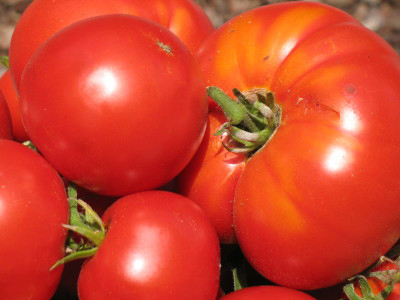
Before we deal with the impracticalities and out-and-out harm of using salt water for irrigation, let’s look at why this practice would work on tomatoes. … Continue reading this article “A salt bath for your tomatoes?”
Jeff Gillman a.k.a. Dr. Unbiased!
“Everyone’s taking stands, and unfortunately, some of those taking the strongest stands have the least information.”
– Dr. Jeff Gillman, on “How the government got in your backyard”, co-authored with Eric Heberlig
Fine Gardening did a fine job in a recent interview that was linked to their e-mail update. FG Editor Steve Aitken brings some humor as he quizzes Dr. Jeff. about his new book. Check it out here.
Steve opens with “Is the government really in my backyard?… Continue reading this article “Jeff Gillman a.k.a. Dr. Unbiased!”
What can CO2 do for you?!
Well, it looks like the climate change skeptics are starting to hedge their bets. Global climate is not changing. But if it does change, it’ll change for the better. At least that’s the gist of a book by the Center for the Study of Carbon Dioxide and Global Change entitled “The Many Benefits of Atmospheric CO2 Enrichment”. The book documents 55 different ways that increasing global CO2 will benefit the world. Most of this is built on studies documenting increases in plant growth and/or photosynthesis associated with increasing CO2. … Continue reading this article “What can CO2 do for you?!”
Wet trunk – the whole story
We had a flurry of discussion on this over the weekend. The diversity of possible answers shows you how difficult it is to do diagnosis with only some of the information available. That being said, several of you (Gail, Tom, Dave and Jimbo) all had portions of the problem identified. Here’s the whole picture:

As both trunks of this double-leadered tree have continued to expand in girth, they’ve created the perfect conditions for disease to occur in the narrow constriction between the trunks.… Continue reading this article “Wet trunk – the whole story”