April foolery revisited

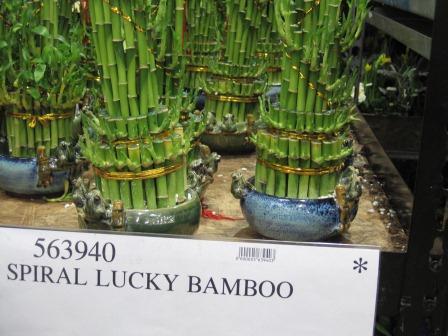
You certainly had fun with this!  Yes, it’s “lucky bamboo,” a name which is completely inappropriate given that it’s not bamboo (but Dracaena sanderiana) and it’s certainly not lucky:

Now “spiral lucky bamboo” is usually dracaena (or as I like to call it “not-bamboo”) that’s been exposed to a unidirectional light source and turned at intervals to create a contorted spiral shape:

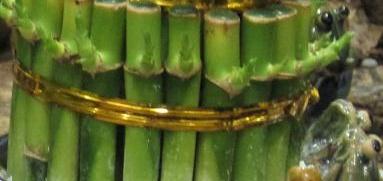
These plants, on the other hand, have been cut into straight sections and bound with shiny gold wire in ever increasing lengths so that we have a leaning tower of not-bamboo surrounded by adulating ceramic frogs (good eyes Anne and Jam!). … Continue reading this article “April foolery revisited”

Looking for the lowdown on tree rings

Often we use our blog space as a soapbox from which to pontificate, but today I’m looking for some input from our loyal readers.  Last week I received a note from an editor looking for some words about tree rings.  We’re talking about landscape tree rings for planting annuals or perennials, not dendrochronology.


The editor was interested in specifics on tree rings for large existing trees such as what type of materials to use, what types of flowers or plants worked best, which trees can or can’t have tree rings, etc.  … Continue reading this article “Looking for the lowdown on tree rings”

April foolery

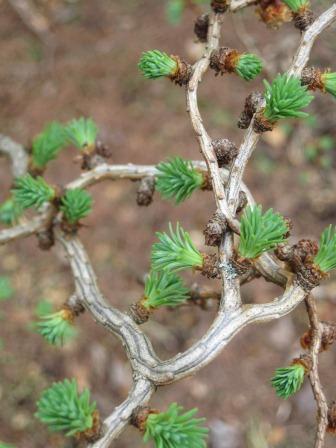
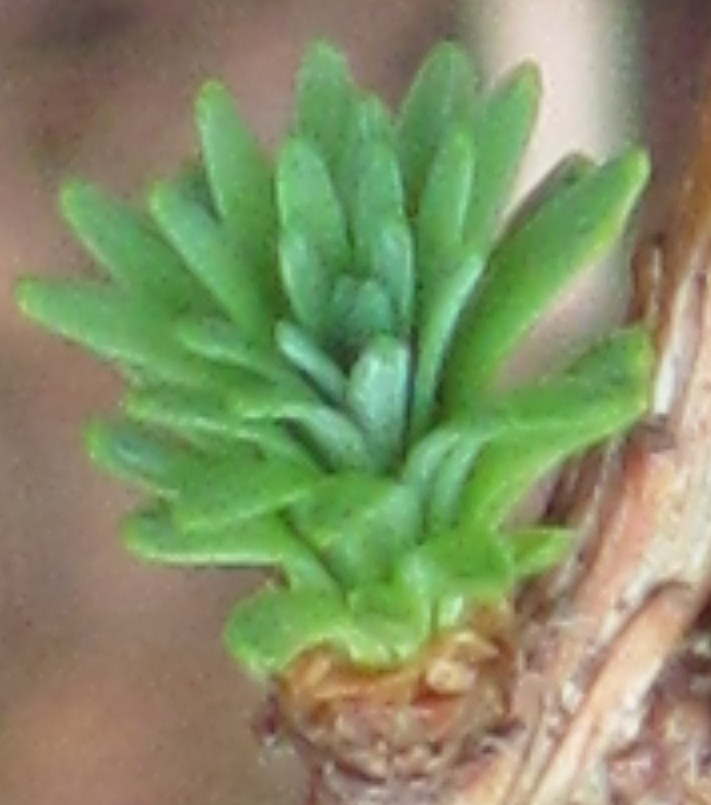
Let’s see if anyone can figure out what this is:

What’s the plant, and what in the world has been done to it?

Answer Monday!

Are Pretty Flowers Useful?

Yesterday I had the opportunity to listen to Marla Spivak, a very highly regarded bee scientist, talk about how bees defend themselves from disease.  Very interesting stuff.  I took a lot of information away from the talk, two bits of which I want to share with you.

The first is a vocabulary word — propolis – go ahead, google it (I don’t think too much inappropriate stuff will pop up) – it’s an antimicrobial “ointment” which bees create from stuff like the resins on tree buds.… Continue reading this article “Are Pretty Flowers Useful?”

Is “lasagna gardening” really worth the effort?

This week I got a complimentary copy of Urban Farm, dedicated to “sustainable city living.”  The cover story is Lasagna Giardino – follow this recipe for a lasagna garden that grows perfect plants – Italian or not.

This is not a new idea, but was popularized several years ago as a way of preparing soil for planting.  The article relates the steps:

1)  Prepare the ground by mowing the lawn
2)  Dig up the first 12″ of soil (double digging)
3)  Place a layer of “noodles” (paper and cardboard are popular) – the low nutrient material
4)  Place a layer of “sauce” (the green material)
5)  Repeat as often as you like and “let it cook”

I like the first step of this. … Continue reading this article “Is “lasagna gardening” really worth the effort?”

It’s Spring-o’clock Somewhere…

We’re supposed to get an inch or two of snow tomorrow.  It was 75 degrees last week. Typical schizophrenic spring weather. But spring was already in full bloom a few weeks ago in Dallas, Texas.  Our group of Virginia Tech floriculture faculty and grad students visited for the National Floriculture Forum, a meeting of researchers and educators. It was organized by Texas A&M and hosted by the Dallas Arboretum, home of uber-horticulturist Jimmy Turner.

The Arb was right in the middle of their “Dallas Blooms” festival – they plant half a million spring bulbs each year for the most amazing show this side of Keukenhof. … Continue reading this article “It’s Spring-o’clock Somewhere…”

Keep Calm and Carry On: Part II

Recently I posted that many of the “rules” that gardeners cling to so tightly regarding tree planting (i.e., dig the planting hole 3 times the width of the root ball, always amend the backfill with organic matter) are probably better considered ‘suggestions’ than rules.  While these practices won’t hurt, there are much better ways to spend time and effort to ensure long-term survival when planting a tree.  Here are the top four:

Irrigate.  No matter how much time and effort goes into the ‘perfect’ planting hole; for most parts of the country, trees that are not irrigated after planting are doomed.  … Continue reading this article “Keep Calm and Carry On: Part II”

Looks like larch!

Great debate on the identity of Friday’s mystery plant! Several of you guessed larch, and this particular one is contorted larch (Larix kaempferi ‘Diane’), a cultivar of Japanese larch:

(As an FYI to a side discussion in the comments, tamarack is the common name for American larch, Larix laricina.)

And the eagle eye award to those of you who saw that YES! WE FINALLY HAVE A SEARCH FUNCTION on the blog! It’s still being tweaked so that the results pages will be a little more sophisticated, but it works.… Continue reading this article “Looks like larch!”

Friday’s quiz…a twofer!

Here’s the mystery plant part for the week:

Now for question number two:  there’s something new on the blog this week.  Can you find it?

Answers on Monday!

How to get the information out?

Over the last two weeks I’ve been dwelling on the information that people get about gardening from various sources.  I’m not talking about really serious gardeners – I’m talking about the guy  down the block who might grow six tomatoes, two cucumbers, and a head of lettuce.  He’s got 6 trees on his property and he keeps his lawn nice, but not immaculate, by mowing weekly and fertilizing and applying herbicides once a year.  Where is this guy getting his gardening information? … Continue reading this article “How to get the information out?”