We’ve had quite a bit of discussion this past week on the FaceBook page regarding Kelly Norris’s article in Fine Gardening on dealing with clay soils. While Kelly’s article mainly addressed selecting plants for heavy soils, there was a side-bar on cultural approaches to dealing with clays; including the standard advice to avoid adding sand to clays. This advice has been around for years. The first time I recall hearing it was from Dr. Carl Whitcomb when I took his Arboriculture class nearly 30 years ago (Fall 1984 to be exact). … Continue reading this article “Let’s get (soil) physical…”
A Tree Story
Given my line of work, it’s probably no surprise I’m a sap for tree stories (no pun intended). Last week I was in Nova Scotia for the biennial International Christmas Tree Research and Extension conference. The conference and associated tours provided an opportunity to learn about Christmas tree production in Nova Scotia, one of the leading Christmas tree producing regions of North America. During the conference I also learned about the annual tradition of Nova Scotia’s Tree for Boston.… Continue reading this article “A Tree Story”
Neon continued!
I’ll follow Bert’s highly informative, thought-inducing post with something not statistically significant. Hey, it’s summer.
My last post on ultra-bright “neon” plants had a comment from Sarah…
“I saw some iresine in a local garden center the other day, sun coming
through it at just the right angle, and the shade of blazing pink that
came through was basically every Barbie accessory I ever had. It just
seemed wrong somehow. Took a picture of it with my phone.” … Continue reading this article “Neon continued!”
How to lie with statistics
I’m attending the American Society for Horticultural Science (ASHS) meeting this week in sunny (and hot) Palm Desert, CA. Tomorrow I will be presenting some of the early results from the SOME-DED-TREES study. For those that are new to the blog, SOME-DED-TREES is the acronym for the Social Media DesigneD TREe Establishment Study. Last year, my students and I established a landscape tree study in which the treatments were suggested by Garden Professor’s blog readers. Actually, we ended up installing two studies: one to look at fertilization at planting and one to look at impacts of mulching at planting. … Continue reading this article “How to lie with statistics”
Neon for your garden
Was wandering through Target on Monday for the first time in months.
Helloooo!? The 80’s called and wants its neon crap back.
Didn’t care for it then and certainly don’t care for it now. Though there is the increased safety factor of being highly visible at all times, whether in sunglasses or underwear.
But never mind my lack of style.
It made me think about a few plants that, if the light is right, certainly display that glowing, saturated color, found in the “Astro-Brite” pack of copy paper usually reserved for yard sales and such.… Continue reading this article “Neon for your garden”
Brace yourself
The photo below (graciously sent to me by former MSU Extension Educator Jennie Stanger) graphically illustrates the importance of removing ALL staking and supporting materials from trees once they are established.
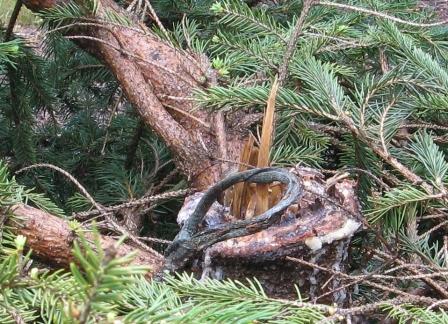
Just a matter of time (Photo: Jennie Stanger)
In this case the stakes were removed but the strapping material was left around the tree. Since this is a spruce, Jennie supposes no one wanted the prickly job of wading into the center of the tree to take off the strap. … Continue reading this article “Brace yourself”
The heartbreak of ‘Carrot-top’ syndrome
The perk of participating in a blog is you get a platform to vent on your pet peeves. Recently I’ve seen several classic examples of ‘Carrot-top’ syndrome. No, I’m not talking about the red-headed comic; though he tends to annoy me too.

Annoying Carrot-top #1.
The ‘Carrot-top’ I’m referring to occurs when white pine trees are sheared as Christmas trees but then planted as landscape trees. The typical result is that the side and lower branches remain suppressed while the terminals go crazy. … Continue reading this article “The heartbreak of ‘Carrot-top’ syndrome”
Going off half-cocked
The good news about being a landscape extension specialist is you get to comment on a variety of landscape tree problems. The bad news? You get to comment on a variety of landscape tree problems. In an average week I probably get 10-15 tree-related calls or e-mails from homeowners, landscapers, growers, extension educators, lawyers, newspapers, and on and on. Sometimes the problem is routine and obvious like tar spot on maples; “I have these spots that look like tar on my maple leaves…” Sometimes the problem looks routine and turns into something else entirely different like the Imprelis herbicide debacle. … Continue reading this article “Going off half-cocked”
Sheep-eating flowers?!
I was planning to follow up on Jeff’s phosphorus post with a bit more “phun with phosphorous.” However, I was completely derailed by Ray Eckhart’s message and link left for me on our GP facebook page with this headline:
RHS ‘sheep-eating’ plant about to bloom in Surrey
“The Royal Horticultural Society (RHS) at Wisley said the Puya
chilensis, a native of Chile, would bloom in the next few days and last
about a week.
In the Andes it uses its sharp spines to snare and trap sheep and other animals, which slowly starve to death.”… Continue reading this article “Sheep-eating flowers?!”
Phosphorus and Big Macs
Minnesota, and I were cruising through old pictures and files and getting all sentimental about the cool stuff we used to do. A lot of it was never published just because after we were done with one thing we were just too damn excited to move on to the next. Anyway, one of the neatest experiments that we never wrote up was a phosphorus experiment. Here’s what it looked like to the casual observer.
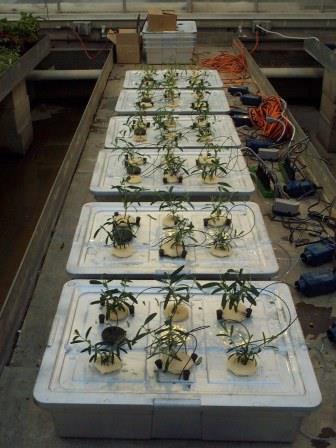
Now let me explain the neat part to you a little. … Continue reading this article “Phosphorus and Big Macs”