Did you ever know one of those annoying people who always talks about how great everything is back wherever they were from; the kind of folks that make you want to say, “If things were so much better there, why are you here?” I have to confess I’m one of those people. No one’s ever actually given me the “If things were so much better there” line, but I’m sure my Michigan friends have been tempted. … Continue reading this article “Fall color time…”
My Thoughts on 2,4 D
My sister, who lives in the Pittsburgh area, just gave me a call. She and her husband have two kids and a lawn and she wanted to know my feelings about using herbicides to keep the grass free of weeds. When we were growing up our parents had a large lawn (and lots of fruit trees) and it took two of us two hours to mow the whole thing. It kind of turned her off to grass. … Continue reading this article “My Thoughts on 2,4 D”
Weird and Wonderful Plant Wednesday: Threefer!
This is a tale of three plants in my garden that would make the cruelest of multiple choice answers. Heh. Hence the inclusion of all three in this post:
a. Manihot esculenta
b. Abelmoschus manihot
c. Abelmoschus esculentus
d. All of the above
e. Aaaargh.
Manihot esculenta is Cassava or Tapioca; worthy of an entire post on its own. But the choice ornamental version is M. esculenta ‘Variegata’ or variegated tapioca. I first saw it (gawked and squealed, actually) at Allan Armitage’s fab trial garden at the University of Georgia.… Continue reading this article “Weird and Wonderful Plant Wednesday: Threefer!”
Pop quiz answer
Today’s post is a follow-up to yesterday’s quiz on foliar fertilization. I asked our blog readers to match the needle nitrogen content of Nordmann fir trees with the fertilizer treatments they had received.
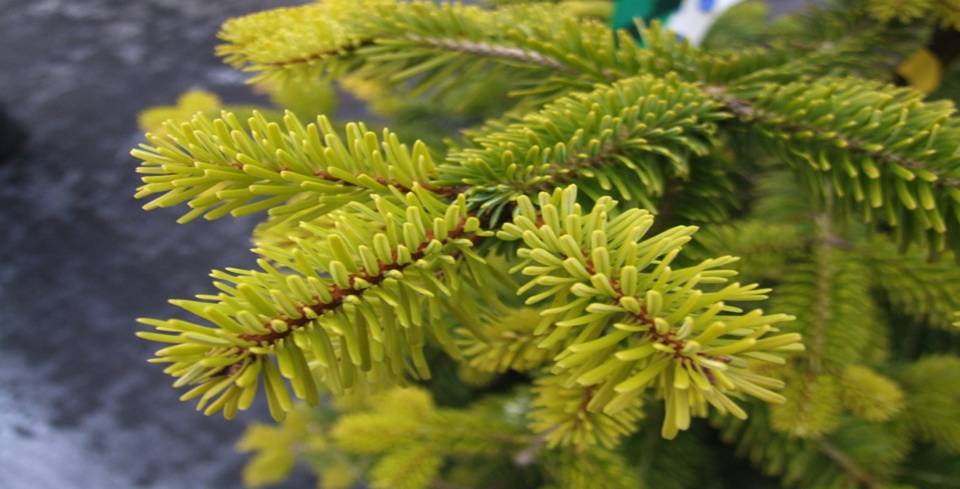
Nutrient deficient Nordmann fir
The correct order is:
1) control: no fertilizer 0.98%
2) soil applied controlled release fertilizer 1.70%
3) foliar nitrogen fertilizer 1.14%
4) soil applied fertilizer + foliar feed 1.91%
While the foliar fert had a small effect, it’s important to note that, from a statistical standpoint, foliar fertilization did not significantly increase needle nitrogen concentration. … Continue reading this article “Pop quiz answer”
Podcast #8 – Water Works
We’ve finally gotten our summer here in the Pacific NW and it’s been pretty hot for a few weeks. The plants weren’t really prepared for this, so we’ve had to irrigate quite a bit to keep all that lush foliage happy. So the topic of this podcast is Water Works – focusing on how water moves in the soil and through plants.
One of the more interesting tidbits I found this week is a recent USDA study on growing more potatoes with less water.… Continue reading this article “Podcast #8 – Water Works”
Don’t be snookered
Just a short (but irritated) note about the latest fawning over compost tea. Please, people, as Jeff pointed out nearly two years ago on this blog, just because Harvard (and now Berkeley) buy snake oil it’s not transmogrified into science. Middle America would be better served by using compost as a mulch and letting nature make the tea.
Pop quiz time!
It’s the start of new semester. Best way to get student’s attention is with a pop quiz right off the bat! So in that vein, we’ll cross things up and give a quiz on Monday instead Friday. Relax; to make things a little easier we’ll make this one a matching exercise.
Here goes. At our recent Christmas tree conference in Austria, a colleague of mine at Oregon State University, Chal Landgren, presented the results of a study to look at the effectiveness of foliar fertilization on Nordmann fir. … Continue reading this article “Pop quiz time!”
Bambara
This past summer I had the chance to talk with an old friend of mine, Hamado Tapsoba, who I hadn’t seen in 15 years. We had gone to graduate school together, but after graduation he headed back to Burkina Faso, and I headed up to Minnesota. Anyway, while we were talking I told him that we were growing peanuts at the University (yes, I tell everybody — peanut news needs to be shared!). When I told him some of the problems that we had with shorter seasons he asked why we weren’t growing Bambara groundnuts. … Continue reading this article “Bambara”
Podcast #7 – Better Red Than Dead
This week’s podcast is dedicated to anthocyanins – those pigments that give plants red, blue, and purple colors. Anthocyanins are also powerful antioxidants, important visual signals for pollinators, and often deadly to insect pests. The myth of the week explains why red leaves aren’t usually a sign of phosphorus deficiency, but instead an indicator that anthocyanins can help plants survive many environmental stresses.
My interview this week is with Cass Turnbull, founder of PlantAmnesty, a Seattle organization dedicated to “ending the senseless torture and mutilation of trees and shrubs.” … Continue reading this article “Podcast #7 – Better Red Than Dead”
You guessed it…
The glorious Allium ‘Globemaster.’
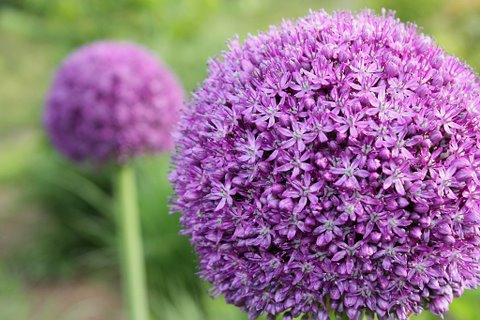
Michelle and Laura B. nailed it, and Jennie had the correct genus.
A little taxonomic correction – it is NOT A. giganteum, as many catalogs and articles suggest, but rather a hybrid between A. macleanii and A. christophii; described by the breeder himself – Jan Bijl – in a 1990 issue of The Plantsman (vol. 12 pp 152-156). Unless I’ve totally messed up and this is ‘Gladiator,’ not ‘Globemaster.’ They’re quite similar.… Continue reading this article “You guessed it…”