So let’s see here…someone planted a nice little Japanese maple outside a hotel, and everyone was happy. Then an elm started to grow next to it, and it looked pretty good. In fact, it looked better than the maple. So, what the heck? Let the elm grow and ignore the maple. And now….At what point do you decide which tree to sacrifice so that the other can live a reasonably healthy life? (Yes, there is a correct answer!)… Continue reading this article “Is it an Elmaple!”
A scary Halloween story
Those of you that have followed the blog for a while know that poor tree planting is one of my pet peeves. It drives me crazy to watch tree installers use backhoes to gouge out gigantic holes and then drop in the intact root ball, clay, burlap, twine and all. But this dig-and-dump method (or “cost effective practice” according to installers) of installing trees often dooms them (the trees, not the installers) to a slow and ugly death.… Continue reading this article “A scary Halloween story”
Scenes From A Zoo
The other day I went to a local zoo with my family. I’m not a big zoo lover. I hate to see animals in cages and kept from their natural wanderings and habits, but this zoo serves as a rescue, so I didn’t complain too much. As we were walking around I couldn’t help but notice the following container which I can only suppose once served as a food or water bin for one group of animals or another.… Continue reading this article “Scenes From A Zoo”
The great urban potato experiment
I don’t grow vegetables at home, mostly because I don’t have the space and partially because I don’t have the time. But I did want to try the potatoes-in-a-barrel method, which I also tried last year. But this year I planted about 6 weeks earlier (end of April) than I did the previous year (mid-June). Here’s my mid-October harvests from both years:
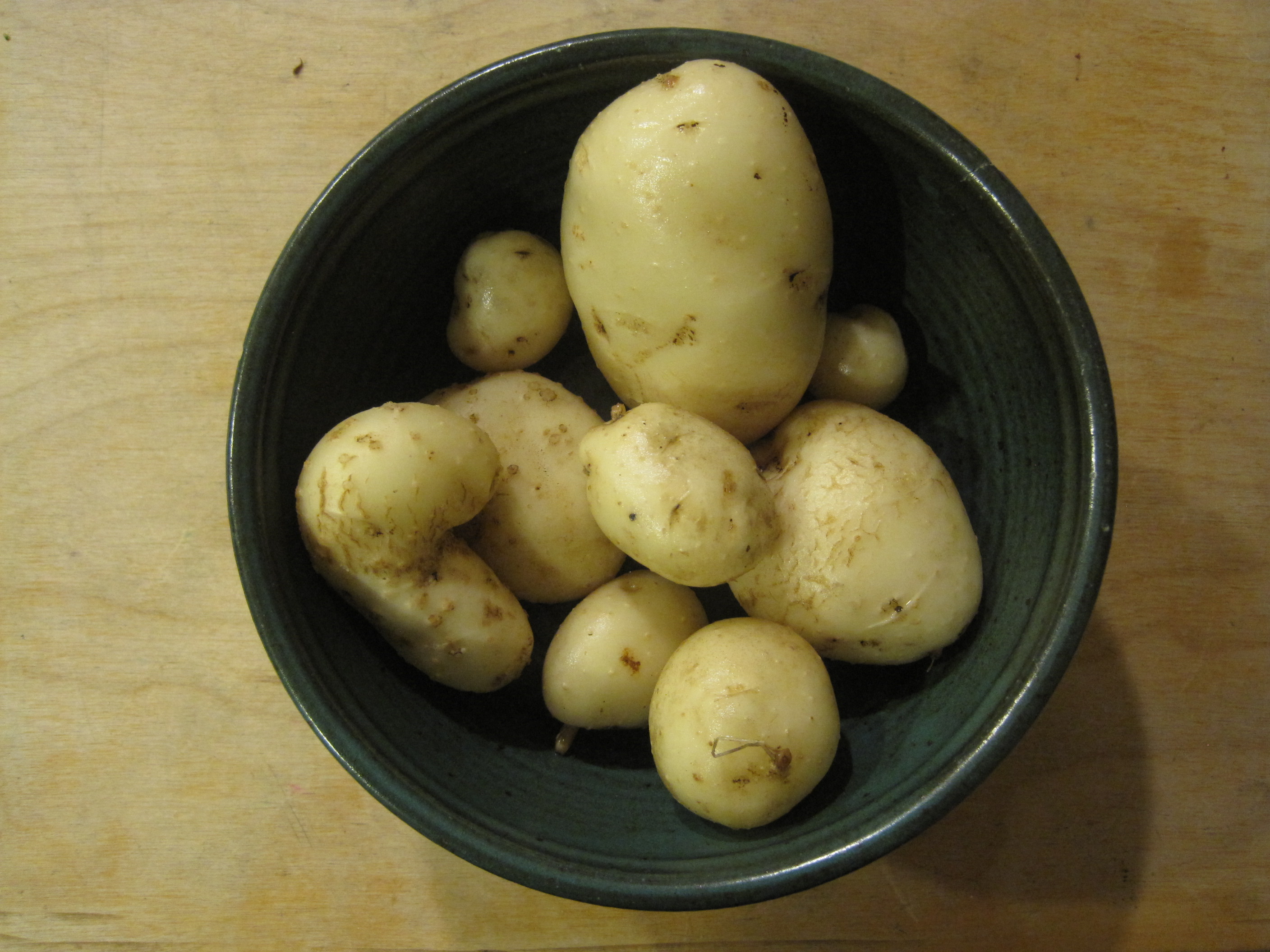
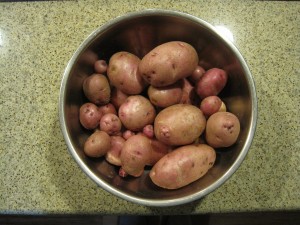
Next year I’ll try planting even earlier. It’s not a huge harvest, but it’s fun to do, especially with kids.… Continue reading this article “The great urban potato experiment”
What’s wrong with my pine tree…? Nothing!
Every once in a while in this line of work we’re actually able to give a homeowner some good news about their trees. A case in point is a call that we frequently get this time of year that starts like this: “My pine tree looks like it’s dying! It’s dropping all of its needles!” If the caller has access to the internet and a digital camera I usually request that the send me a couple of photos; if not, I ask them whether the tree is shedding needles along the outermost part of the limbs or on the interior.… Continue reading this article “What’s wrong with my pine tree…? Nothing!”
Cool plant of the day: Canary Bellflower
I’m such a plant nerd that a few years ago I actually decided to get Canarina canariensis, the Canary Bellflower, for no other reason than that it is one of the very few members of the campanula family that has red-orange flowers instead of the usual purple-blue ones.
Okay. Maybe that isn’t the most normal reason to add a plant to one’s garden, but I am VERY happy I did.
That color!
I’ll admit, it isn’t a plant that is particularly well adapted to life here in Michigan… as the latin name suggests (twice!)… Continue reading this article “Cool plant of the day: Canary Bellflower”
Walnut warfare
Recently, a question about using black walnut chips for mulch was posted on our Garden Professors Facebook group page. As gardeners know, black walnut has a reputation as a chemical warfare species that will kill anything growing underneath it – a phenomenon called allelopathy. So it’s logical to wonder about the lethality of walnut chip mulches.
To get a good feel for the science behind black walnut’s allelopathic abilities, I was fortunate to find a relatively recent review on the topic (Willis, R.J.… Continue reading this article “Walnut warfare”
Digging these wasps!
After writing about the unusually bad scourge of Japanese Beetles earlier in the month, I thought I’d continue on down the “garden bugs” path. The Japanese Beetles have died down, but now we have oodles of these pretty black and yellow-spotted waspy things around. They’re everywhere, and in large numbers. I planted some buckwheat over our potato garden bed, and it is covered up with them. The point of the buckwheat was as a primo late-season nectar source for our honeybee hives as they prepare for winter.… Continue reading this article “Digging these wasps!”
What about fall fertilization?
Posted by Bert Cregg
We had a question on the Facebook site regarding fall fertilization of landscape plants. Fertilization in general, and fall fertilization in particular, is a complex topic and needs a little more room for explanation than the Facebook discussion allows.
As a general rule, most landscape trees and shrubs can maintain acceptable growth and appearance without fertilization. There are a couple of reasons for this. As Linda noted in the Facebook discussion, woody plants are fairly efficient at internal nutrient recycling.… Continue reading this article “What about fall fertilization?”
One tree’s leaves… over 400 kinds of bacteria!
Okay… this bit of research just blew my mind.
Researchers took leaf samples from just ONE tree in Panama, and identified over 400 different kinds of bacteria making their home there. Sampling 57 different tree species, the total number of bacteria types ballooned to over 7,000. You can read more about the study here.
That’s a lot. I love this kind of research because it just reinforces how LITTLE we know about this world we live in.… Continue reading this article “One tree’s leaves… over 400 kinds of bacteria!”