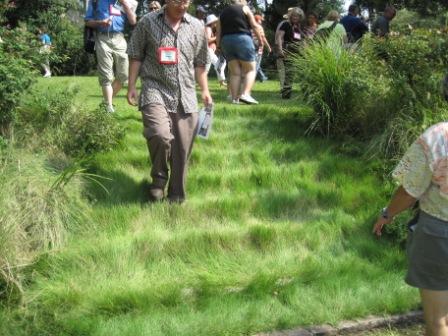
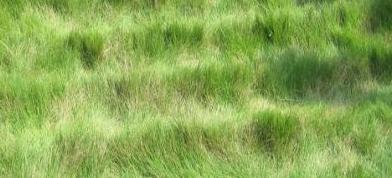
During my trip to Dallas last week, I saw several low-water lawns, including this one using buffalograss (Bouteloua dactyloides):

The question is – why does have this wave structure?
Another revealing picture and answer on Monday!
During my trip to Dallas last week, I saw several low-water lawns, including this one using buffalograss (Bouteloua dactyloides):

The question is – why does have this wave structure?
Another revealing picture and answer on Monday!
Last year we completed a small research study on how to kill buckthorn. If you live in the upper Midwest then you’re familiar with this plant as a shrub which has escaped cultivation, been spread by birds, and generally made a nuisance of itself, particularly at the edges of forested land.
Buckthorn is notoriously difficult to kill after it gets more than about a foot high. It laughs at single applications of roundup. If it’s pulled out of the ground any roots that don’t come with it have a good chance of sprouting shoots themselves, and it seems to enjoy being treated with organic herbicides like vinegar. … Continue reading this article “How to Kill Buckthorn”
Alert reader Matt Wood pointed out a recent article in the NY Times on mulching with newspaper and wondered about my take on the topic.
For use on landscapes, I do not like sheet mulches of any stripe. They tend to hinder to air and water movement, most especially in unmanaged landscapes like restoration sites. A classic example is the use of cardboard or newspaper covered with wood chips. The chips are easily dislodged, exposing the sheet mulch which quickly dries out and becomes hydrophobic. … Continue reading this article “Sheet mulching – benefit or barrier?”
So we last left off discussing the issue regarding the fact that the point is incumbent on us that one can’t refer to a native as "invasive" withou…
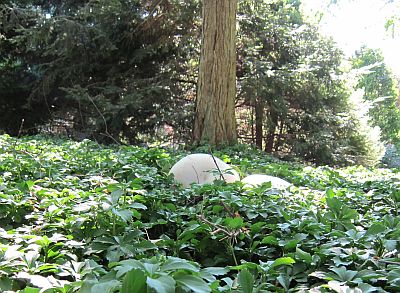
Look!
What’s that??!
There! Amongst the Pachysandra!

Is it a freshman? Perhaps passed out in our campus garden in despair after yet another stinging defeat of the Hokies?
*
*
*
*
*
*
*
*
*
*
Nay, ’tis a pair of Calvatia gigantia – Giant Puffballs.… Continue reading this article “It’s a Bird! It’s a Plane! It’s a …Butt?”
We’ve been beating up nurseries over Why-Oh-Why (W.O.W) do they sell things like Scot broom. Here’s one of my favorite W.O.W’s from the landscape side (Homeowner division).

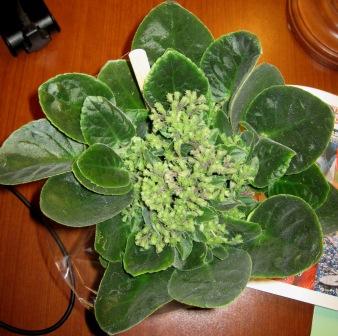
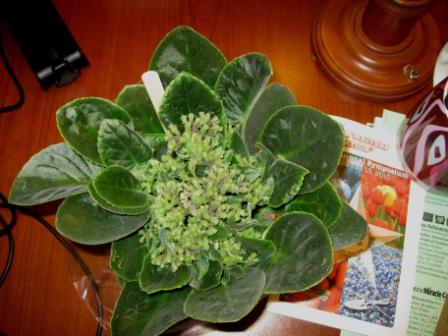
Friday’s puzzle scared you off! Matt was correct – this is an African violet (Saintpaulia spp.). But unlike other African violets, this one never opens its flower buds (Sandy nailed it!). Originally cultivated in Germany, these plants are marketed in the US by Optimara Violets. That’s all I can tell you about this quirky little cultivar.

I’m in Dallas for the next 4 days attending the GWA (Garden Writers Association) annual conference. (I get to give a talk on Horticultural CSI on Sunday!) Tonight we had a slew of vendors to explore, and among the offerings I found this plant:

So today’s question – what is this plant? And what makes it so unusual? The first question might be easy – the second one, not so much.
Answer and more info on Monday!
One of the products that I often hear gardeners raving about are their fertilizer / pesticide combination spikes which are supposed to not only feed your plants, but also kill all of the insects which attack them. I, personally, have not used these products, but I’m generally the kind of person who says “If it works for you then keep using it”. Still, these spikes bug me a little. Here’s why.
First of all I should point out that I’m not opposed to fertilizer spikes by themselves. … Continue reading this article “Are Fertilizer and Insecticide Spikes a Good Idea?”
Since we’re back on the alien train (spaceship?), I thought I’d bring up another of my least favorite shrubs – Scots broom – as our next installation of WOW (why oh why?).
Scots (or scotch) broom (Cytisus scoparius) is a much-reviled intruder in the western and eastern United States. Originally introduced as a sturdy ornamental, this legume quickly invaded disturbed areas and is labeled as a noxious weed in several western states. In Washington, it’s quarantined. … Continue reading this article “W.O.W. (aka Why oh why do nurseries sell this plant)?”
Loyal reader and thoughtful commenter Ray Eckhart posted a while back (something along the lines of) wouldn’t it be nice if we could come to some agreement on all this “what’s invasive” terminology. This has been flitting in and out of my brain but has not found sufficient gray matter to come to rest. Regardless, here goes. I’ve attempted to capture these concepts in as few words as possible. My opinions in no way reflect those of the Garden Professors, blog host Washington State University, or anyone else important, for that matter.… Continue reading this article “Defining Your Terms”