Winter Trade Show Report

Disclaimer: The information and images below should not be construed as any sort of recommendation, remedy or advice. Just some cool and/or weird stuff I saw at a green industry trade show. Plus this blog needs more photos.

Was at the Mid-Atlantic Nursery Trade Show (MANTS… and yes, there is a Pennsylvania version…PANTS) in Baltimore a couple of weeks ago.  It’s a wonderful opportunity to visit with past students (now gainfully employed – yay!).  I also get to personally thank the nurseries and other businesses that generously support our Horticulture Department and Garden. … Continue reading this article “Winter Trade Show Report”

Warning: This blog may be hazardous to your health

Following up on Jeff’s post last week regarding blue spruce.  Jeff noted, and several posters agreed, that even though blue spruce will eventually have a host of pest problems, for the first 10 years or so it’s a darn good looking landscape conifer.  Jeff went on to draw the analogy that choosing a blue spruce is like choosing sexy sports car or gas guzzler over a boring, high MPG sedan.  To a certain extent the libertarian in me agrees. … Continue reading this article “Warning: This blog may be hazardous to your health”

Porsche 911 or Toyota Camry

Earlier today I was in a meeting with some other professionals from across Minnesota (and a few from Wisconsin and other areas) to discuss the disease problems of conifers.  Our discussion quickly became focused on the use, and overuse, of Colorado blue spruce, a tree that just doesn’t do well in Minnesota — Or Michigan from what Bert has written!  Everyone in the meeting was yammering on about how we need to educate nurseries and consumers about how terrible the Colorado blue spruce is in our environment — you’re lucky if you can get 10-15 years out of the thing before it succumbs to one disease or another. … Continue reading this article “Porsche 911 or Toyota Camry”

Fast food is unhealthy for plants, too

In early December, I posted my thoughts about fertilizing crops vs. landscapes.  An anonymous reader asked if we could follow up by discussing the relationship between excessive fertilizers and plant susceptibility to pests and disease.  It’s taken a month to get the scientific literature (and my act) together, but here it is.

There are decades’ worth of articles about the direct relationship between increased nutrient availability and increased susceptibility to pests, disease, and disorders.  One of the earliest articles linked the incidence of celery blackheart to over-fertilization. … Continue reading this article “Fast food is unhealthy for plants, too”

A comment about home remedies from Catherine Daniels

In case you didn’t see yesterday’s comment that was added to Jeff Gillman’s January 6 post on home remedies, I’ve posted it here.  Dr. Catherine Daniels is WSU’s pesticide coordinator:

I’ve enjoyed reading the science-based information on your site. Keep up the good work. As regards home remedies, that is slippery slope, both legally and morally. Having a written definition of what you will or will not accept is helpful, especially if done in advance. Then you can be sure of being consistent and deliberate at least.… Continue reading this article “A comment about home remedies from Catherine Daniels”

Landscape conifers: The Good, the Bad, and the Underused

This week is our annual Great Lakes Trade Expo, the main trade show and education venue for Michigan nursery and landscape industry. One of my talks was for the Arboriculture track on landscapes conifers. The theme this year was “The Good, the Bad, and the Underused.” Hey, you try giving a dozen talks a year for 10 years and see if you can come up with an original title!


The selections were based the following, admittedly subjective, criteria.… Continue reading this article “Landscape conifers: The Good, the Bad, and the Underused”

Pampas unpuzzled

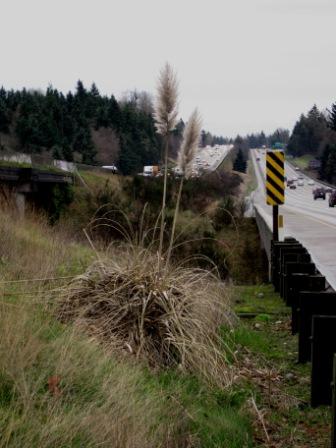
Great discussion and answers on this one, gang!  Yes indeed, this is a plant out of place – as several of you noted.  But not only has it escaped from an ornamental landscape, it’s decided to grow, quite happily, in the median strip of I-5:

Another odd thing is that the species has not been officially recognized as invasive in Washington State.  It’s been languishing on the “Monitor” weed list for at least two years.  Our climate is a bit chilly for it, which may be part of the reason it looks so bad right now. … Continue reading this article “Pampas unpuzzled”

Pampas puzzler

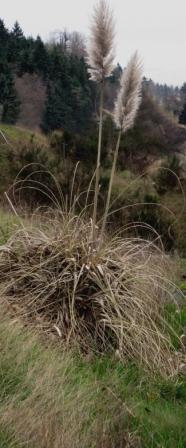
Here’s a photo of some pampas grass (Cortaderia selloana), much beloved by many homeowners in their landscapes:

But what’s unusual – and undesirable – about this particular specimen?  Hint:  the landscape has been modified a little.

Answer on Monday!

Where to Draw The Line on Home Remedies

On Tuesday Holly posted an extremely interesting article about how Bounce could help control fungus gnats.  Then one of our frequent commenters (and all around great guy) Ray Eckhart pointed out that he has a problem with promulgating an off-label use of a product.  And that got me to thinking.  What household products is it OK for us to suggest that a consumer use for a non-labeled purpose, and what products shouldn’t we suggest?  This is a question that has haunted me for a long time, so with this post I want to give you my line of thinking – I’m not trying to tell you what’s right or wrong – just trying to let you know my thoughts on the topic.… Continue reading this article “Where to Draw The Line on Home Remedies”

Will cabling a tree’s crown make it stronger?

In a previous column (December 1, 2010) I discussed the problems that wet, heavy snow can cause for trees and shrubs – particularly evergreens.  In response my colleague Terry Ettinger mentioned a cabling technique discussed in the 2nd edition of Arboriculture (1991).  I think it’s worth looking at the science behind this practice and some of the unintended consequences.

Harris’s Arboriculture text is considered the bible for landscape professionals, including certified arborists.  In the late 1990’s, Dick Harris was joined by Jim Clark and Nelda Matheny, two other gifted academics who have crossed over into practical writing. … Continue reading this article “Will cabling a tree’s crown make it stronger?”