Mortal Kombat – garden version

Soil solarization is regarded as an environmentally friendly alternative to pesticides for controlling nematodes, weeds and disease.  Sheets of plastic (generally clear) are spread over the ground and solar energy heats the soil underneath to temperatures as high as 55C (or 131F).  Since the soil environment is usually insulated from temperature extremes, the organisms that live there are unlikely to be resistant to heat stress.

This is a practice best suited to agricultural production, where monocultures of plants have attracted their specific diseases and pests. … Continue reading this article “Mortal Kombat – garden version”
Bordeaux Mix

One of my favorite stories about pesticides is the story of Bordeaux mix.  It’s a story of France in the 1800s (so it must be pretty romantic, right?) and how they were suffering from a shortage of grapes.  Don’t feel sorry for them — it was really their own doing.  Over the course of the 19th century grape vines were brought from the United States to test their merits against European grapes.  It was quickly discovered that, for the most part, American grapes were not the equal of European grapes for winemaking. … Continue reading this article “Bordeaux Mix”

A salt bath for your tomatoes?

This morning I got an email from one of my gardening colleagues, wondering about the wisdom of watering tomato plants with salt water.  He had a link to a UC Davis website which tacitly endorses spraying tomato plants with 10% salt water “to increase their nutritional value and taste.” Unreferenced “worldwide studies” are mentioned, along with the “major potential benefit of providing irrigation for crops in areas with freshwater restrictions.”

Before we deal with the impracticalities and out-and-out harm of using salt water for irrigation, let’s look at why this practice would work on tomatoes. … Continue reading this article “A salt bath for your tomatoes?”

Jeff Gillman a.k.a. Dr. Unbiased!

“Everyone’s taking stands, and unfortunately, some of those taking the strongest stands have the least information.”
Dr. Jeff Gillman, on “How the government got in your backyard”, co-authored with Eric Heberlig

Fine Gardening did a fine job in a recent interview that was linked to their e-mail update.  FG Editor Steve Aitken brings some humor as he quizzes Dr. Jeff. about his new book.  Check it out here.

Steve opens with “Is the government really in my backyard?Continue reading this article “Jeff Gillman a.k.a. Dr. Unbiased!”

The roots of the rhody problem

There were several good shots at analyzing Friday’s unhappy rhododendron.  Mature leaf size can be determined by light levels, as both Lisa B and Tom &  Paul suggested.  Moving a plant from a low to high light environment could cause this change in leaf size.  This rhododendron hasn’t been recently transplanted, however, so we can eliminate light levels as a cause.  (And there was no other impediment to light, such as the presence of shading plants.)… Continue reading this article “The roots of the rhody problem”

Friday puzzle: unhappy rhododendron

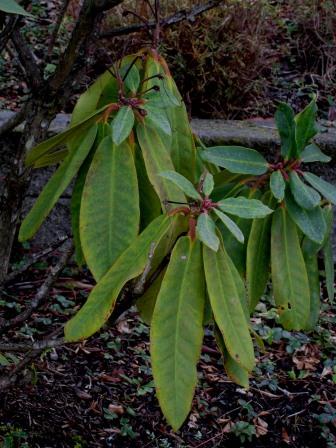
Today we have a diagnosis question. Consider this unhappy rhododendron:

While there is more than one problem with this poor thing, the one I’d like you to think about is why the newer leaves are smaller than the old leaves. (They are fully mature.) There are two parts to this question:

1) What is the physiological reason that the leaves are smaller? (In other words, what is directly causing this difference?)
2) Knowing this, what does this tell you about the underlying problem?… Continue reading this article “Friday puzzle: unhappy rhododendron”

Breaking up Tree Week with an Important Announcement! (Or Not — depending on how you feel about shameless plugs)

OK, here it is, my one and only shameless plug — because my publisher says: Hey! You need to at least let people know that the book exists!

So — I’m excited to say that my next book, How The Government Got In Your Backyard, which I co-wrote with my good friend (and old college roommate) Eric Heberlig, who is an Associate Professor of Political Science at UNC Charlotte, is finally out.

In case it isn’t immediately obvious, I love to write.… Continue reading this article “Breaking up Tree Week with an Important Announcement! (Or Not — depending on how you feel about shameless plugs)”

Blog Survey Results, Part 1

I was gently reminded last week that I never published the results of our survey, asking our readers for feedback on the first full year of posting on The Garden Professors. All four of us are extremely grateful to those of you that participated, as we could use this information in our annual reporting and reviews.  Thank you all for taking the time.

To keep this from being too long for our blog, I’m going to just cover the first two questions today. … Continue reading this article “Blog Survey Results, Part 1”

Valentine’s Day, yet again…

We make fun and call it “National Forced Affection Day” (NFAD) around
our house. But it’s big business.

The National Retail Federation did a survey of 8900+ consumers in their 2011 Valentine’s Day Consumer Intentions and Actions Survey They found that the
average person will shell out $116.21 on traditional Valentine’s Day merchandise this year, up 11 percent over last year’s $103.00. Men spend twice
as much as women. Total holiday spending is expected to reach $15.7 billion.… Continue reading this article “Valentine’s Day, yet again…”

Proposed phosphate fertilizer ban – a dissection of the criticisms

A few brave souls gave Friday’s homework assignment a good shot.  Ryan did a nice critique of the bullet points; Kenny did a little digging on WFFF, the organization behind the email; and Tom chimed in with the fact that Israel managed to do this a long time ago without impairing plant health.  Gold stars for all!

Here’s my initial analysis of the statements made, based on reading the bill (which you should do if you haven’t yet; it’s neither long nor difficult to understand):

WFFF: 1) The intent section contains scientifically inaccurate statements, creating a false precedent that turf fertilizer is a significant surface water pollutant and is not necessary for a healthy lawn.… Continue reading this article “Proposed phosphate fertilizer ban – a dissection of the criticisms”