Pocket parks and urban corridors

As you may know, I spent most of the last week in Charlotte, NC.  On my last night, I got to visit uptown and enjoy the pocket parks along Tryon Street.  Here’s one of them at the intersection of Tryon and Trade:
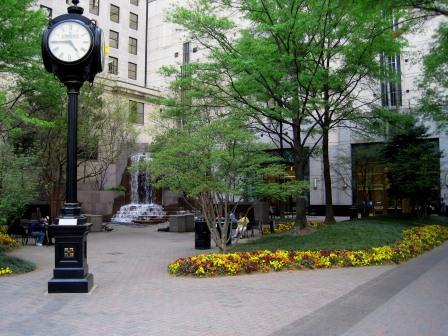
It has a lovely water feature – it was a warm day and the breeze from the fountain cooled the air off significantly.

A little further on was this plaza, featuring jasmine-covered “umbrellas”:
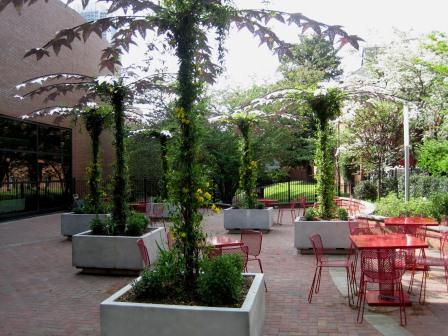
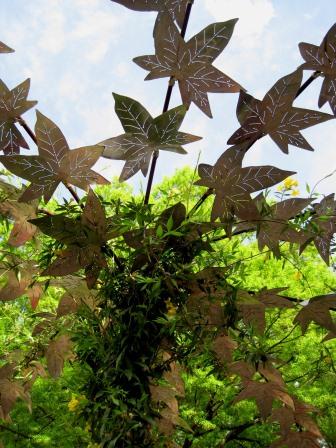
The umbrellas were actually sculptures – little works of art on their own:
The nicest things about the uptown area were the wide streets and equally wide sidewalks. … Continue reading this article “Pocket parks and urban corridors”
The invisible, insidious presence of heavy metals

I spent the last two weeks in Spain, combining business with pleasure.  It’s interesting when something that starts out as part of the pleasure ends up being business instead.


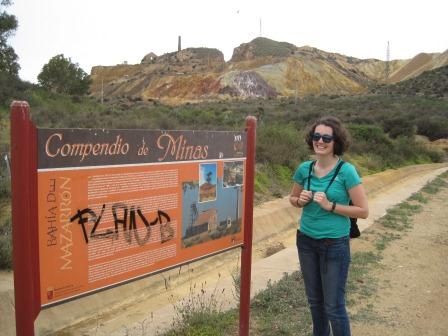
Charlotte translated this sign for me – it’s historical information. Note the brightly colored mine tailings in the background.

My daughter is teaching English in Mazarrón, a small town in the province of Murcia. The climate there is very similar to southern California, though drier and not as warm: it’s pretty much a scrubland ecosystem.… Continue reading this article “The invisible, insidious presence of heavy metals”

The End (hopefully) of Molasses Malarkey

I’ve been discussing the purported insecticidal properties of molasses in my last couple of posts. I’m hoping this will be the final nail in the coffin (or stopper in the bottle):

Here’s the end of the original blog piece linked above:

“Microbial bloom and Fire Ants
“These two things seem unrelated. Microbes and specifically bacteria consume simple sugars (which is why your momma made you brush your teeth). When soil born microbes are exposed to simple sugars, their numbers can double in just 30 minutes.… Continue reading this article “The End (hopefully) of Molasses Malarkey”

Garden Professors on the Mike Nowak show

Last Sunday Jeff Gillman and I were guests on Mike Nowak’s Chicago-based gardening show.  It’s now linked up, so check it out if you feel so inclined!

There’s been discussion on Facebook as well, primarily about (you guessed it) compost tea.  (You’ll need to find the #gardenchat group and scroll down to Mike’s posting to see the lively discussion.)

The Return of Molasses Malarkey

Last time I posted I began discussing this link about horticultural molasses. Let’s continue with the dissection:

“When molasses is sprayed directly on plants, it is absorbed straight into the plant. Once absorbed, the sugar content of the plant goes up. If you need proof, go pour a Coke on a spot in your lawn, in a week you will see exactly what I mean. Simple sugars are how plants store energy for rainy days and winter hibernation.… Continue reading this article “The Return of Molasses Malarkey”

Molasses malarkey

Yesterday I received this link from a Facebook friend who said “when I read this I thought of you.”  More likely she was thinking of (enjoying?) the mental agony I suffered as I waded through this morass of misinformation. (By the way – those of you who are educators of some sort – this would make a great “how many things are wrong?” question for your students.)

There’s SO much to discuss in this post that I think I’ll split it up into separate posts. … Continue reading this article “Molasses malarkey”

What’s a view without trees?

A while back I wrote about a Seattle-area neighbor dispute over a tree partially blocking their view.  Sadly, the tree lost out in this case, which was decided a few weeks ago.

Now a second tree vs. view dispute was reported this week.  You’ll have to read the story to see how many things are inaccurate/indefensible/infuriating about the “trimming” of this 90 foot western red cedar (a native species).  My personal favorite: “the tree violated neighborhood bylaws ensuring no house’s view would be blocked.”… Continue reading this article “What’s a view without trees?”

News flash – genes don’t explain everything!

Last week dedicated blog follower Ray E. sent me this link to a story in the Smithsonian magazine.  It’s a fascinating look at adaptive responses by frog eggs and apparently is causing quite a stir in the evolutionary biology community.  Phenotypic plasticity, which is the ability of an organism to modify its appearance or behavior based on environmental cues, is being hailed as a “revolutionary concept in biology.”

I don’t get it.

Anyone who’s studied plants for any length of time knows about this phenomenon. … Continue reading this article “News flash – genes don’t explain everything!”

Buried alive – the roots version

Bert’s post yesterday inspired me to share one of my own timelines that I followed for 7 years.  As many of you know, I am a proponent of bare-rooting container and B&B shrubs and trees.  One of the benefits is that you can prune away malformed roots, but another is that you can ensure the roots come into contact with the native soil as soon as possible.  It’s interesting to see what happens over time with the more typical “pop and drop” method.… Continue reading this article “Buried alive – the roots version”

The secret of immortality

Last Sunday’s New York Times had a story about immortal jellyfish.  It was interesting, and given my previous life as a marine biologist, it was also a topic that was comfortably familiar. But really, I wasn’t that impressed.  Because plants do the same thing, yet no one bats an eye.

Gardeners and other plant aficionados have exploited the plant kingdom’s ability to remain forever young.  How many of us have taken cuttings of mature plants, rooted them, and started new ones? … Continue reading this article “The secret of immortality”