A holiday gift idea

In deference to the holiday season, I’ll step down temporarily from my soapbox and mention a great holiday gift idea for your favorite gardener.

I saw this sedum stump a few years ago when I was speaking to a Master Gardener group in British Columbia.  The porous nature of the stump would make it easy for the roots of the sedums and other rock-garden types of plants to establish. And the stump could be easily moved to wherever the recipient desired.… Continue reading this article “A holiday gift idea”
Research that gardeners should appreciate!

Today I received my November 2012 issue of Arboriculture and Urban Forestry.  This is one of the few peer-reviewed journals that generally has information of immediate value to gardeners and landscape professionals as well as academics.  This issue contains an article entitled “Evaluation of biostimulants to control Guignardia leaf blotch (Guignardia aesculi) of horsechestnut and black spot (Diplocarpon rosae) of roses.” (And before you ask, no, I can’t attach the article or link to it. … Continue reading this article “Research that gardeners should appreciate!”

Important, must-read announcement regarding pesticide use

There’s a new report out from the Weed Science Society of America (WSSA) which blasts a common piece of gardening advice: use least toxic pesticides only as a last resort.  Popular as it may be, this advice is not scientifically grounded and can actually cause more harm than good.  The WSSA is joined in this announcement by the American Phytopathological Society (APS) and the Plant-Insect Ecosystems Section of the Entomological Society of
America (P-IE ESA).

This is a must-read for anyone who is a responsible educator regarding pesticide use, which includes Master Gardeners and other horticulture paraprofessionals. … Continue reading this article “Important, must-read announcement regarding pesticide use”

Archived webinar available

We had a decent turnout on the webinar yesterday – saw a few names from our blog readers there.  I hope everyone was able to see and hear the presentation and didn’t have any technical difficulties?  If you did, please let me know so we can fix them for next time. For those of you who weren’t able to attend, it’s been archived for viewing at your leisure.

I used suggestions that readers suggested on the blog to demonstrate how to search academic databases for science-based information on products and practices related to gardening. … Continue reading this article “Archived webinar available”

Up in smoke

If you read my postings the last few weeks, you know that I’m doing a webinar on Wednesday on searching academic databases for information of interest and use to gardeners.  While researching one of the suggested topics (should we mow leaves into the lawn or bag and dump them?) I found a 2012 article* entitled “Biomass yield from an urban landscape” in the journal Biomass and Bioenergy.  My blood ran cold when I read this part of the abstract:

“It was estimated that the City of Woodward could generate about 3750 Mg of biomass dry matter in a normal rainfall year and about 6100 Mg in a high rainfall year if every homeowner collected their lawn thatch and clippings, and tree leaves, twigs, and limbs for bioenergy production.”… Continue reading this article “Up in smoke”

Webinar update – yes, YOU can attend!

A few days ago I posted about a webinar I’m doing on using academic databases for gardening myth-busting.  At the time I wasn’t sure what the rules were for viewing the webinar, but happily I’ve found out we can have outside viewers!  So here’s the information about when and how to log on to Adobe Connect (keep in mind this is Pacific Standard Time here).

Speaker: Linda Chalker-Scott

Date: Wednesday, November 7

Time: 10:30-11:30 a.m.

Address: http://breeze.wsu.edu/ext_skills/Continue reading this article “Webinar update – yes, YOU can attend!”

Who says you can’t get decent fall color on the west coast?


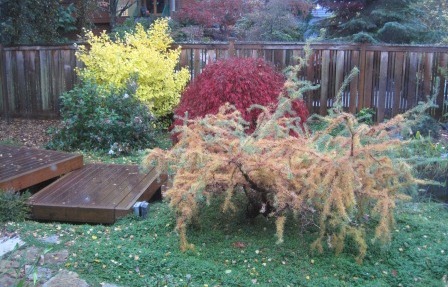
Thanks to our gingko, contorted larch, Japanese maple, and viburnum we’ve got it all:
Happy Halloween!
Continue reading this article “Who says you can’t get decent fall color on the west coast?”

What to do with storm damaged trees?

For those of you whose trees suffered storm damage this week, the ISA (International Society for Arboriculture) has an online article that may be of use.

If any of you have photos or questions regarding tree damage, please comment below.  Photos can be sent to me (lindacs followed by @wsu.edu).

Ideas needed for webinar

I’m doing a webinar for WSU Extension folks next week with the decidedly unsexy title of "How to run literature searches when writing extension publications and how to develop client material using the information from the lit search." In reality, it’s how to research gardening topics, identify the myths (those practices and products with no basis in science), and then write up the valid scientific parts for use by gardeners.  I’d hoped to get some ideas from this group on specific topics to demonstrate the process, but have gotten nothing. … Continue reading this article “Ideas needed for webinar”

Something different to end the week

Thanks to Neil H. for sending this my way.

This is from The Tree Whisperer:

ALERT!  HOW TO HELP THE TREES. Hurricane Sandy is coming to the East Coast, USA

If you are inclined to talk with trees–and aside from the practical things you can do–here is another way you can help your trees through the storm: Hurricane Sandy.  (Or send help, if you are elsewhere.)  

Go outside and walk among your trees and plants on your property.

Continue reading this article “Something different to end the week”