Here’s the trunk of a Japanese maple I photographed last month at a big box store in Seattle:
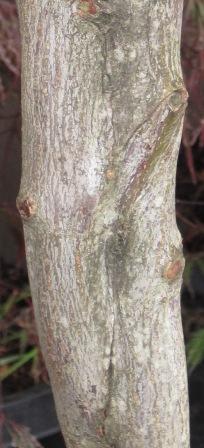
Why does the trunk look like this? Answers and more photos on Monday!
Here’s the trunk of a Japanese maple I photographed last month at a big box store in Seattle:
Why does the trunk look like this? Answers and more photos on Monday!
I’m going to add a bit more to Bert’s discussion. Through the efforts of Dr. Eric Wiseman of Urban Forestry at Virginia Tech, we have a
Utility Line Arboretum (ULA). Modeled after Dr. Bonnie Appleton’s original ULA for Virginia at the Hampton Roads research station, Eric’s includes many woody taxa suitable for planting in the vicinity of power lines (see a nice list of Bonnie’s favorite power-line-friendly taxa here).
Eric came to me with his plan in 2006 and we found some space in our Hahn Horticulture Garden to get it going.… Continue reading this article “So what to plant under power lines?”
One of our semi-recurring themes on the Garden Professor’s is our WOW’s or “Why Oh Why’s”. As in “Why oh why do nurseries continue to sell invasive plants?” Today, I’d like to turn things around a bit and look at a group of people that are often maligned by the public but, in fact, are getting a bad rap and could use a break; utility arborists.

Right tree, right place?
Utility arborists face a nearly impossible and unenviable task. … Continue reading this article “Utility arborists: Give ‘em a break”
Like Linda, I believe that we don’t plant enough bare-root trees. Trees that are harvested and sold bare root tend to establish better and recover faster from transplant shock than trees sold in containers or as B&B (balled and burlapped) stock. But, in general, trees that are purchased in as bare-root stock are smaller than the other two styles, with B&B generally being the production method which yields the largest trees.
I disagree with Linda that, as a general rule, B&B stock should have its roots washed off prior to transplanting — I’ve done it and I’ve lost trees. … Continue reading this article “Big Trees for Crime Reduction”
I’ve blogged before about the importance of getting tree roots in contact with the landscape soil during transplanting (you can find those posts here, here, here, here, and here). My advice to bareroot woody species upon installation is often ignored in favor of the quick-n-easy methods so often showcased on HGTV (“A complete landscape makeover in a weekend!”). And of course everything looks great…for a while. Let’s see what happens after a few years.… Continue reading this article “Newsflash: trees will die if their roots can’t establish”
As many of the blog readers are aware, I do a lot of writing about conifers. In the process I mingle with members of the American Conifer Society or ‘ACS’ for short -although some wag has suggested that ACS actually stands for Addicted Conifer Syndrome, such is the devotion of these enthusiasts for their beloved conifers. A couple weekends ago I was privileged to attend the first ever ACS ‘Illinois Conifer Rendezvous’ hosted by Rich and Susan Eyre, owners of Foxwillow Pines nursery in Woodstock, IL. … Continue reading this article “A lawn alternative we can support: Conifers!”
One of my colleagues emailed me a couple of pictures last week taken in Puyallup, WA. As you can see, there’s a trellis supporting a massive old trunk…
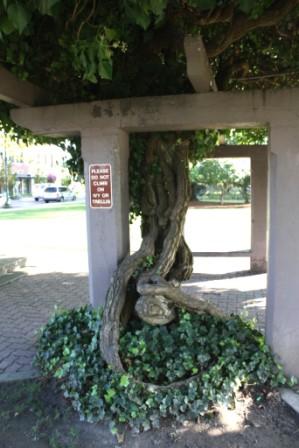
…and crown…
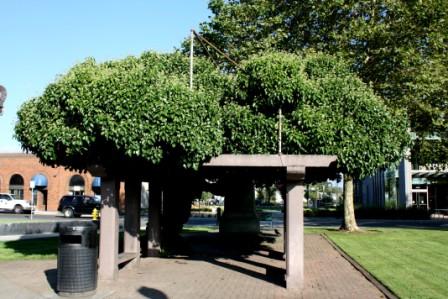
of an ancient Hedera helix ‘Baltica,’ a cultivar of English ivy.
For those of you not in Washington or Oregon state, English ivy is a designated noxious weed. Thousands of dollars and hours of labor are spent on removing this species from forested areas in Washington state, where it crowds out native species and increases tree failure simply through the weight of vegetation. … Continue reading this article “When history and good stewardship collide”
About a year ago I posted my thoughts about the nursery production practice of heading young trees (“whips”) to stimulate lateral branching or columnar form or whatever. (You can find this original column here.) A healthy discussion ensued, much of which revolved around the need for appropriate follow-up pruning to ensure the development of a stable crown structure of headed trees.
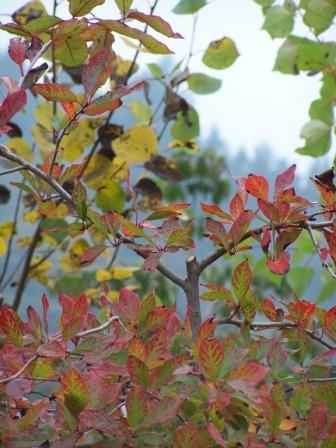
Fast forward to last month, where a column I wrote for NPM (Nursery Production and Management) magazine hit the web. … Continue reading this article “Off with their heads!”
Last year we completed a small research study on how to kill buckthorn. If you live in the upper Midwest then you’re familiar with this plant as a shrub which has escaped cultivation, been spread by birds, and generally made a nuisance of itself, particularly at the edges of forested land.
Buckthorn is notoriously difficult to kill after it gets more than about a foot high. It laughs at single applications of roundup. If it’s pulled out of the ground any roots that don’t come with it have a good chance of sprouting shoots themselves, and it seems to enjoy being treated with organic herbicides like vinegar. … Continue reading this article “How to Kill Buckthorn”
Lots of good, thoughtful answers from you over the weekend about these trees. Here’s another photo from a bit farther away:
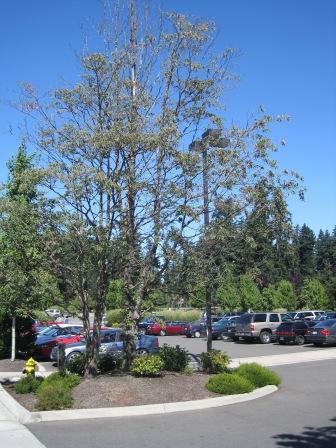
As Laura pointed out, there’s a relatively new parking lot here. The creation of the parking lot both compacted the surrounding root zone, then covered it with impermeable surface. The dogwoods are huddled on their little island, which is unirrigated, unmulched, and indeed hot in the summer as Daniel said. All of these environmental insults, in addition to the mature age of these trees, have led to what we call a “mortality spiral”: trees are environmentally stressed and then become more susceptible to opportunistic pests and diseases. … Continue reading this article “Dying dogwood diagnosis”