Here’s a photo of two mature dogwood trees that are obviously on their way out:
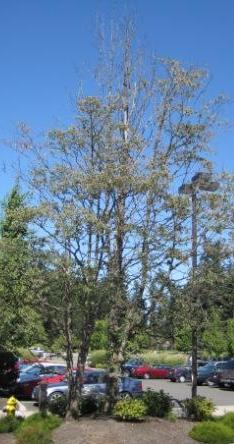
What happened? There’s been no construction in the area since the parking lot was paved several years ago.
Answer on Monday!
Here’s a photo of two mature dogwood trees that are obviously on their way out:
What happened? There’s been no construction in the area since the parking lot was paved several years ago.
Answer on Monday!
Sorry to be late with my post this week – I was away reviewing grant proposals. It was interesting and useful work, but really drains your brain. So with that being said, my post is long on pictures and short on words.
One of the things that bugs us GP types is poor plant placement. Why bother planting a tree if you’re not going to allow it to grow naturally? Here are some photos to mull over the weekend. … Continue reading this article “Why bother having trees?”
OK, this Friday’s quiz is the real deal: everyone gets to play “Extension Specialist for a Day”. I am stumped on this and so are my colleagues here at MSU. I used to work for a guy who liked to say, “None of us is as smart as all of us”. Let’s put it to the test.
The photos below come from a nursery here in Michigan. The trees are container-grown Red sunset maples. Pretty routine crop around here. … Continue reading this article “Friday quiz: The case of the bumpy maples”
One of the first courses a horticulture student takes is plant materials, or, in the case of a forestry student, dendrology. Why? Pretty simple; it’s hard to select plants if you don’t know what they are and what they’ll do in the landscape. Of course, the classic example is a large tree or shrub planted in a tight spot that eventually devours an entire house. But we usually don’t have to look too far to find situations where a homeowner or landscaper clearly had no idea what plant he or she was dealing with. … Continue reading this article “The importance of knowing your plants”
While the Emerald Ash Borer (EAB) continues to expand in the upper Midwest (see http://www.emeraldashborer.info/files/MultiState_EABpos.pdf for a current infestation map), EAB is old news here in Michigan, especially in the southeastern part of the state. Efforts to restore urban and community forest canopy lost to EAB will continue, however, for the foreseeable future. In 2003 we established an Ash Alternative Arboretum MSU Tollgate Education Center in Novi, MI – which is near ‘Ground Zero’ for the EAB infestation in North America.… Continue reading this article “What’s old is new again”
This past weekend marked our first real bout with severe thunderstorms here in Mid-Michigan. Several lines of storms moved through the mid and southern part of the state and northern Ohio. The storms in southern Michigan and Ohio also spawned some tornadoes. Around here, storm damage was confined mainly to downed trees causing power outrages and some damage to homes and buildings.
Severe weather outbreaks provide some opportunities to observe tree failures and gain insights into how they can be prevented. … Continue reading this article “Riding the storm out”
As part of our discussion of the relative merits of fall planting, Linda mentioned an article in Arboriculture and Urban Forestry that suggests that frequent, light irrigation might be better for landscape trees then the usual recommendation of infrequent soakings. While I will withhold final judgment until I see the article (I did a scan of the last two year’s table of contents for A&UF but missed the article in question), here’s my rational for following the standard recommendation.… Continue reading this article “Good to the last drop”
One of the joys of working on a university campus is that construction never seems to end. As near as I can tell there are about 3,000 orange construction barrels that permanently reside on the MSU campus that simply get shuffled from one end of campus to the other every few months. Along with all the construction comes a never ending series of new landscape projects. Driving by one of the most recent projects the other day got me to thinking about the myth of Fall planting. … Continue reading this article “Is Fall Really a Great Time to Plant Trees?”
As most of you know, roots circling around a container isn’t considered a good thing. And so people try various things to control circling roots. One of the more creative horticultural minds out there, Carl Whitcomb, a guy why basically got sick of academia and went into private industry (and, as far as I can tell, loathes peer review and the whole process of publication), decided to see what he could do about making containers that don’t encourage circling roots. … Continue reading this article “Building a Better Container”