One of the biggest issues facing urban and community forestry in the eastern half of North America is the Emerald Ash Borer (EAB). As most people are aware, EAB was accidentally introduced in Michigan some time in the late 1990’s. By 2002 when the insect was found and identified, thousands of ash trees in and around Detroit were dead or dying. Since then the insect has continued to spread, partly by natural dispersal but also by hitchhiking on logs and firewood.… Continue reading this article “Shoot your favorite ash”
Tag: woody
Buddleia or Buddleja? I prefer butterfly bush…
…because apparently they can fly:

Buddleia or Buddleja?
I recently heard that Mike Dirr has come out with the next edition of his book on woody landscape plants. Dr. Dirr (I can’t seem to bring myself to call him Mike, even after all these years) was my major advisor in graduate school, so I’m really looking forward to getting it. In the meantime I heard that he included a section on my thoughts about how to spell the scientific name of the butterflybush, a plant that I worked on to get my Ph.D.. … Continue reading this article “Buddleia or Buddleja?”
Another look at TreeGators
Following up on Linda’s earlier comments about potential problems with TreeGators, my summer interns and I did a random spot check of about 150 TreeGators currently in use on the MSU campus. As background, MSU Landscape Services plants about 1,200 trees and shrubs each year. All newly-planted trees which are not on an automatic irrigation system are fitted with one or two TreeGators, which are filled from a water wagon every week or every two weeks, depending on weather. … Continue reading this article “Another look at TreeGators”
Bare Root Trees
For the past 11 years I’ve been running a nursery at the University of Minnesota called the TRE (for Teaching, Research, and Extension) nursery where we research all kinds of fun stuff like Dutch elm disease, the dangers of mulching, and what happens when you plant a tree too deeply. One of the most interesting things we’ve done recently, though, is to install Missouri gravel beds into the nursery. Missouri gravel beds are called Missouri gravel beds because they were invented by Chris Starbuck, a professor at Missouri State. … Continue reading this article “Bare Root Trees”
A Brief Discussion on the Wisdom of Barberry as Median Plant
We never know who to blame (or, rarely, thank) for roadside or median plantings. State D.O.T.? Local municipality? Subcontractor to either of the previous?
A few years ago, this appeared in the median of the Highway 460 bypass – the main road leading to Virginia Tech:
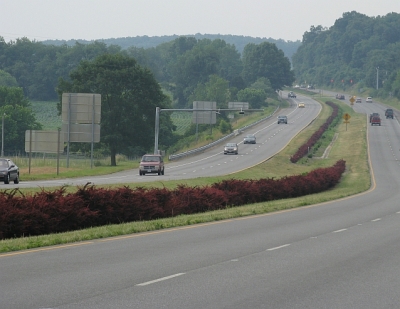
I am somehow reminded of Sideshow Bob from The Simpsons…
Two hedge rows. One of green Japanese barberry (Berberis thunbergii, cultivar unknown); the other of the purple form (Berberis thunbergii var.… Continue reading this article “A Brief Discussion on the Wisdom of Barberry as Median Plant”
Modern day torture stakes
Torture stakes were used centuries ago as a slow means of executing prisoners. Unfortunately, the practice lives on every time someone incorrectly stakes a newly planted tree. Though I’ve written about tree staking before (click here to read more), I’ll use today’s blog to demonstrate another unintended result of improper staking – decapitation. A normal tree develops taper as it grows. At eye level, a tree trunk is narrower than it is at ground level: that’s taper. … Continue reading this article “Modern day torture stakes”
Mulch Volcanoes
After Linda’s post yesterday I just had to add my own 2 cents about gator bags. I use ’em and I like ’em. But, that said, I never allow gator bags to sit against trees for an extended period of time (Maybe 6 weeks when the tree first goes in). That’s just asking for trouble! But looking at those bags got me thinking about a project which we’re finishing up this year. Volcano mulching. Believe me, it sounds a lot cooler than it is. … Continue reading this article “Mulch Volcanoes”
Long term problems with Tree Gators?
So, Bert, you (and others) have done research on Tree Gator-type products and found them useful in providing water to newly planted trees and shrubs. For those of you that haven’t seen supplemental irrigation products, they are heavy-duty plastic bags that zip up to create a sleeve around tree trunks and drip water from their perforated bottoms (Figure 1). The City of Seattle uses them routinely, but I’ve seen a number of trees fail in spite of the additional irrigation. … Continue reading this article “Long term problems with Tree Gators?”