Gardeners plus QR Codes equals Really Happening?

Proven Winners is putting QR codes on plant tags. So is Walters Gardens, a major wholesaler of perennial liners. Growers often purchase tags from the propagator to go along with the liners. In the case of patented plants, that’s a common method of collecting royalties – the finishing grower has to purchase the tag.

Quick response (QR) codes are everywhere. For those that are vague on the concept, it’s a two-dimensional barcode. Install a code-reader app on your smartphone, snap a photo of the code, and your web browser takes you to a specific site for more information. … Continue reading this article “Gardeners plus QR Codes equals Really Happening?”

Selection and Protection: Preventing the heartbreak of splayage

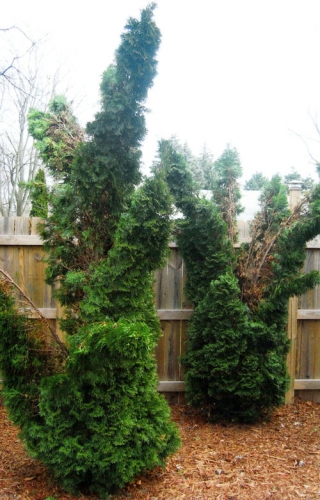
We’ve had considerable discussion over on the FaceBook site concerning snow damage to columnar arborvitae.  This is a common phenomenon resulting in a condition Holly has dubbed ‘splayage’.


The question, of course, is what to do about it?  My standard response to addressing most problems related to winter injury is there are two options: selection and protection.


Selection means putting the right plant in the right place.  For columnar arbs this means not planting them in areas prone to wet heavy snow.   … Continue reading this article “Selection and Protection: Preventing the heartbreak of splayage”

How to give a better talk

This past week I gave a talk at our state wide nursery and landscape trade show.  After my talk I stuck around and attended a couple of sessions, most of which were pretty good.  One talk, however, set my teeth on edge.  The presenter was a grounds manager for a local college that has embarked on a program of all-organic landscape care, including use of compost tea.  Personally I don’t know much about compost tea aside from the fact that mention of the term causes Linda to go apoplectic. Continue reading this article “How to give a better talk”

Won’t you help the poinsettias?

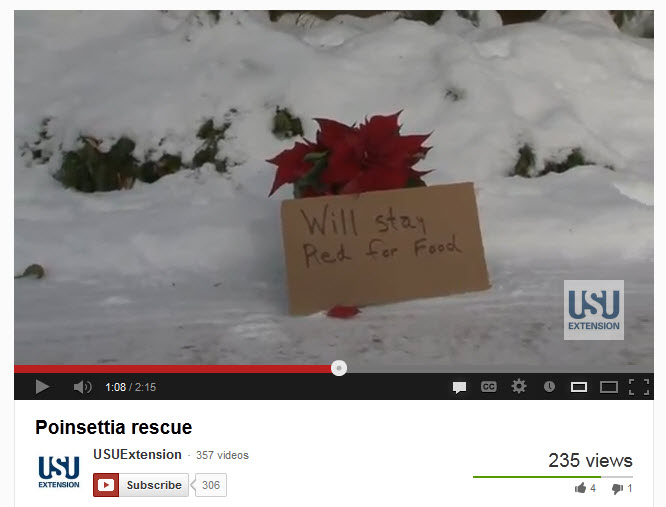
Those creative Utah Sate University Extension folks are at it again.  Jerry Goodspeed’s hilarious Gnome Management video was a big hit among the gardening crowd a couple of years ago. 

His current effort is a bit more…film noir. 

"Mission accomplished" if you’ve been shamed into watering that poor poinsettia languishing in the dining room.  A little fertilizer wouldn’t hurt, either.

Balance

By this time most of you have probably read all about Mark Lynas, the anti-GMO activist who decided that GMOs are actually a net benefit to society.  I’ve been asked by a few people to comment on how I feel about Mr. Lyna’s changing sides.  I think they expect me to be jumping up and down for joy.  But that’s not how I feel at all.  I’m happy when anyone decides to let research lead them to a conclusion rather than politics or gut feelings, but in this case it also makes me nervous. … Continue reading this article “Balance”

Where did the 10-20-30 rule come from? Is it adequate?

We’ve been having an interesting discussion over on the Urban Forestry group on LinkedIn on the origins and suitability of the 10-20-30 rule for tree diversity in urban forests.  For those that aren’t familiar, the 10-20-30 rule is a guideline to reduce the risk of catastrophic tree loss due to pests.  The rule suggests an urban tree population should include no more than 10% of any one species, 20% of any one genus, or 30% of any family.… Continue reading this article “Where did the 10-20-30 rule come from? Is it adequate?”

News flash – genes don’t explain everything!

Last week dedicated blog follower Ray E. sent me this link to a story in the Smithsonian magazine.  It’s a fascinating look at adaptive responses by frog eggs and apparently is causing quite a stir in the evolutionary biology community.  Phenotypic plasticity, which is the ability of an organism to modify its appearance or behavior based on environmental cues, is being hailed as a “revolutionary concept in biology.”

I don’t get it.

Anyone who’s studied plants for any length of time knows about this phenomenon. … Continue reading this article “News flash – genes don’t explain everything!”

Over-Interpreting

One of the things that scientists need to be able to do is to figure out what the research that they conduct means without over-interpreting it.  This isn’t as easy as it seems, for example, if a particular pesticide at a particular dose kills mice, then should it also kill humans?  Without testing we really don’t know – though we certainly have suspicions.  If we allow our suspicions to take over and we say that, based on the mouse data, the pesticide necessarily does or doesn’t affect humans then we’re over-interpreting.… Continue reading this article “Over-Interpreting”

Happy New Year

As trite as it sounds, I try to slow down and enjoy the simple things around the holidays.  We are starting to get some more seasonal weather, which means cold temperatures and occasional snow flurries.  Once we get our first real snow cover I pull out my birdfeeder from beneath the shop-bench in the garage, fill it up and set it in a beech tree outside our kitchen window.  No one in our family is a birder but it’s interesting to see how nearly everyone takes time to linger over their morning coffee or tea to watch the steady parade of chickadees, nuthatches, cardinals, and jays at the feeder.   … Continue reading this article “Happy New Year”

Final Exam of 2012?

Actually, just a pop quiz.

Continuing the "flowers that look like Christmas ornaments" bit as started on our Facebook page…here’s another, as seen a couple of days ago in our visit to the conservatory at the Biltmore Estate, Ashevegas, N.C.


You can probably guess the family by the leaf shape
.


Nice dangly peduncle, no?

Let’s have some guesses, temperate-zone readers! This had me stumped, and I’m not unfamiliar with tropicals. And yes, I want one.… Continue reading this article “Final Exam of 2012?”