We’ve been having an interesting discussion over on the Urban Forestry group on LinkedIn on the origins and suitability of the 10-20-30 rule for tree diversity in urban forests. For those that aren’t familiar, the 10-20-30 rule is a guideline to reduce the risk of catastrophic tree loss due to pests. The rule suggests an urban tree population should include no more than 10% of any one species, 20% of any one genus, or 30% of any family.… Continue reading this article “Where did the 10-20-30 rule come from? Is it adequate?”
Tag: biodiversity
Does native matter?
We’ve had lots of lively discussion on my post regarding the Mark Davis et al. comment in Nature on natives and exotics. I have been traveling and otherwise occupied and have not had a chance to comment so I feel a little like the kid that kicked the anthill and then ran away. Fortunately, Holly was gracious enough to forego her post today (I promise to return the favor, Holly!) so I can chime back in.… Continue reading this article “Does native matter?”
Excerpt from Davis et al. letter to Nature on natives vs aliens
In yesterday’s post I linked to a letter in Nature by Mark Davis and a number of other ecologists on the role and native and alien plants. Unfortunately the journal requires a subscription. Copyright laws prevent me from re-printing the entire article, however, below is an excerpt from the conclusion, which I think captures most of their message.
“Most human and natural communities now consist both of long-term residents and of new arrivals, and ecosystems are emerging that never existed before.… Continue reading this article “Excerpt from Davis et al. letter to Nature on natives vs aliens”
Visiting Professor guest post: Native wildflowers
Recently I have been fascinated by the native wildflower field I planted last fall. Although I seeded it with the same mixture of seeds (mixed with sand to spread them evenly), you can see that we have clumps of different flowers throughout the area.
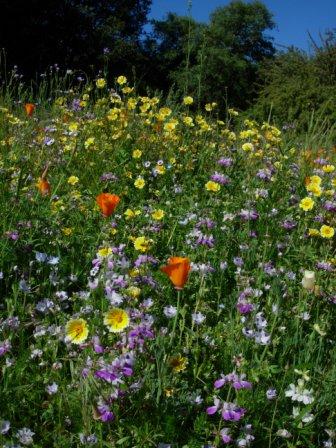
Figure 1. Descanso Gardens, California
The area where the wildflowers were planted had several 1-2 foot raised mounds; some were in the shape of keyholes. These were built with silty sand from a nearby seasonal stream that had some erosion problems in a rainy year.… Continue reading this article “Visiting Professor guest post: Native wildflowers”