You CAN grow it, but is it worth it?

Facebook

As winter sets in here in Michigan, I’m seeing gardeners deploying winter protection. Like this, which I saw on a visit to Hidden Lake Gardens with some friends recently:
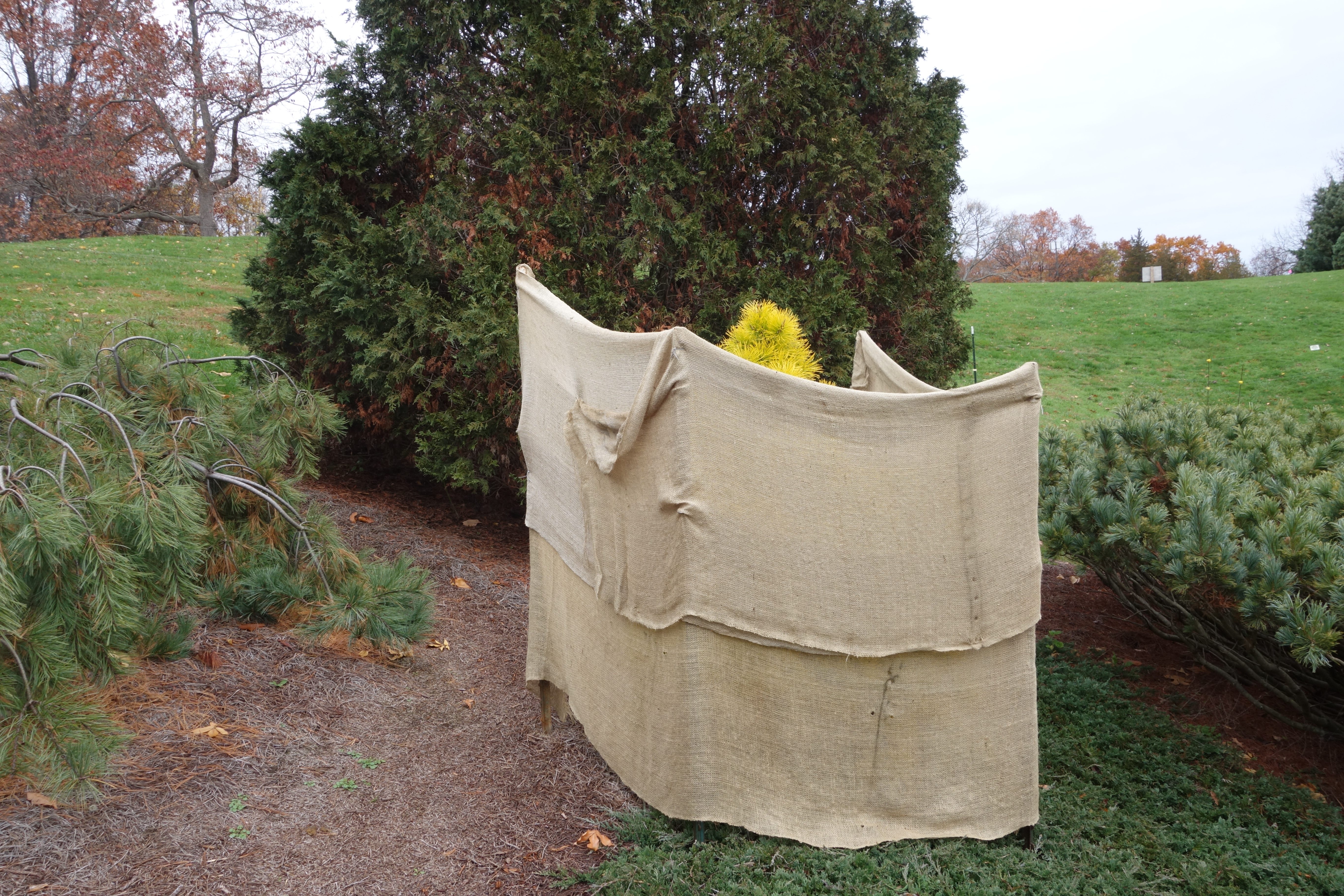
pinus contorta Chief joseph covered

Well. Isn’t that attractive? Come around to the far side, and you see this:
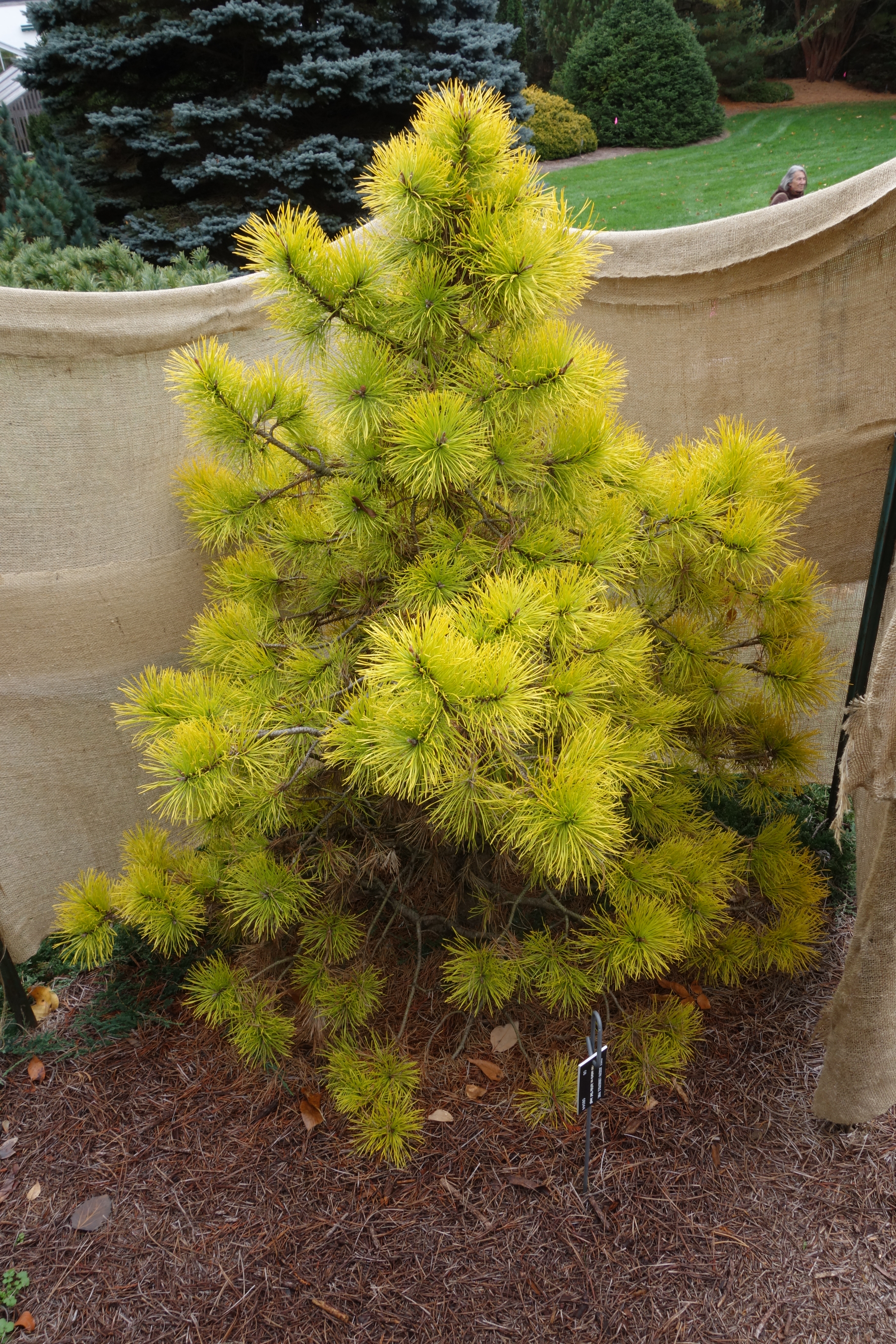
pinus contorta Chief joseph

Pinus contorta ‘Chief Joseph’ which is a stunningly beautiful conifer, green in the summer, this brilliant shade of gold in the winter. Sadly, those gold needles are also incredibly prone to turning a less brilliant shade of brown if exposed to too much winter sun and wind. Hence the ever-so-attractive sun-and-wind shade they’ve installed here.

Call me old-fashioned, but the point of a garden is to be pretty, and though you CAN wrap delicate shrubs in burlap or upend styrofoam cones over tender roses or even (yes, I’ve seen it) put little roofs over your hardy succulents to keep excess rain off of them, but is it really worth it? For me, if I have to put something ugly on my plants to keep them healthy, it isn’t worth it. In my garden, I’d lean towards something else I also saw on that visit:

Chamaecyparis obtusa Crippsii

Chamaecyparis obtusa ‘Crippsii’ No, it isn’t quite as stunning as the pine… but it will grow and not turn brown, with no fuss.

What about you? Are there plants you are willing to make your garden ugly to keep happy?


Facebook

When trees can’t predict weird weather

Facebook

Our normally mild corner of the country got hit early and hard with cold weather a few weeks ago. For several days straight, our home thermometer read anywhere from 22-25F. Now, Seattle routinely gets temperatures this low sometime during the winter. But this cold spell came very early – much earlier than our regionally adapted trees and shrubs were used to. The effect on our plants was significant.

20141112_080049Rhodies react to cold but tolerate the freezing temperatures

Trees and shrubs start getting ready for dormancy in the summer. They key in on the progressively shorter days and make biochemical preparations that are unnoticeable. When the first frosty evenings arrive, leaf color changes begin immediately. Chlorophyll, proteins and sugars are scavenged and stored in trunks and roots – we see leaves change from green to red, orange, yellow, and eventually brown. Slowly an abscission layer is laid down at the base of the leaf petiole, and when the layer is complete the leaf dies and falls.

But this year the trees weren’t ready. It got cold really fast, and green leaves died on the trees. And they are still there. Eventually these old leaves will fall, though some of them may stay on until spring.

Cold shocked leavesBoth the hydrangea in the foreground and the styrax in the back have retained their leaves after the cold snap.

What does this mean in terms of tree health? Well, it won’t kill them, but it does set them back in terms of food storage. A lot of the nutrients that were still in the leaves when they froze are lost to the tree. So there may not be as many reserves for winter root growth, or for spring leaf flush. Overall, we could expect to see less than normal growth in established trees and shrubs.

Facebook

Infographic with a BIG grain of salt

Facebook

Infographics can be great: They’re bright colorful ways to make sometimes complex concepts visual and easy to understand. Sadly, “easy to understand” does not necessarily equal “accurate” and they can also be extremely misleading.

Take this beautifully made image from National Geographic. It is an older image — first posted back in 2011, but it makes the rounds on social media from time to time, and popped up in my facebook newsfeed a couple days ago.

Look at it! Oh no! We’re loosing all of our vegetable genetic diversity!

Or not. First, it is comparing apples to oranges. This image looks a commercially available varieties in 1903 and compares it to the number of varieties in one specific center for preserving genetic diversity. What happens if we compare the same metric? If you look at the number of varieties in the National Seed Storage Laboratory, that was founded in 1958… so in 1903, at the top of the graph, the number for all these vegetables would be… zero. If you look at the present day, the current umbrella organization for all the US government funded efforts to preserve genetic diversity of crop plants is GRIN, (Germplasm Resources Information Network)  and if I do a quick search through that database using the keyword “tomato” I get… 9281 results. That is a pretty overwhelming improvement over 79 in 1983.

And what about commercially available varieties? To use tomato as an example again, in 1903, they found 408 varieties offered commercially. I just added up the varieties listed by just ONE seed company, Baker Creek Seeds, currently lists 287 different varieties of tomatoes. That is just ONE company. I have no doubt that if I added up all the varieties that are offered for sale in the giant pile of seed catalogs I get every spring it would be FAR more than the 408 on offer in 1903.

So… are we losing genetic diversity in our crop plants? Probably. There are lots of traditional varieties and land races that were never available commercially that have do doubt been lost, but to be honest, I think we’ve done a pretty good job at preserving the diversity. And certainly the USDA’s system of gene banks is an incredibly well run, impressive thing that deserves high praise indeed, for not merely preserving vast amounts of important genetic diversity but also working hard to characterize it and make it available to researchers and breeders so it can actually be put to work in the development of new and improved selections to try and feed the world.

So despite how colorful and easy to understand this infographic is, you don’t need to freak out about a massive loss of genetic diversity in our vegetable crops. Save that freaking out for all the wild species that have gone extinct or are about to go extinct thanks to habitat destruction and climate change world wide…

Facebook

Get a handle on your microclimates

Facebook

Practically the first thing a budding gardener (at least in the US) learns is their USDA winter hardiness zone. Based on average winter low temperatures, hardiness zones have many flaws but are still a very useful tool in figuring out what plants can and cannot survive your particular winters.

Right after learning about winter hardiness zones, we generally hear about microclimates – the idea that small precise locations within our garden may be, sometimes significantly, warmer or colder (or wetter or drier) than the surrounding climatic norms. The most pronounced producer of microclimates in most people’s gardens is their house – the sunny southern and western walls in particular can be markedly warmer than the rest of your yard. If you have hills, you also get frost pockets in low lying areas and warm south-facing hill sides.

But just how much warmer ARE your microclimates?  I used to live in a drafty, poorly insulated nearly 100 year old house which had VERY warm microclimates all around it because all the heat my furnace put out was rapidly leaking out into the outside world. Great for growing plants that normally wouldn’t take my winters, but oh, the heating bills! A modern, well insulated house leaks a lot less heat out into the garden. Over time in a garden, you can learn by trial and error just how far you can push growing tender plants in warm microclimates by planting things and watching them die or survive. But there is an easier and faster way to figure out your microclimates. Collect some actual data, getting firm numbers of how warm and cold different parts of your yard are.

20141104_130607

I’m heading into the first winter in a new garden, and getting ready to deploy a handful of cheap mechanical min-max thermometers. I’m placing one out in the open, the others against the south wall of a shed and other places I think should prove to be warm microclimates. Out they go, and after particularly cold weather – or just in the spring – I can check the different minimum temperatures they’ve recorded. A few degrees differences isn’t worth worrying about, but get to 10 degree differences, and you are talking a whole winter hardiness zone warmer.

In addition to comparing different locations in my garden, I also like to compare the actual temperatures I’m recording with those from local official weather stations (to do that, just go to www.weather.gov, enter your zip code, and then click “3 day history” on the right side of the screen). The zone map is created based on readings from weather stations like these, and if your particular yard is consistently showing temps warmer or colder than the local official readings (provided, of course, your thermometers are accurate), you should adjust your winter hardiness zone accordingly.

Finally, a min-max thermometer is a great way to test various winter protection methods. Tender plants can be insulated with a thick layer of leaves or (my favorite) cut conifer branches or even styrofoam boxes. How well do these protections work in your garden? Tuck a thermometer in with the plant before you cover it and then, come spring, check the minimum temperature it recorded against what you saw in the open air. Again, a difference of 10 degrees Fahrenheit corresponds to a whole winter hardiness zone warmer, giving you real actionable information about what you might be able to over-winter with the help of different sorts of insulation.

It is worth reiterating that minimum winter temperature is only one of a myriad of factors that go into winter hardiness, moisture, duration of cold, health of plants, and even summer heat matter as well, but winter lows are important, and it can be easily and precisely measured. So why not get some numbers on it so you can have a better idea of just what tender plants you can get away with in your various microclimates? A few thermometers is a lot cheaper than putting out a bunch of rare perennials and having them freeze out on you.

Facebook

A scary Halloween story

Facebook

Those of you that have followed the blog for a while know that poor tree planting is one of my pet peeves. It drives me crazy to watch tree installers use backhoes to gouge out gigantic holes and then drop in the intact root ball, clay, burlap, twine and all. But this dig-and-dump method (or “cost effective practice” according to installers) of installing trees often dooms them (the trees, not the installers) to a slow and ugly death. So in honor of Halloween, let me share my latest horror story.

Twice a day I drive down this street in NE Seattle. I’ve long admired the row of dead street trees left to remind us all of our own mortality. A few of these Liriodendron have somehow survived though “survival” seems a generous term. They’re more like zombies, slowly losing body parts but somehow still functioning until someone puts them out of their misery.

Dead #1 Dead #2 Dead #3

One lone tree seemed to defy all odds. Until our latest windstorm, which revealed the cause of all this arboricultural agony.

Downed tree Rootball side Rootball

That’s right, there’s the clay-covered rootball, still intact. Only one root has managed to escape into the native soil. There may be others on the opposite side, but by now (several years after installation) there should have been sufficient root establishment to prevent failure.

Several of us have written about bare-rooting trees before, and while there’s still not consensus on the practice I think we would all agree that the tree planting in this case was not acceptable. There are better ways, and yes they take more time (or “not cost effective” according to installers), but planting trees right mean fewer replacements later.

Facebook

The great urban potato experiment

Facebook

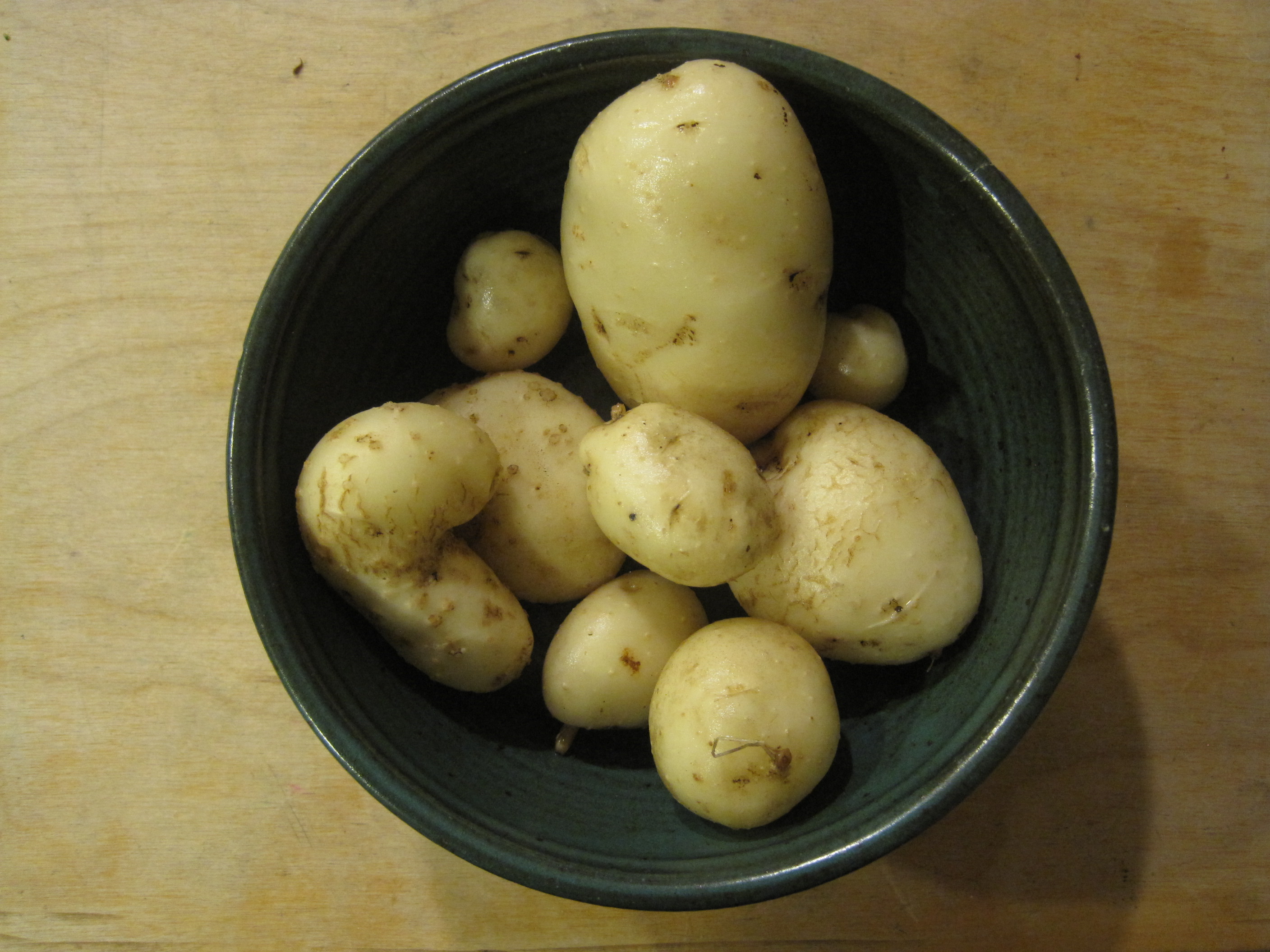
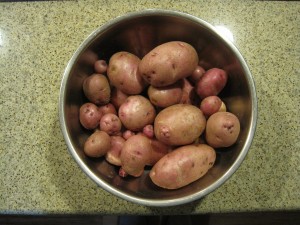
I don’t grow vegetables at home, mostly because I don’t have the space and partially because I don’t have the time. But I did want to try the potatoes-in-a-barrel method, which I also tried last year. But this year I planted about 6 weeks earlier (end of April) than I did the previous year (mid-June).  Here’s my mid-October harvests from both years:

October harvest  IMG_7560

Next year I’ll try planting even earlier. It’s not a huge harvest, but it’s fun to do, especially with kids. A richer media (like a green compost along with soil) might give you a better harvest.

If you want to try this yourself, here’s how to do it:

1) Use a plastic trash bin with holes drilled into the sides. Be sure to locate the barrel in full sun.

2) Put a layer of soil on the bottom, and add potatoes. (You can cut them into smaller portions, each with an eye, if you don’t have as many sprouted ones as I did.)

April planting 20143) Cover with soil and water well.

June 0554) As shoots and leaves emerge, continue to add soil or other media to the barrel, leaving the tops of the shoots and a few leaves exposed. I used a mixture of soil and composted wood chips. Water well.

June 0565) Continue to add media as needed, and continue to water through the season.

June 0106) When leaves begin to die back, you can dump the barrel onto a tarp and pick out your potatoes. Save the media for next year’s barrel.

Facebook

Cool plant of the day: Canary Bellflower

Facebook

I’m such a plant nerd that a few years ago I actually decided to get Canarina canariensis, the Canary Bellflower, for no other reason than that it is one of the very few members of  the campanula family that has red-orange flowers instead of the usual purple-blue ones.

canarina 2
Canarina canariensis
A Platycodon showing much more typical coloration for this family

Okay. Maybe that isn’t the most normal reason to add a plant to one’s garden, but I am VERY happy I did.

Canarina canariensis

That color!

I’ll admit, it isn’t a plant that is particularly well adapted to life here in Michigan… as the latin name suggests (twice!) it is native to the Canary Islands off the West coast of Africa, where the climate is consistently dry, fairly cool, but never freezes. The summers are extremely dry, with a short rainy season in the winter. And the Canary bellflower has adapted to that by dying back to the thick fleshy roots in the summer, and then sending up the long trailing stems and flowers in the winter when the rains come.

That isn’t ideal for growing here in Michigan, but I’ve found I can get it to grow here pretty easily, actually. It is growing and blooming like crazy right now, and once it gets cold, I’ll move it inside, and let it dry out. As the soil dries, the plant goes dormant, so it can sit there patiently until spring and more settled weather when I can water and set it off into growth again. It works, and though it is a bit more work than most of the other plants I grow, it is worth it. I like looking at the lovely flowers, and speculating about the unique evolutionary path that caused this one genus to develop orange flowers while the rest of the family largely stuck with the tried-and-true purple.

Facebook

Walnut warfare

Facebook

Recently, a question about using black walnut chips for mulch was posted on our Garden Professors Facebook group page. As gardeners know, black walnut has a reputation as a chemical warfare species that will kill anything growing underneath it – a phenomenon called allelopathy. So it’s logical to wonder about the lethality of walnut chip mulches.

To get a good feel for the science behind black walnut’s allelopathic abilities, I was fortunate to find a relatively recent review on the topic (Willis, R.J. 2000. Juglans spp., juglone and allelopathy. Allelopathy Journal 7(1):1-55.). This well-written review includes a fascinating section on the historical background of walnut allelopathy, which was first mentioned in 36 BC by the Roman author Varro. But the science of allelopathy really started less than 100 years ago, when a Virginia researcher noticed the injury caused to tomato plants growing near black walnut (Juglans nigra) in his home garden. Subsequent experiments by him and others suggested that the orangish hydroquinone juglone leaching primarily from leaf litter and hulls.

SONY DSCSource: Wikipedia.

The research results on walnut, juglone, and allelopathy have been nothing if not inconsistent. For every report of toxicity in an exposed species, another report found no effect. In fact, much of the supposed allelopathy might instead be due to walnut’s highly competitive root systems, which could suck up available water and nutrients over a vast expanse of soil.

Black walnut tree Source: Flickr user davidburn

There are a number of other factors that help account for ambiguous results:

1) Juglone is not the only secondary metabolite produced by walnut species. They are loaded with a number of untested phenolics, flavonoids, alkaloids, terpenes and other quinones which could have allelopathic activity.
2) Juglone concentrations vary greatly among walnut species. They also have seasonal variability in the same individual.
3) Light conditions, rainfall, soil chemistry, and many other abiotic factors can influence juglone levels.
4) Organic matter and clay particles in soils can bind juglone, reducing its movement within the soil.
5) Microbial activity breaks down juglone.

Carefully controlled laboratory experiments can demonstrate juglone allelopathy to a number of plant species, especially at the seedling stage. However, there is little evidence from landscape level research to suggest that allelopathy is the reason that plants are damaged by being in proximity to walnut trees. In fact, the author of the review study concludes that even though Juglans species provides the best known and most widely accepted example of allelopathy, there is “still is no unambiguous demonstration of its effect” as “no one has as yet demonstrated that juglone is actually taken up by plant roots.”

walnut tree Source: Wikipedia

Where does this lead us in our discussion of walnut mulch toxicity? Fresh hulls and leaves appear to be the primary source of allelopathy, but not the wood. And even these sources may be quickly neutralized by soil conditions. Therefore, a walnut chip wood mulch should pose no danger at all to landscape plantings.

Facebook

One tree’s leaves… over 400 kinds of bacteria!

Facebook

Okay… this bit of research just blew my mind.

Researchers took leaf samples from just ONE tree in Panama, and identified over 400 different kinds of bacteria making their home there. Sampling 57 different tree species, the total number of bacteria types ballooned to over 7,000. You can read more about the study here.

trees
A few trees. A nearly inconceivable number of microorgansims


That’s a lot. I love this kind of research because it just reinforces how LITTLE we know about this world we live in. Our world is filled with a massively diverse microbiome that we know virtually nothing about. Research is ongoing, and hopefully in the coming years we’ll begin to understand more about how these unseen organisms influence the world we live in. I’ll be fascinated to learn more.

In the mean time, any mention of microorganisms in a gardening context instantly raises questions of the efficacy of products containing (supposedly) beneficial fungi and/or bacteria for our soil. The huge, barely understood diversity of bacteria living in every aspect of our world is a good indication of why the research on adding specific microorganisms to soil generally show no impact, or only an impact in certain specific circumstances. This stuff is complex, and we’re just barely beginning to learn about it. Hopefully in the future we’ll begin to learn how to manipulate the microorganisms that live with our plants, but I wouldn’t expect it to happen over night. Right now, I’m just following the basic rule of adding organic matter to my soil to make a good home for the organisms that live there, and following the research as it opens a window to this unseen world all around us.


Facebook

What’s wrong with this picture?

Facebook

The  Seattle Times recently had a front page story on what Seattle’s new waterfront might look like. Back in 2009, the city began work on this project, hiring “rock-star landscape architect James Corner, designer of the celebrated High Line in New York City” to develop the big picture. (Note: I’ve been to the High Line and have posted on it before – it’s fantastic.) As you can see from the linked article from the Times, many of Corner’s architectural renditions for the greenway are presented, including this one:

waterfront2
COURTESY OF JAMES CORNER FIELD OPERATIONS AND CITY OF SEATTLE
An architectural rendering shows what a Pioneer Square beach at the foot of Washington Street could look like.

For those of you not familiar with Seattle’s waterfront, it’s built right next to Puget Sound, a huge inland sea connected at its mouth to the Pacific Ocean. So it was with much surprise that I saw what appear to be Douglas firs (Pseudotsuga menziesii) along the cobbled beach. Douglas firs are not particularly salt tolerant, nor would they be very happy with the tidal action or seasonal storms that will flood the beach on a regular basis. Even if these were not Douglas firs (native to Seattle) but some other salt-tolerant species (mangroves?), it’s doubtful they would look as picturesque as the drawing shows. Neither would the rest of the trees in the area, whose root zones would normally extend far into saline soils under the beach and sound.

Am I being picky? No, I don’t think so. Landscape architects should know better than to use plantings as decorations for their designs, like candy sprinkles on cupcakes. Plants aren’t just design elements. Choosing plants that are appropriate to a site is a science as well as an art.

I can’t believe that in the five years that Seattle’s been working on this project that horticultural science hasn’t been a major component of landscape planning.

Facebook