In my last post I announced that we would be conducting the first landscape transplant experiment designed by social media. We have about 100 ‘Bloodgood’ plane trees in 25 gallon containers that are leftover from a recent nursery trial. The trees will be planted at our Hort station and receive minimal care after planting beyond an initial watering and a kiss for luck. I asked for some suggestions for potential treatments and got some good suggestions. … Continue reading this article “Vote early and often!”
Tag: woody
High-end WOW (Why oh why)
A few weeks ago I was lucky enough to speak to the Portland Garden Club and see some absolutely gorgeous private gardens. But alas…even in the midst of such botanical riches I still managed to find something to make me shudder.
Now I have nothing against garden remodels – or boxwood hedges (though I generally find them unimaginative). But here’s a good example of shrub salvaging gone horribly wrong:
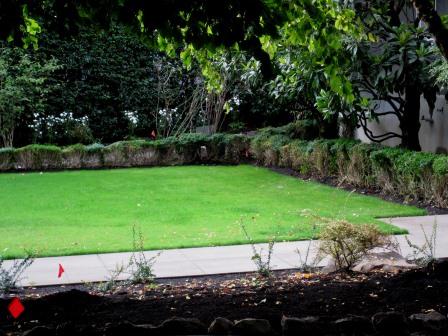
Deadwood boxwood
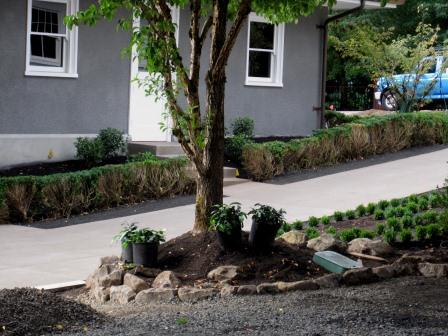 And again
It will take a long time for these boxwoods to fill in. … Continue reading this article “High-end WOW (Why oh why)”
An unusual company
This week I’m in Charlotte, NC as a guest of Bartlett Tree Experts. In addition to providing tree services, this company also maintains the Bartlett Tree Research Laboratories and Arboretum. The latter includes over 300 acres of tree collections and ongoing research trials. Here’s a sampling of the tree research we had a chance to observe:
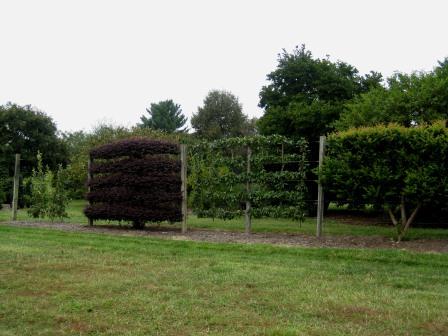
Demonstration espalier pruning…
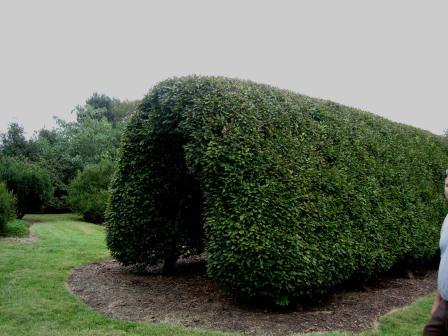
…and pleaching
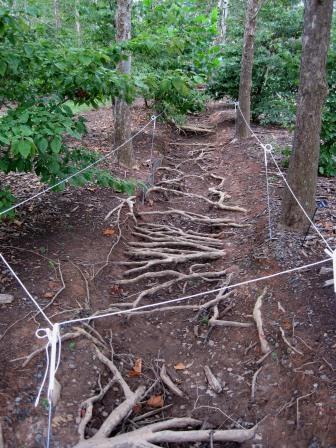
Comparison of root barrier materials. This area was covered with a sidewalk for a number of years and then exposed to observe tree rooting patterns. … Continue reading this article “An unusual company”
Pop quiz time!
It’s the start of new semester. Best way to get student’s attention is with a pop quiz right off the bat! So in that vein, we’ll cross things up and give a quiz on Monday instead Friday. Relax; to make things a little easier we’ll make this one a matching exercise.
Here goes. At our recent Christmas tree conference in Austria, a colleague of mine at Oregon State University, Chal Landgren, presented the results of a study to look at the effectiveness of foliar fertilization on Nordmann fir. … Continue reading this article “Pop quiz time!”
Podcast #7 – Better Red Than Dead
This week’s podcast is dedicated to anthocyanins – those pigments that give plants red, blue, and purple colors. Anthocyanins are also powerful antioxidants, important visual signals for pollinators, and often deadly to insect pests. The myth of the week explains why red leaves aren’t usually a sign of phosphorus deficiency, but instead an indicator that anthocyanins can help plants survive many environmental stresses.
My interview this week is with Cass Turnbull, founder of PlantAmnesty, a Seattle organization dedicated to “ending the senseless torture and mutilation of trees and shrubs.” … Continue reading this article “Podcast #7 – Better Red Than Dead”
Spin Cycle
The issue of potential damage to conifers by the turf herbicide Imprelis continues to get a lot of air play in this neck of the woods. One of the interesting things about watching an emerging story such as this is watching some of the sideshows that go on around it and how people spin the issue to match their needs and agenda.
Example 1:
Heritage Lawn Care Company put out flyers in neighborhoods in southeast Michigan with affected trees to promote their service. … Continue reading this article “Spin Cycle”
Imprelis update
I’ve been continuing to track some of the reports of injury to conifers associated with the new herbicide, Imprelis. Interest in the problem is likely to escalate given a front page article in the Sunday’s Detroit FreePress. http://www.freep.com/article/20110710/NEWS06/107100467/New-lawn-chemical-chief-suspect-mysterious-deaths-trees
I visited about ten sites last week with an applicator that had used Imprelis this spring. The landscaper was a certified applicator with about 15 years of experience with herbicides, insecticides and fungicides, who was knowledgeable about his chemicals and plants.… Continue reading this article “Imprelis update”
Imprelis damage to landscape conifers
Herbicide issues seem to be dominating my life these days. Over the past several weeks reports have surfaced around the Midwest of landscape conifers – primarily spruces and pines – that have developed rapid and severe die-back. While there are a host of insect pests and pathogens that can cause die-back in conifers, the recent cases are noteworthy in the speed with which trees expressed symptoms.
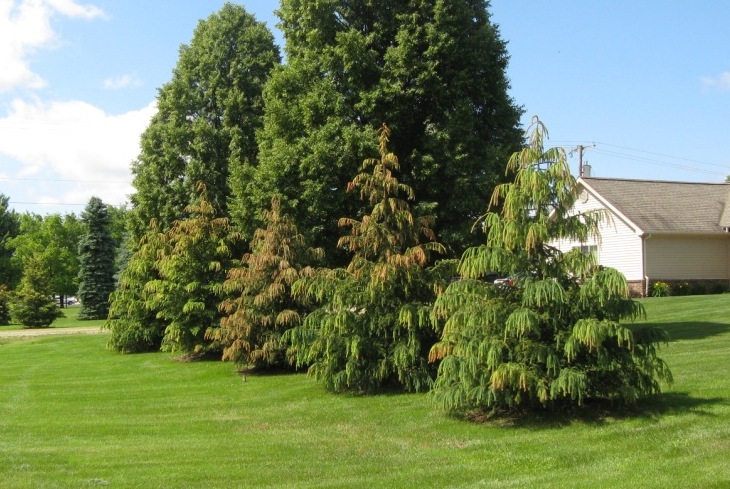
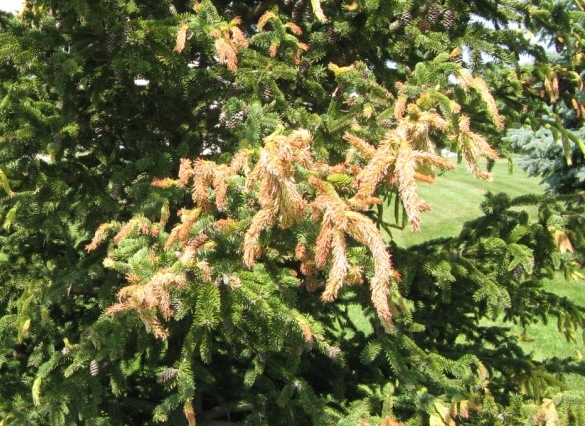
Photos: Andy and Carol Duvall
In many cases that have been reported the common thread appears to be the use of Imprelis, a turf herbicide developed and marketed by Dupont. … Continue reading this article “Imprelis damage to landscape conifers”
WOW again (Why oh Why?)
I’m going along with the “dead tree” theme of the week, but doing a little prognosticating at the same time. Bert and Holly showed you tree demise on site; I’m going to show you tree demise in the making. We can call this “dead plant walking.”
I’ve done a few WOW postings in the past, often with a focus at what you might find at a nursery or big box store. Here’s a recent find at an unnamed BBS, in the “topiary” section:
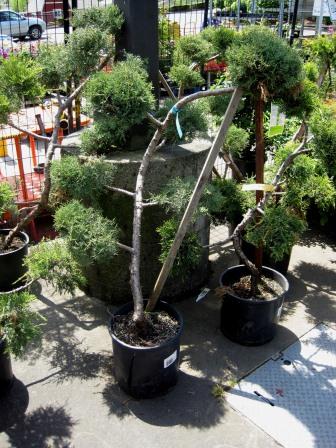
Unless you intend to have a giant stake as part of your topiary statement, this tree (actually a juniper) will morph into a prostrate form before your very eyes. … Continue reading this article “WOW again (Why oh Why?)”
Getting to the root of the problem
After getting off to a cool and soggy start, summer has come with a vengeance to Michigan, with heat indices expected to push 100 degrees by Wednesday. Along with warmer temperatures, summer also means our research season is getting into full swing as well. One of our biggest efforts these days involves our project to look at pre-plant storage and handling on shade tree liners.
As many GP blog readers are aware, emerald ash borer (EAB) has dominated the conversation regarding shade trees in the Midwest for the past 6-8 years. … Continue reading this article “Getting to the root of the problem”