Many blue spruce trees in our area are suffering from a progressive decline. This is more than the usual combination cytospora canker & rhizospaera needlecast that tend to make most mature blue spruce look crappy. The current syndrome has been linked to phomopsis blight and affected trees show increasing branch die-back and in some cases trees go from a having a few dead branches to completely dead in a 3-4 years. Because of this alarming and pervasive issue, I’ve been asked to put together a list of alternative selections for blue spruce as part of my extension duties.… Continue reading this article “A rose by any other name…”
Bud Markhart
Tuesday morning I started the day by going outside, lighting a propane torch, and doing a little bit of flame – weeding for a demonstration. Then I went inside, answered a few e-mails, and worked on a paper. Around 4:00 I decided to go get a haircut because Wednesday I was due to speak before a portion of the Minnesota congress, along with a Professor in the department of Plant Pathology, to seek funding for a project that we have which identifies Dutch elm disease resistant elms in Minnesota.… Continue reading this article “Bud Markhart”
MossTiles – a really bad idea
A few months ago a colleague alerted me to MossTiles, which can be attached to walls to create interior vertical gardens. They look really cool, and I assumed they consisted of some tough little moss species rooted in a mesh-enclosed planting mix. But the more I read about them, the more confused I became. They don’t need light – or fertilizer – or water (though misting them occasionally is recommended). More investigation was in order.
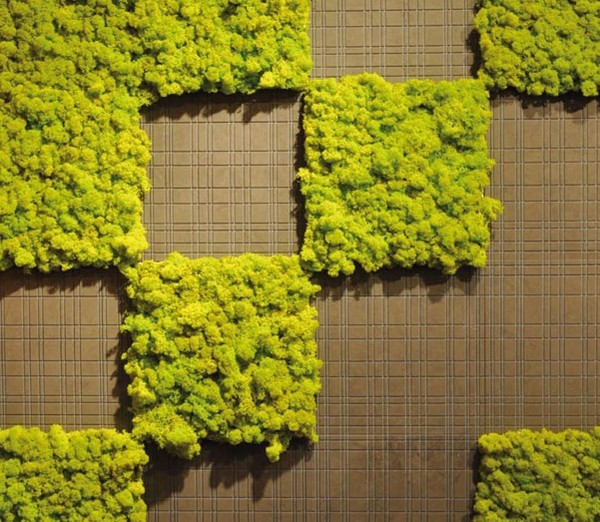
It turns out that these aren’t made from moss at all, but lichens – specifically reindeer moss (Cladonia rangiferina).… Continue reading this article “MossTiles – a really bad idea”
Grow Something Rude and Smelly!
Tired of
Tradescantia? Sick of Stachys? Exhausted from Echinacea?
Stick THIS in your border!
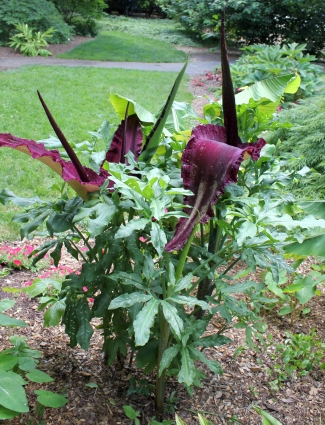
Dracunculus vulgaris at the Hahn Horticulture Garden, Virginia Tech. Hardy to USDA Zone 5b.
Closely related (as one might imagine) to
Amorphophallus. Lovely silver-splashed foliage, velvety crimson spathe, and big honkin’ spadix in early summer.
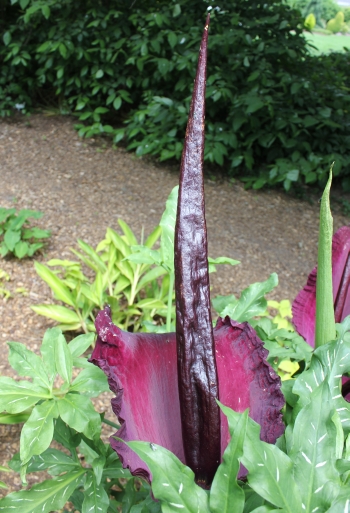
Easy to grow; part shade and good drainage seem to work well. After a few years, you’ll have several offsets to share with your dearest friends/worst enemies.… Continue reading this article “Grow Something Rude and Smelly!”
Ten years of life with the Green Menace: Part 2
Posted by Sara Tanis and Bert Cregg
NOTE: Last week I gave an update on the 10-year anniversary of the discovery of the emerald ash borer in the U.S. In response to the post, Sonia John raised a couple of points:
“Please share your knowledge about the status of efforts to: 1. introduce insect species or other biocontrols that predate the EAB, and 2. evaluation of the degree of resistance to EAB of Asian (and European) Fraxinus spp.… Continue reading this article “Ten years of life with the Green Menace: Part 2”
Pest Alert for western Washington – late blight
I know most of you are not residents of western Washington, but this information might be of interest to gardeners everywhere.
Pest: Late blight (Phytophthora infestans)
Hosts at risk: Tomato and potato
Conditions of risk: cool, moist environment
Found: Images typical of late blight infection on tomato have been submitted from two Puget Sound area (King/Snohomish county) farms. Growing conditions were plants in field soil where the area was covered with a plastic hoop structure.… Continue reading this article “Pest Alert for western Washington – late blight”
This Really Bugs Me
I get things wrong sometimes – I’ve had slip ups when speaking and said things I didn’t intend to say. I’ve written things that I wish I had the chance to rewrite because I explained things poorly. I’ve even gotten my facts mixed up from time to time. Still, it bothers me when someone who should know better delivers information that is blatantly wrong.
Yesterday I was looking at YouTube videos regarding compost tea. As anyone who has ever looked up compost tea on YouTube knows, if you look long enough you’ll eventually come to videos of Dr.… Continue reading this article “This Really Bugs Me”
Why I don’t like cardboard mulch
I’ve discussed my dislike of cardboard mulch before: like other sheet mulches it restricts water and gas transfer between the soil and atmosphere. In published comparison studies, other mulch choices generally outperform cardboard in terms of plant growth, weed control, etc. But there’s one area where cardboard is tops compared to every other mulch material tested.
Termites.
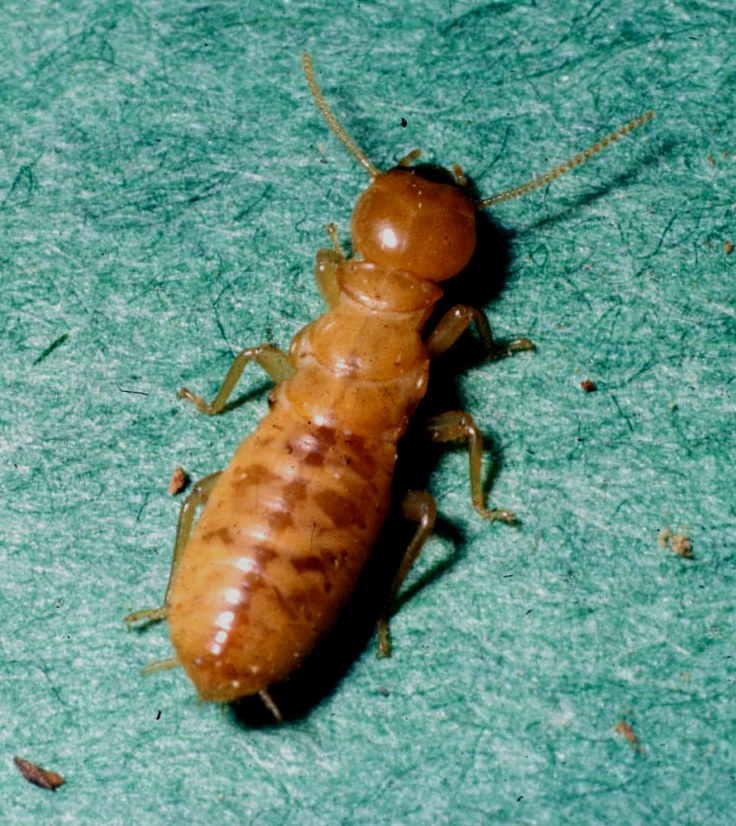
Termites LOVE cardboard. Did you know that termite researchers use cardboard feeding stations to lure termites? And cardboard is often used as the “control” in feeding studies, because termites will always eat it?… Continue reading this article “Why I don’t like cardboard mulch”
Ten years of life with the Green Menace
This summer marks an anniversary of sorts. Shortly after I joined the faculty at Michigan State University in the fall of 1999 MSU Extension began to get reports of dead and declining ash trees in and around Detroit. Since ash trees had relatively few serious pest issues and none that routinely caused mortality, the mysterious ash decline was attributed to cumulative environmental stresses, ash yellows or various site factors. In the summer of 2002, however, a little-known exotic beetle from Asia, emerald ash borer (Agrilis planipennis) was identified as the causal organism.… Continue reading this article “Ten years of life with the Green Menace”
A Tale of Two Herbicides
I performed a little demonstration the last few weeks which I thought you might be interested in seeing. So here it is:
I took a little weedy spot of land out in the nursery and divided it into four sections. Three weeks ago I applied Round-up to one of the sections and vinegar to another. Then, a few days ago, I applied vinegar (again) to the third section and Round-up (again) to the fourth.… Continue reading this article “A Tale of Two Herbicides”