In prepping grad students for their first big talk at a scientific meeting I always tell them everything will be fine – until the first data slide hits the screen. The audience will nod knowingly during the introductory comments and even during the materials and methods, but data charts and tables are to scientists what chum is to hungry sharks. So clearly I should have known better than to post figures without error bars in last week’s post. … Continue reading this article “Blood in the water…”
Demonstrating Diversity
As I noted a few posts back, this summer marks the 10th anniversary of the discovery of emerald ash borer (EAB) in southeast Michigan. While a lot of progress has been made on many fronts in the battle against EAB, the outlook for ash trees in North America still looks bleak for the foreseeable future. Ash trees, both green and white ash, were popular choices as street and landscape trees throughout the Midwest and elsewhere. … Continue reading this article “Demonstrating Diversity”
Up and running again
Over the weekend our blog was inaccessible. The server room in Pullman (where this blog is housed) overheated and everything was shut down. I apologize to those of you who tried to comment and/or post. Things are back to normal, at least for the time being.
I’m Burnin, I’m Burnin, I’m Burnin For You! — A Short Story Told With Pictures
To those of you who don’t like Blue Oyster Cult, I’m sorry, I just couldn’t stop myself.
A couple of weeks ago I mentioned that I spend some time flame weeding. It’s a technique for getting rid of weeds by frying them using a 500,000 BTU (I’m not kidding – that’s how powerful this thing is rated) torch hooked up to a propane tank. It’s not something I do a lot, just something that I get the urge to do periodically — when I need to feel macho.… Continue reading this article “I’m Burnin, I’m Burnin, I’m Burnin For You! — A Short Story Told With Pictures”
Suddenly Symphyotrichum
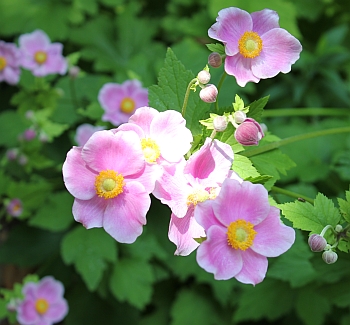
Also the Anemone x hybrida, Solidago, etc. Everything’s blooming early here in the Mid-Atlantic.

"Fall-Blooming Anemone." Not.
I teach an herbaceous plant i.d. and use course each fall and spring. By looking back at my plant lists, I can tell what was blooming when. I usually teach the asters at the end of September.
That’s going to be tough this year, since they are all BLOOMING RIGHT NOW dammit. This will be a great experiment in "does deadheading = rebloom" for many of the asters. … Continue reading this article “Suddenly Symphyotrichum”
Making hay while the sun shines
If you live anywhere east of Montana you know that two-thirds of the country has been roasting under record heat for the past few weeks. While the weather has been a bane to farmers and many others, it has provided us with an ideal set of conditions to begin to look at the responses in the SoMeDedTREES project.

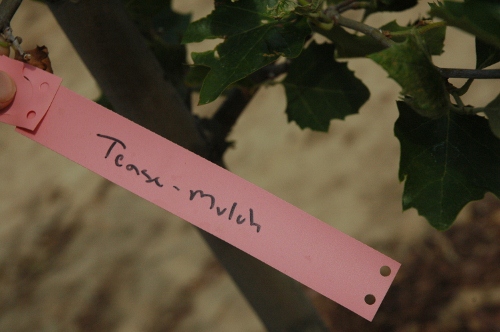
To recap, we installed two experiments with 25-gallon container-grown ‘Bloodgood’ planetrees. In both experiments we applied one of three treatments to the root systems at planting: 1) “Shaved” the outer portion of the root system to remove circling roots, 2) “Teased” apart the outer portion of the rootball to remove circling roots and 3) “Control” where we did nothing to the root system, or “Pop and drop” to use Linda’s terminology. … Continue reading this article “Making hay while the sun shines”
The ugly side of compost
In my part of the world we’re able to send most of our organic stuff through the green cycling program, where it ends up being made into compost. Cedar Grove contracts with the City of Seattle to do this service. As you might imagine, this requires huge, multiple facilities to handle all of the organic material that comes through the system. And it’s not difficult to imagine that problems arise, especially in choosing locations for these sites.… Continue reading this article “The ugly side of compost”
A rose by any other name…
Many blue spruce trees in our area are suffering from a progressive decline. This is more than the usual combination cytospora canker & rhizospaera needlecast that tend to make most mature blue spruce look crappy. The current syndrome has been linked to phomopsis blight and affected trees show increasing branch die-back and in some cases trees go from a having a few dead branches to completely dead in a 3-4 years. Because of this alarming and pervasive issue, I’ve been asked to put together a list of alternative selections for blue spruce as part of my extension duties.… Continue reading this article “A rose by any other name…”
Bud Markhart
Tuesday morning I started the day by going outside, lighting a propane torch, and doing a little bit of flame – weeding for a demonstration. Then I went inside, answered a few e-mails, and worked on a paper. Around 4:00 I decided to go get a haircut because Wednesday I was due to speak before a portion of the Minnesota congress, along with a Professor in the department of Plant Pathology, to seek funding for a project that we have which identifies Dutch elm disease resistant elms in Minnesota.… Continue reading this article “Bud Markhart”
MossTiles – a really bad idea
A few months ago a colleague alerted me to MossTiles, which can be attached to walls to create interior vertical gardens. They look really cool, and I assumed they consisted of some tough little moss species rooted in a mesh-enclosed planting mix. But the more I read about them, the more confused I became. They don’t need light – or fertilizer – or water (though misting them occasionally is recommended). More investigation was in order.

It turns out that these aren’t made from moss at all, but lichens – specifically reindeer moss (Cladonia rangiferina).… Continue reading this article “MossTiles – a really bad idea”