Is “lasagna gardening” really worth the effort?

This week I got a complimentary copy of Urban Farm, dedicated to “sustainable city living.”  The cover story is Lasagna Giardino – follow this recipe for a lasagna garden that grows perfect plants – Italian or not.

This is not a new idea, but was popularized several years ago as a way of preparing soil for planting.  The article relates the steps:

1)  Prepare the ground by mowing the lawn
2)  Dig up the first 12″ of soil (double digging)
3)  Place a layer of “noodles” (paper and cardboard are popular) – the low nutrient material
4)  Place a layer of “sauce” (the green material)
5)  Repeat as often as you like and “let it cook”

I like the first step of this. … Continue reading this article “Is “lasagna gardening” really worth the effort?”
Mouse Tombstones

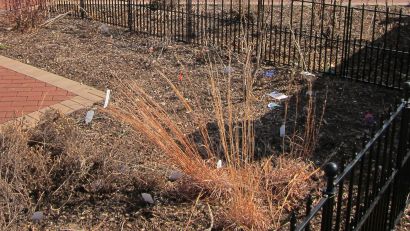
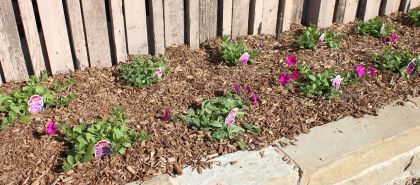
Doing this…


I must identify each and every Wave petunia!

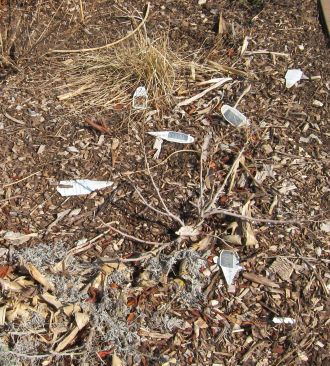
leads to this…

and this…

Unfortunately, the second and third photo are from a college teaching and display garden. There are a lot of inexpensive yet more attractive ways to relate plant identification to your visitors.

We all do this, of course, to some extent in our home gardens. Walk around with weird plant in hand, dig hole, stick it in, say to self "I’ll come back and get that label to add to my (pick one) Excel garden database/bag of random tags/photographic memory."… Continue reading this article “Mouse Tombstones”

A salt bath for your tomatoes?

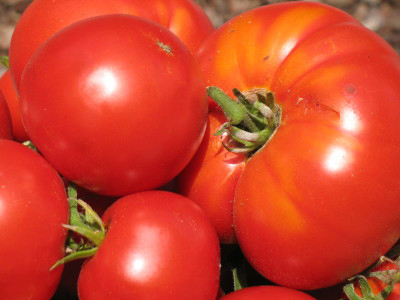
This morning I got an email from one of my gardening colleagues, wondering about the wisdom of watering tomato plants with salt water.  He had a link to a UC Davis website which tacitly endorses spraying tomato plants with 10% salt water “to increase their nutritional value and taste.” Unreferenced “worldwide studies” are mentioned, along with the “major potential benefit of providing irrigation for crops in areas with freshwater restrictions.”

Before we deal with the impracticalities and out-and-out harm of using salt water for irrigation, let’s look at why this practice would work on tomatoes. … Continue reading this article “A salt bath for your tomatoes?”

Parking tickets, compost tea, and pseudoscience in the Ivory Tower

Back in November 2009, Jeff posted an educational and amusing commentary about Harvard’s use of compost tea. Much vigorous discussion followed, and we’ll return to that topic in a moment. But first, I’d like to tell you about my morning yesterday.

In September of 2010, I received a ticket for parking longer than 2 hours in a restricted zone. Now, there was no way I committed this infraction; I had hard core proof that could not be rationally challenged.… Continue reading this article “Parking tickets, compost tea, and pseudoscience in the Ivory Tower”

Tree terrors continue

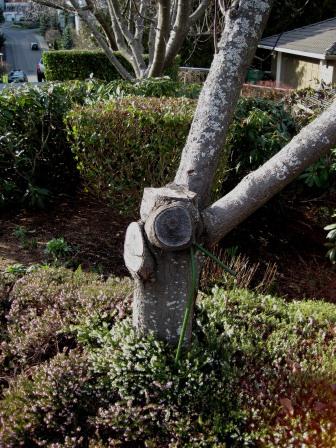
You might remember back in October 2009 I gave one of the first Friday quizzes.  The featured tree had epicormic shoots, and Monday’s answer revealed the neglected wire staking that was slowly girdling the main trunk.  (Be sure you click on those links to see what the tree looked liked in 2009.)

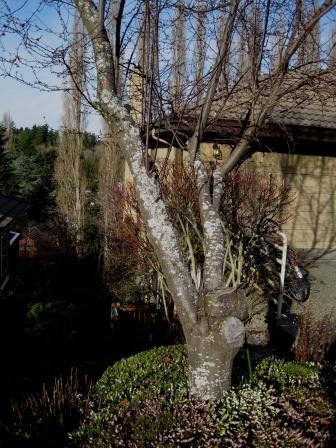
I thought you might be interested to see what this tree looks like now:

A picture is worth a thousand words….many of those unprintable.… Continue reading this article “Tree terrors continue”

Unspeakeable Acts of Pruning

(Hey, I think it’s Tree Week on the GP!)

Our land has a nice buffer of big, old oaks, hickories, and maples between us and the two-lane highway.  Power and phone lines thread through the middle of them. Thus, I have nightmares about orange Asplundh trucks.

So with much concern, I noted that utility crews and
subcontractors have been out in full force in our rural area,
inexplicably leaving one tree and then “pruning” another.

OMG that's awful

I pulled over and snapped this latest atrocity last night.… Continue reading this article “Unspeakeable Acts of Pruning”

Guano

One of the best organic fertilizers out there – at least in terms of how plants respond to it —  is bat guano.  As most of you probably already know, bat guano is made of bat droppings.  What you probably don’t realize is that bat droppings need to be aged for a while in an arid environment before they become guano.  Caves provide the perfect environment for this to occur, and so that is where most bat guano comes from.… Continue reading this article “Guano”

Planting trouble: multiple trees in one hole

[I enjoyed Jeff’s Valentine story so much that I thought I’d stick to the theme of togetherness…for better or worse.]

A week or so ago a reader asked about the practice of planting three or four fruit trees in the same hole.  Having not heard of this before, I checked on the web and found many “how to” pages geared to home gardeners who either want a longer harvest of a particular fruit (early to late) or a mixture of different species. … Continue reading this article “Planting trouble: multiple trees in one hole”

Fast food is unhealthy for plants, too

In early December, I posted my thoughts about fertilizing crops vs. landscapes.  An anonymous reader asked if we could follow up by discussing the relationship between excessive fertilizers and plant susceptibility to pests and disease.  It’s taken a month to get the scientific literature (and my act) together, but here it is.

There are decades’ worth of articles about the direct relationship between increased nutrient availability and increased susceptibility to pests, disease, and disorders.  One of the earliest articles linked the incidence of celery blackheart to over-fertilization. … Continue reading this article “Fast food is unhealthy for plants, too”

Organic Honey?

As there seems to be a good deal of interest in the topic of honeybees, and I’m a beekeeper, albeit relatively novice, I thought I might continue a bit of discussion.

I’ve been beekeeping for three years, and I sold my first honey harvest this fall.  Six gallons, divided into pint and half pint-sized jars.  As a newbie, extracting the honey from the frames and getting it into the jars was, by far, the messiest thing I’ve ever done.  Continue reading this article “Organic Honey?”