Another in our ongoing series of mystery plant parts – what am I?
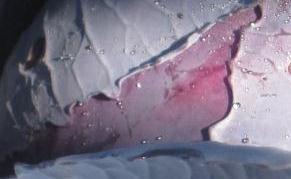
Answer on Monday!
Another in our ongoing series of mystery plant parts – what am I?
Answer on Monday!
I’m getting my feet under me with podcasting – it’s becoming more fun and less scary. The theme for this one is “Garden Concoctions,” so the Plants in the News and Myth Busting segments are along those lines.
My interview this week is with Maurice Skagen, owner and designer of Soos Creek Botanical Gardens. This 23 acre plant collection has been carefully cultivated over the last 30 years and just recently opened to the public.… Continue reading this article “Podcast #2 – Garden Concoctions”
A recent NYT post reports that adding fish meal to lead-contaminated soils will cause the lead to bind to phosphate found in fish bones. As the article explains, this chemical reaction results in the formation of pyromorphite, “a crystalline mineral that will not harm anyone even if consumed.”

Given my concerns about excessive phosphate loading in urban soils, I contacted Dr. Rich Koenig, an urban soil scientist and chair of WSU’s Crop and Soil Science department. … Continue reading this article “Out of the lead frying pan and into the phosphate fire”
Today marks a grand experiment…I’ve made the leap into podcasting. Each episode is less than 30 minutes and contains (among other things) an outdoor interview with someone who does something interesting with gardens and landscapes. This week’s podcast features Seattle landscape designer Richard Greenberg, who took me on a tour of a garden he’s been working on for 20 years:
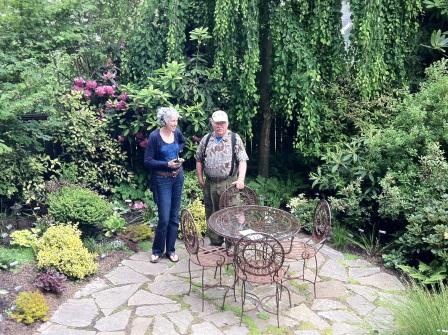
Linda with Richard Greenberg
The nice thing about having the blog host the podcasts is that I can include some photos from my interview sites. … Continue reading this article “Podcasts are here!”
Can’t get anything past our blog readers! Yes, from the highly cropped photo on Friday two readers quickly recognized emerging Indian pipe (Monotropa uniflora):

These plants have no chlorophyll, instead relying on fungal partners who colonize both their roots and the roots of nearby photosynthetic plants. So ultimately this is a parasitic species, as it takes resources from the photosynthesizers in its root network without reciprocal benefit.
These are not commonly found plants, so I think it’s really cool that they appeared in such profusion in a home landscape.
This week I received some photos of some mysterious white tubes emerging from a pile of lawn moss. Do you know what they are?
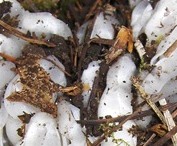
Answer Monday!
I’ve been thinking a lot about Jeff’s recent post on “What happens to the horticulturist.” It’s true – universities rely more and more on faculty-generated grants for funding, so new hires tend to be in “hot” areas of research. Fewer horticultural generalists are hired in teaching/research positions, and the same is true for Extension – the educational outreach arm of land-grant universities.
Many of you might not even know what Extension really is. In my opinion, that’s because Extension as a whole has done a pretty poor job of evolving with the times. … Continue reading this article “A Garden Professor is most severely vexed”
Friday’s “evil frog eye” was actually part of a voodoo lily (Dracunculus vulgaris), found growing in a drainage ditch in California (I’ve seen one in a drainage ditch in Seattle as well):
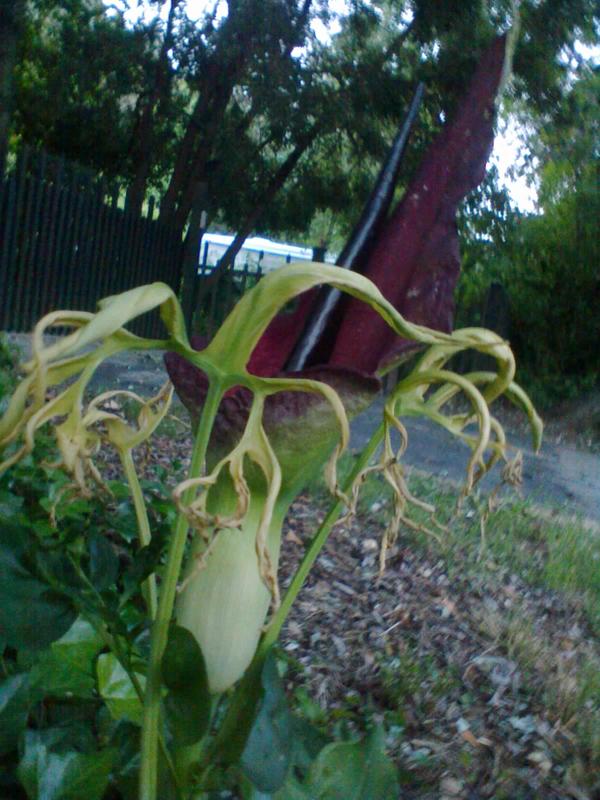
Obviously this introduced garden ornamental has escaped cultivation and is now “going rogue.” Will it become a nuisance weed? Will it displace native species? Should it be banned from sale by nurseries?
Sigh.
Or possibly something else?
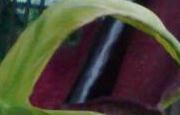
Answer Monday!
Blog reader Shawn sent this link to me yesterday. It’s a pretty short take on a complex topic, but even so I was troubled by the perception that all nuisance weed species are our own fault.
Sure, it’s true that humans have moved plants or plant parts around with them for centuries. Sometimes it’s been deliberate, and sometimes it’s been accidental. But other animals also move plants around, especially seeds. When we draw this kind of distinction between what we do and what other animals do, philosophically we are removing ourselves from the natural world.… Continue reading this article “In defense of weeds?”