Today I was sent a link to a posting on “droopy leaves.” Essentially, it suggests that droopy leaves are a means to conserve water on hot days and that watering these plants causes more problems than it solves because the roots don’t get enough oxygen. A link to the science of transpiration is provided. The advice is to wait until the evening and if the plants perk back up, then they didn’t need water after all.… Continue reading this article “Hot weather and not-so-hot advice”
Author: Linda Chalker-Scott
Dr. Linda Chalker-Scott has a Ph.D. in Horticulture from Oregon State University and is an ISA certified arborist and an ASCA consulting arborist. She is WSU’s Extension Urban Horticulturist and an Emerita Professor in the Department of Horticulture. She conducts research in applied plant and soil sciences, publishing the results in scientific articles and university Extension fact sheets.
Linda also is the award-winning author of five books: the horticultural myth-busting The Informed Gardener (2008) and The Informed Gardener Blooms Again (2010) from the University of Washington Press and Sustainable Landscapes and Gardens: Good Science – Practical Application (2009) from GFG Publishing, Inc., and How Plants Work: The Science Behind the Amazing Things Plants Do from Timber Press (2015). Her latest effort is an update of Art Kruckeberg’s Gardening with Native Plants of the Pacific Northwest from UW Press (2019).
In 2018 Linda was featured in a video series – The Science of Gardening – produced by The Great Courses. She also is one of the Garden Professors – a group of academic colleagues who educate and entertain through their blog and Facebook pages. Linda’s contribution to gardeners was recognized in 2017 by the Association for Garden Communicators as the first recipient of their Cynthia Westcott Scientific Writing Award.
"The Garden Professors" Facebook group - www.facebook.com/groups/GardenProfessors
Books: http://www.sustainablelandscapesandgardens.com
Chlorosis mystery uncovered – maybe
Sorry about the long wait in discussing the weekend’s post! (Technical troubles with access here in BlogVille.) In any case, many of you zeroed in on the defunct lime kiln as a possible pH adjuster. It would have been really interesting during those years to see how materials were processed – for instance, was there a lot of lime dust that settled over the area? Where did the limestone come from – was it carted in by train or was it local?… Continue reading this article “Chlorosis mystery uncovered – maybe”
Interveinal chlorosis mystery
Today my family took our annual 4th of July weekend hike. We ended up on a fairly new trail through the Robe Canyon Historic Park. It was a gorgeous day and we saw all manner of plants and animals. The highlight of this trail is an old lime kiln; bricks and other remnants of early settlers are scattered around the area. The kiln closed in the 1930’s. (The hot link embedded in the park name leads to a 2004 article about the trail and the history of the site.)… Continue reading this article “Interveinal chlorosis mystery”
A Garden Professor migrates east, albeit briefly
I was AWOL last week, as I had 3 presentations to get ready for 3 different states all in the span of 4 days. Yow! But they are over and done, and I’ll try to keep up on the blog from now on.
This is a short but amusing post (to me anyway). My second talk was in Virginia, where I spoke to Master Gardeners at their annual conference. The speaker right before my talk was fellow GP Holly Scoggins. … Continue reading this article “A Garden Professor migrates east, albeit briefly”
Gigantic hostas
I know Friday’s puzzle was a bit too easy – but I needed some way to discuss the giant hostas we have in our landscape this year:
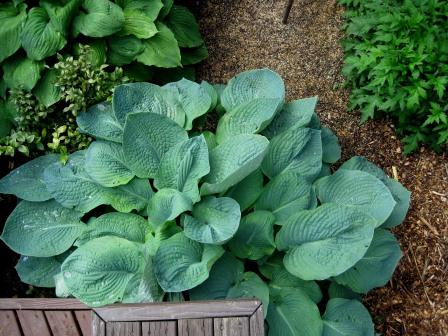
We have had a very wet and cold spring. While it was misery for us above-ground types, the plants absolutely loved the abundant water. When the leaves open and expand on these continually-watered plants, they reach maximum size. The hosta leaves in this photo aren’t the size of dinner plates – they’re more like turkey platters.… Continue reading this article “Gigantic hostas”
Green swirl
What am I?
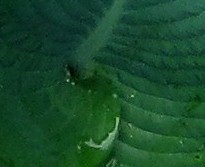
Answer Monday!
Check out Dr. Jeff on NPR
Be sure to read Jeff’s comments to NPR on pesticides and organic gardening.
WOW again (Why oh Why?)
I’m going along with the “dead tree” theme of the week, but doing a little prognosticating at the same time. Bert and Holly showed you tree demise on site; I’m going to show you tree demise in the making. We can call this “dead plant walking.”
I’ve done a few WOW postings in the past, often with a focus at what you might find at a nursery or big box store. Here’s a recent find at an unnamed BBS, in the “topiary” section:
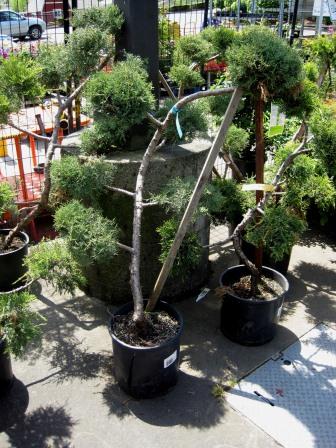
Unless you intend to have a giant stake as part of your topiary statement, this tree (actually a juniper) will morph into a prostrate form before your very eyes. … Continue reading this article “WOW again (Why oh Why?)”
A jewel of an orchid
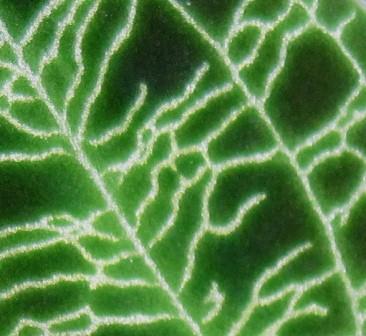
Orchid fanciers Derek and Joseph correctly identified Friday’s mystery plant as a jewel orchid, specifically Macodes petola:
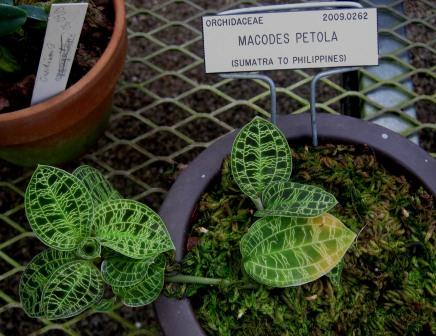
Friday’s sparkly leaf photo shows why “jewel orchid” is the common name used for several genera of orchids with showstopping foliage.
And Ray noted that Goodyera spp. (rattlesnake plantain) is a native US jewel orchid with beautiful variegated foliage. Next time you’re hiking in the woods, keep your eye out for this common yet striking plant.
Friday’s guess what I am plant
What am I? (There has been no alteration of this photo, other than cropping, nor was it taken under any special lighting.)
Answer on Monday!