Pop Quiz!

Bet you weren’t expecting this on TUESDAY, eh?
Heh, heh.

Situation:  these photos are from a grad student project.  We wanted to create, observe, and record nutrient deficiency symptoms, so we grew the plants hydroponically in a made-from-scratch nutrient solution, containing everything except one particular nutrient. There were 12 separate batches of solution, one missing each essential mineral nutrient (N,P, K, Ca, Mg, S, Fe, Mn, Cu, B, Mo, Zn – couldn’t exclude Cl as it’s too common in salts). … Continue reading this article “Pop Quiz!”
I think about these things as I peer into my coffee cup…

This winter, we’re working on renovating part of the campus Hort Garden. We’re tossing around lots of ideas/themes, but I’m leaning towards a garden full of “Plants with a Purpose”. Edible, fiber-producing, medicinal…you get my drift.  Which brings me to today’s bloggerific topic: beverages.

Mankind has, throughout history, infused or fermented just about every species of flora in an effort to get either perked up or calmed down.  These plant potions are often classified anthropologically as, ahem, “ceremonial beverages”.… Continue reading this article “I think about these things as I peer into my coffee cup…”

Advice Requested!

Greetings, all!

I am not a tree-care expert, having invested most of my mental capital into herbaceous plant stuff.  But I know enough to be dangerous: spiraling/strangling roots and narrow crotch angles are bad news. But at what point do they become “unfixable”? So I’m asking my illustrious colleagues and diligent readers (a.k.a “all y’all) for advice.

We have a lovely specimen in our campus Horticulture Garden…Acer ‘White Tigress’ – a hybrid between A. davidii and A.Continue reading this article “Advice Requested!”

Compost Tea? How About Compost Pee!

My news tab in Firefox is the BBC “latest headlines” page. It’s a great place to get pretty darn unbiased news plus the U.K. equivalent of “News of the Weird”.  SO, relative to our ongoing discussion of composting…here’s a story ripped directly from the BBC headlines. Follow the link for a video (interview, that is).

Disclaimerage: I nor any of the other Garden Professors endorse this activity, nor any claims as to its usefulness, scientific relevancy, harrumph harrumph, etc,.Continue reading this article “Compost Tea? How About Compost Pee!”

To Prune Or Not To Prune, That Is The Question…

Dabney rules!

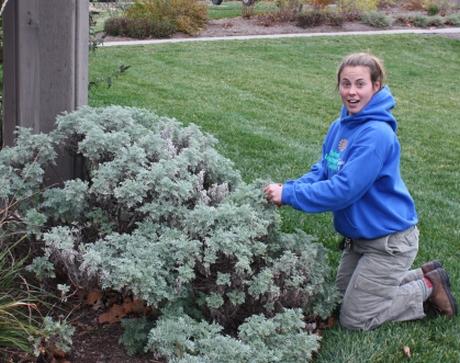
“Dabney! No! Wait!”  Just kidding. Dabney Blanton, our lovely and talented horticulturist, knows not to prune the Artemisia in the autumn.

I imagine most gardeners have experienced a frost or freeze by now [exceptions: our Southern Hemisphere readers (howdy to Jimbo)…or anyone in the deeeeep south].

The perennials here in Blacksburg have taken a couple of hits; time to start trimming things back. In the Hahn Horticulture Garden and in my own personal garden, we like to leave perennials and ornamental grasses up as long as possible – gives us something to look at besides mulch, plus the wee birdies enjoy it.… Continue reading this article “To Prune Or Not To Prune, That Is The Question…”

How on Earth Did I Land This Gig?!

Linda referred to my recent absence from the blog – but it was in the name of education, I swear!

Cocos nucifera, the iconic coconut palm.  My office for the past two weeks. Or a Corona advertisement. You pick.

This study abroad to the Dominican Republic sent Virginia Tech students (mostly biology and natural resources majors) to the Punta Cana Ecological Foundation for the entire semester, with faculty rotating in for two-week stints on topics from ornithology to geography.… Continue reading this article “How on Earth Did I Land This Gig?!”

Where the Buffalo Roam

Just kidding. We have no buffalo on the campus of Virginia Tech, just lots and lots of students with the flu. Yuck.  But this is much more interesting:

Bouteloua dactyloides (bless you!), better known as buffalo grass:

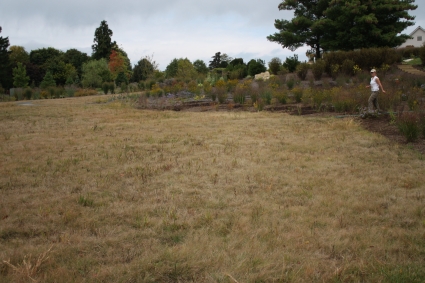
We’ve recently added a 1-acre meadow to our on-campus teaching and display garden (the Hahn Horticulture Garden at Virginia Tech).

Native trees, shrubs, perennials,and grasses surround a central lawn of buffalo grass. As one of the components of tall- and short-grass prairie, it is a popular forage in the west and midwest. … Continue reading this article “Where the Buffalo Roam”

RAWRRR!

Posted in honor of Garden Rant’s Halloween-related garden photo contest.

Pick me, Amy, pick me!!!


Now For The Scary Part

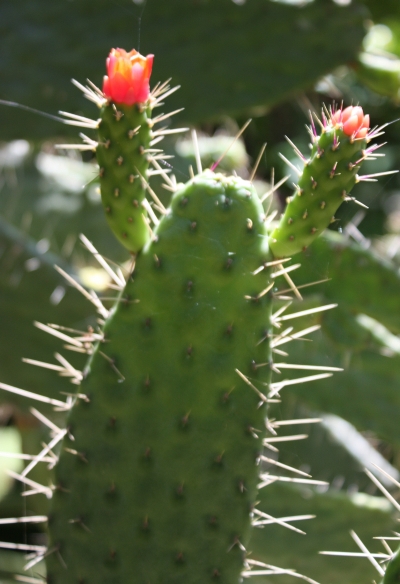
This little dude is the Florida Semaphore Cactus, native only to hardwood hammocks in the middle and lower Keys. According to the Center for Plant Conservation, Opuntia corallicola may very well be the most endangered plant in the United States.”  Only one wild population remains (eight individuals), plus a few sites of re-introduction. Loss of habit and an exotic cactus moth have contributed to the demise of this most personable of cacti.… Continue reading this article “RAWRRR!”

The Heartbreak of Plagiotropism…

…Otherwise known as “splayage”. When vegetatively propagating some species of woody plants, care should be taken when selecting where to take a cutting (piece of stem) to root.  Propagation from terminal cuttings (pointy end up) usually results in orthotropism or a vertical growth habit.  Cuttings from extremely lateral branches (those that grow parallel to the ground) can, in a few species, result in a spreading growth habit or plagiotropism.

This is not always undesirable – some species are purposefully propagated this way to maintain the prostrate habit that particular cultivar is known for.… Continue reading this article “The Heartbreak of Plagiotropism…”

More Good Stuff from the Garden Writer’s Conference in Raleigh

I should add “in absentia”… Played hooky from the convention center Thursday afternoon for a trip out to Plant Delights Nursery, Inc. with my former grad student and plant geek extraordinaire, Paul Westervelt. We followed proper Plant Delights etiquette: you make an appointment to visit at a time other than open house or tour. I teach herbaceous landscape plant i.d. as well as ornamental plant production courses, and take every opportunity to bring back images of new technology, growing systems, and great plants to my students. … Continue reading this article “More Good Stuff from the Garden Writer’s Conference in Raleigh”