Pigmented Mulch in Paradise

Just back from a quick vacation to Little Cayman island.  Truly a dot on the map – the whole island is about 7 miles long and a mile wide. Only 150 locals and a couple hundred tourists are on island at any one time.  It’s beyond laid back, with few attractions other than the resident iguanas and red-footed boobies (booby jokes abound).

Airport terminal/post office/fire station.

The big draw is diving – LC is the home to Bloody Bay Wall, one of the most famous dives in the Caribbean. … Continue reading this article “Pigmented Mulch in Paradise”
GP Hit List: Ligustrum sinense (Chinese Privet)

[And I don’t mean “greatest hits”, I mean “Mafia hit”]

Gardeners, yardeners, and designers are on a perpetual lookout for a good hedge species. Hedges are useful in so many ways: providing backdrop for a border, making good neighbors, containing football players, etc.  In reference to the latter, the field at Sanford Stadium at the University of Georgia (cue woofing!) is known as “Between the Hedges”.  In the extensive lore of UGA football, everyone makes like it’s some sacred plant, but (gasp!)Continue reading this article “GP Hit List: Ligustrum sinense (Chinese Privet)”

The Importance of Not Leaving Your Veg Garden Unattended for a Week in July


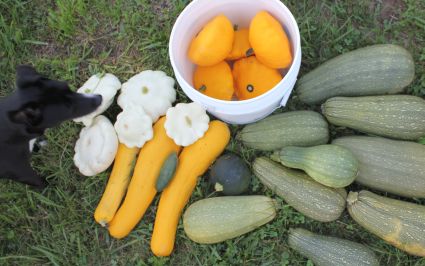
Small dog snout + normal-sized cucumber provided for scale.

This problem is self-explanatory and probably not at all atypical for our readers. Pattypans became UFOs; grey zucchini, footballs.  Note that it’s been very dry here in the Blue Ridge. I shudder to think what would have happened with normal rainfall.


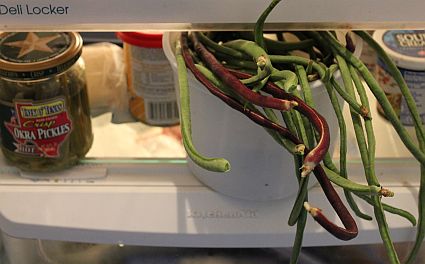
Beans amuck! Scared the hell out of Joel when he opened the fridge. But they wouldn’t fit in the bucket!

If you haven’t tried yard-long beans, give them a shot sometime.… Continue reading this article “The Importance of Not Leaving Your Veg Garden Unattended for a Week in July”

Lamb’s Ears Revisited

A bit more on my recent travels to the big floriculture conference in Columbus, Ohio.  I always try to make it out to the Chadwick Arboretum & Learning Gardens, on the campus of THE Ohio State University. There are several components, including trials, a large arboretum, and several small gardens.  My favorite is the Steven Still Perennial Garden. It’s a lovely mixed garden, designed by Adrian Bloom (Blooms of Bressingham), and was installed in ONE DAY by their garden volunteers – 2005, I think.… Continue reading this article “Lamb’s Ears Revisited”

What’s New?!

Just back from OFA – my discipline’s humongous tradeshow and conference in Columbus, Ohio. All things Floriculture – new perennials, annuals, and seasonal plants, technology, structures, and equipment for greenhouses, and plants and products for floral designers. The bulk of the show and educational sessions is focused on growers, but garden center owners and florists are also targeted.  I was part of two team talks for growers on “Perennial Production Problems and Solutions”.

Aside from the thousands of attendees and hundreds of exhibitors, it’s like a big family reunion for floriculture faculty involved in teaching, research, and Extension.… Continue reading this article “What’s New?!”

John Bartram Lives!

Yep, there he is. Showed up at our state Master Gardener College, just last week. I even went to dinner with him. The snake-on-a-stick startled the bartender just a bit.


The elder Bartram (his son William was also a great botanist and explorer) was the Royal Botanist to King George III and a member of the Royal Academy of Sciences, Stockholm. As with many of the Great Plant Explorers, his life combined botany with politics,
adventure, and lust [for plants,anyway].
Continue reading this article “John Bartram Lives!”

The Other Lamb’s Ears

I’m assuming even you tree people (aka other
Garden Professors) are familiar with the soft, silvery leaves of Stachys
byzantina
or Lamb’s Ear (variously Lamb Ears and Lamb’s Ears).  Not to
disparage S. byzantina, but in our part of the world it looks like a
pile of wet dryer lint in the winter; and can become similarly
disfigured during a hot, wet summer.  Spring brings bright,
pet-able new ears, followed by woolly flower spikes that could serve as
Q-tips for Shrek.… Continue reading this article “The Other Lamb’s Ears”

Creative Uses For Old Water Breakers

Why, oh why, can’t someone engineer a sturdy, long-lasting, horticulturally-correct water breaker.

We have, at last count, six hoses in use at our very spread-out garden & farm.  I go through a lot of breakers, and am down to two, which I rotate around.  In dire need of some new ones (as well as a huge bale of TP), I perused the garden aisle at our local big box (rhymes with “Target”).  Pistol grip schnozzles abound – these things that propel the water
like a 95 mph fastball. … Continue reading this article “Creative Uses For Old Water Breakers”

Beantroversy


Castor Bean – Ricinis communis.  Folks who make their living creating fabulous color displays for public gardens, municipalities, and commercial parks love ‘em.  Civilian gardeners/plant geeks love ‘em.  People who get their knickers in a twist about poisonous plants do not.

Pros:  ridiculously rapid growth, huge leaves for that tropical look, tolerant of less-than-ideal conditions, cheap and easy to grow from seed, weird wild flowers and seed pods.

Cons: pretty darn poisonous. A few seeds (have seen figures from four to 20), chewed up to release the toxic protein ricin, will allegedly kill you.Continue reading this article “Beantroversy”

Duty Calls

As retirements have decimated our Horticulture Department’s faculty ranks, I find myself in the interesting position of teaching a course in small fruit production next fall semester. I’m working on the syllabus as was speak (hence this post).  If you’ve read my bio (“About Us”), you’ll see that this is not my bag.  But our students are clamoring for fruit and vegetable production courses, so someone’s got to do it. We are also  currently without on-campus vegetable faculty, if you can believe it.… Continue reading this article “Duty Calls”