Er, Too Much Coverage?

When botany and advertising collide.  Here we have the latest from AT&T.
The advertisement description’s in quotes.
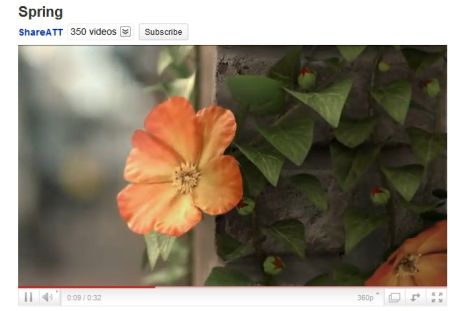

“We open on an urban setting and see a vine begin to grow up a
pillar.”

What kind of vine?? It looks like a mutant clematis, though the leaf arrangement’s wrong, and there are no orange large-flowered ones. Oh well, let’s not be picky. At least it’s some kind of ornamental plant. We’ll call it Clematis broadbandii. Definitely non-native, though.… Continue reading this article “Er, Too Much Coverage?”
Winter Trade Show Report

Disclaimer: The information and images below should not be construed as any sort of recommendation, remedy or advice. Just some cool and/or weird stuff I saw at a green industry trade show. Plus this blog needs more photos.

Was at the Mid-Atlantic Nursery Trade Show (MANTS… and yes, there is a Pennsylvania version…PANTS) in Baltimore a couple of weeks ago.  It’s a wonderful opportunity to visit with past students (now gainfully employed – yay!).  I also get to personally thank the nurseries and other businesses that generously support our Horticulture Department and Garden. … Continue reading this article “Winter Trade Show Report”

Bounce – it’s not just a fabric softening sheet…

…it’s an Integrated Pest Management tool!

[Note added after-the-fact: this was a  tongue-in-cheek bit of  hyperbole – kind of like “it’s not just a Job, it’s an Adventure.” Did not mean to imply that it actually IS an IPM tool. Very badly worded. Hence the beating I took in the comments. Live and learn.]

Fungus gnats (Bradysia spp.) are a pain in the bottom for commercial greenhouse growers. The adults are more of a nuisance than anything else –it just looks bad when a customer picks up your 6” pot of pansies and a bunch of little black gnats take flight. Continue reading this article “Bounce – it’s not just a fabric softening sheet…”

Mo’ Snow

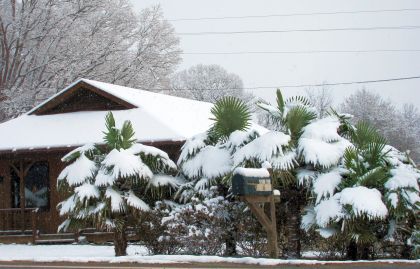
Went down to Georgia to visit family, ended up with 4″ of snow on Christmas. Very exciting for them. For me, not so much. I had just left 6″ of snow that had persisted for three weeks and was looking forward to some sunshine.

Happy holidays to all of our readers, far and wide!


Windmill palms in the snow, Carnesville, Georgia, 12/26/10.

Organic Honey?

As there seems to be a good deal of interest in the topic of honeybees, and I’m a beekeeper, albeit relatively novice, I thought I might continue a bit of discussion.

I’ve been beekeeping for three years, and I sold my first honey harvest this fall.  Six gallons, divided into pint and half pint-sized jars.  As a newbie, extracting the honey from the frames and getting it into the jars was, by far, the messiest thing I’ve ever done.  Continue reading this article “Organic Honey?”

Cirque du Poinsettia

Last week I brought up the seasonal topic of poinsettias. There are so many cultivars to start with, it’ll make your head spin.  Twenty five new varieties were introduced in 2009 alone.  One
of the major breeders lists 36 RED varieties.

But for painting and glitter, growers
and retailers stick to “white” (actually a very pale yellow to cream –
see last week’s ‘Polar Bear’ post) or possibly light pink. The trend had a good start in Europe and crossed the pond in 2004.
Continue reading this article “Cirque du Poinsettia”

It’s Poinsettia Time…

Love ’em or hate ’em, poinsettias are the number two potted flowering plant produced and sold in the U.S., only (very recently) surpassed by orchids. Especially amazing when you consider the five-week market window.  Commercial growers go at poinsettia (“points”) production usually one of two ways:  1) smaller pot, high volume, low margin for mass markets; or 2) larger pot, florist-quality, unusual varieties, for independent garden centers, florists, and other specialty retailers.  If you shopped any big box store this past weekend (bless your heart), you saw rolling racks of “doorbuster” deals such a 4.5″ points priced $1.25 or even less. … Continue reading this article “It’s Poinsettia Time…”

“Leave” Them Alone…Adventures in Extension Podcasting

We’re on the topic of communication this week…how can Extension personnel communicate best with their audience/stakeholders. It used to be via racks of Xeroxed “Fact Sheets” at your local Extension office. A few of these are said to still exist, but with states gutting their extension budgets, the costs of printing have become prohibitive.  And more critically…where do YOU go for information?  A musty file full of handouts? Heck no. Electronic media is tailor-made for extension.… Continue reading this article ““Leave” Them Alone…Adventures in Extension Podcasting”

So what to plant under power lines?

I’m going to add a bit more to Bert’s discussion.  Through the efforts of Dr. Eric Wiseman of Urban Forestry at Virginia Tech, we have a
Utility Line Arboretum (ULA).  Modeled after Dr. Bonnie Appleton’s original ULA for Virginia at the Hampton Roads research station, Eric’s includes many woody taxa suitable for planting in the vicinity of power lines (see a nice list of Bonnie’s favorite power-line-friendly taxa here).

Eric came to me with his plan in 2006 and we found some space in our Hahn Horticulture Garden to get it going.… Continue reading this article “So what to plant under power lines?”

Water is the answer!

Wildlife week continues!  My humble experience with my own gardens past and present, as well as our campus garden, is that the presence of water virtually guarantees the presence of wildlife.  One of the National Wildlife Federation’s top requirements for becoming a  Certified Wildlife Habitat is “supply water” (another requirement: "$20 fee").   Water is, of course, the beverage of choice for most animals (though I did hear of a squirrel that preferred beer). And some creatures require it as a substrate in which to reproduce (that sounded a bit clinical). Continue reading this article “Water is the answer!”