As those that have followed the blog for awhile are aware, among my pet peeves are some of the naïve statements that are repeated ad nauseam by proponents of native plants for landscaping. You know the usual litany: natives don’t need water, don’t need fertilizer, resistant to insects, resistant to diseases, yada, yada… According to the dogma, native plants possess these traits because they’ve evolved here and they belong here. I hasten to point out; I have nothing against natives and think we ought to plant more of them whenever they are an appropriate choice. … Continue reading this article “Is local always better?”
Tag: Native plants
Cake and Cultivars
I was working on something entirely different, but thought better of it. I’d like to continue Bert’s (now Dr. Mister Smartypants) really intriguing discussion.
Because when I read it, I felt a pang of…guilt? Confusion?
I’d describe my usual perspective on the “native” topic as ultra-liberal, highly plant-introduction-centric. New plant? Gimme!!! (“Native” shall appear in this post surrounded by quotes throughout, as a safety measure.)
Commenter Wes perceptively noted “part of the gardening public is becoming so enamored with the concept
of natives that I think they are grasping at straws to to assuage their
belief in ecological principal.… Continue reading this article “Cake and Cultivars”
Can cultivars be considered native plants?
One of the questions that arise in discussing native plants is the question of whether ornamental cultivars (e.g., ‘October golory’ red maple) can or should be considered ‘native’. In short, my answer is ‘No.’
Here’s my rationale on this. First, when we think about natives we need to put political boundaries out of minds and think about ecosystems. Political boundaries – a ‘Michigan native’ or ‘an Oregon native’ – are meaningless in a biological context. What’s important is what ecosystem the plant occurs in naturally. … Continue reading this article “Can cultivars be considered native plants?”
Why do nurseries sell this plant?
I wish I were more like Holly…wandering around nurseries finding pretty and unusual annuals and perennials to get excited about. Instead, I seem to gravitate to plants that annoy me.
Today while looking for some trellises (for those containerized Clematis vines that I’ve been torturing) I saw pots of the Equisetum hyemale (“a tall, evergreen, spreading, reed-like grass”) for sale:
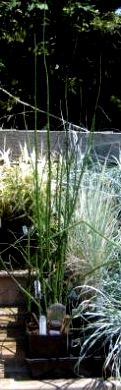

As readers of this blog surely know, Equisetum spp. – or horsetails – are not grasses but primitive relatives of ferns. … Continue reading this article “Why do nurseries sell this plant?”
Visiting Professor guest post: Native wildflowers
Recently I have been fascinated by the native wildflower field I planted last fall. Although I seeded it with the same mixture of seeds (mixed with sand to spread them evenly), you can see that we have clumps of different flowers throughout the area.
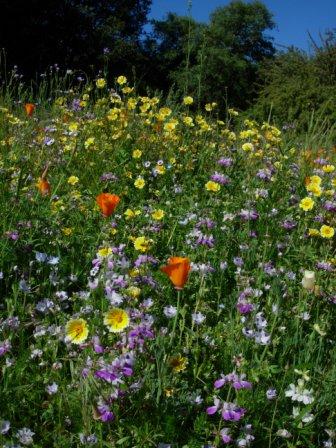
Figure 1. Descanso Gardens, California
The area where the wildflowers were planted had several 1-2 foot raised mounds; some were in the shape of keyholes. These were built with silty sand from a nearby seasonal stream that had some erosion problems in a rainy year.… Continue reading this article “Visiting Professor guest post: Native wildflowers”
Surviving the desert with beauty and efficiency
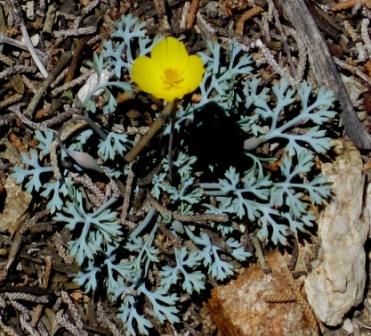
I’m away this week for an out-of-state seminar and a little annual leave. Some of my favorite places to visit this time of year are the high deserts of California. Today we hiked to Horse Thief Creek, a relatively easy trail in the Santa Rosa Wilderness. It’s the perfect time of year to see the high desert in bloom, especially with last winter’s substantial rainfall.
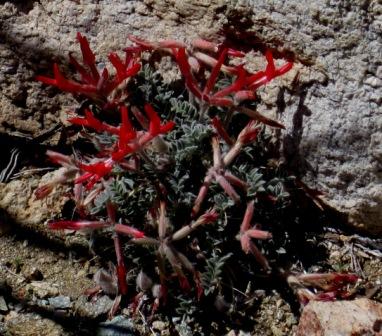
In graduate school I became interested in environmental stress physiology, and I still am entranced by the plant kingdom’s ability to overcome nearly every environmental extreme on earth. … Continue reading this article “Surviving the desert with beauty and efficiency”
I’m Saving Myself for Pollination
Let’s take a very brief respite from the socio-religious implications of science, soil testing, and compost tea to ponder a more lighthearted topic. I need a bit of a morale-boost.
You: “O.K. Holly, Spring’s allegedly coming…how about a closer look at some wildflowers?”
Me: “Done!” (fingers snapping)
For a short time in March, forest floors across Eastern North America can be absolutely littered with a multitude of sparkling white flowers. This very cool little plant, Sanguinaria canadensis, is one of the first wildflowers to emerge in the spring and colonizes deciduous and mixed woodlands.… Continue reading this article “I’m Saving Myself for Pollination”
Native vs. introduced species – the discussion continues
I was asked earlier today to comment on the Garden Rant blog regarding the issue of nonnative plants and insect survival, specifically in reference to Dr. Tallamy’s research. Though I haven’t read his popular book (Bringing Nature Home), I did read one of his most recent papers (DW Tallamy and KJ Shropshire, 2009. Ranking lepidopteran use of native versus introduced plants, Conservation Biology 23(4): 941-947). The authors argue that lepidopterans prefer native to alien species for egg laying. … Continue reading this article “Native vs. introduced species – the discussion continues”
Baptisia: Beyond the Blue
The Perennial Plant Association recently released the identity of the PPA Plant of the Year – for 2010 it is Baptisia australis (False Blue Indigo). Various blogs have noted this (including Garden Professor fave Garden Rant) and I’ve read some interesting comments, both pro and con.
True story: I asked for Baptisia at a small rural garden center years ago; the owner said “Don’t have any; but I think I have a Methodist running around here somewheres…” Badda-bump.… Continue reading this article “Baptisia: Beyond the Blue”
Are natives the answer?
Last week Jeff kicked off a lively discussion about invasive plants. Let me state up front that no one on this blog is promoting invasive plants. But the issues surrounding invasive plants are extremely complex and have profound implications for many groups with whom we work in landscape horticulture and urban and community forestry. It is essential in these discussions that we separate fact from hyperbole. In some quarters, lines have been blurred and people fail to make key distinctions and lump exotic, alien, or non-native species together with invasives. … Continue reading this article “Are natives the answer?”